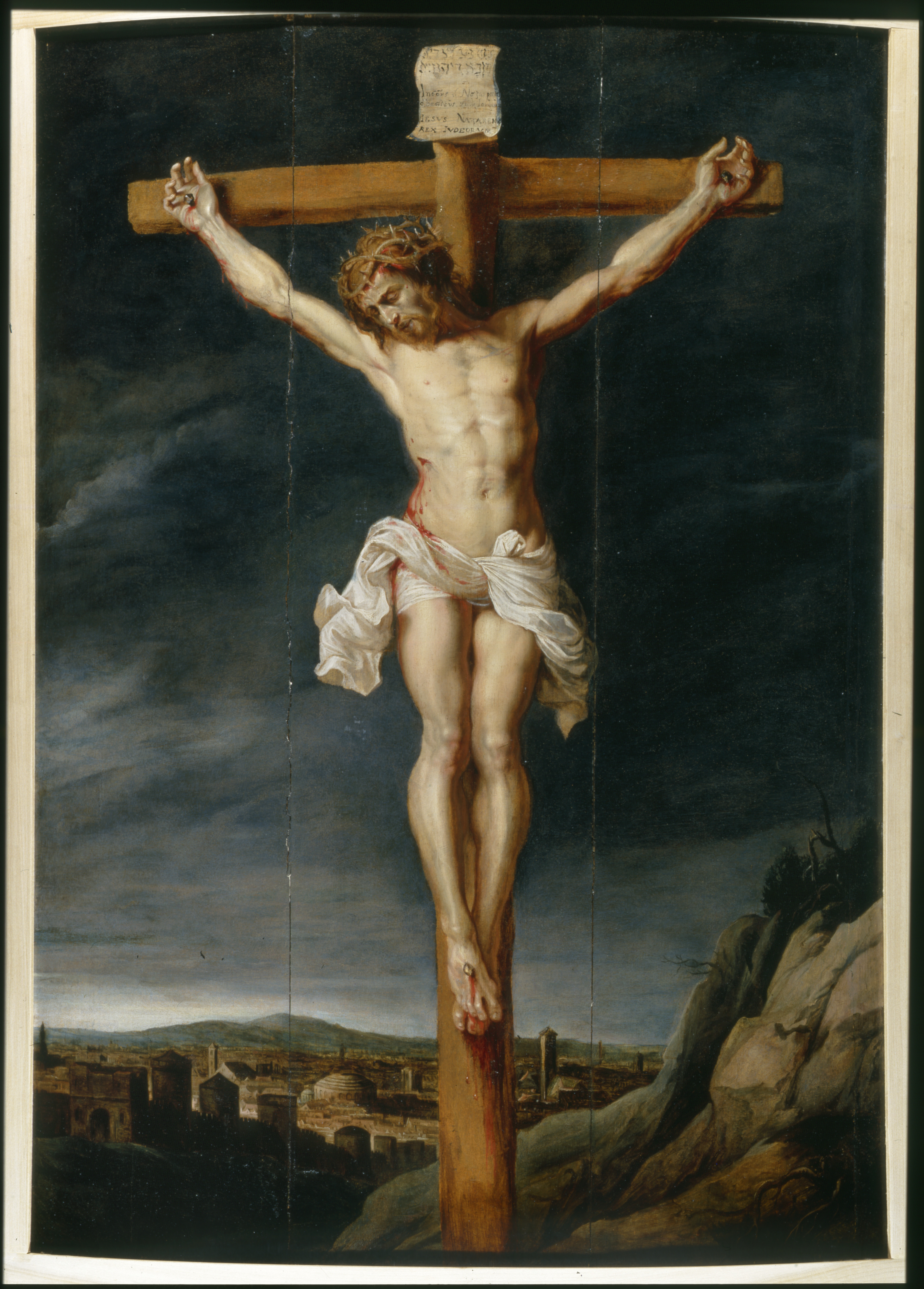

Philippe de Champaigne, Christ on the Cross, ca. 1655
| Artist | Philippe de Champaigne, French, 1602–74 |
| Title | Christ on the Cross |
| Object Date | ca. 1655 |
| Alternate and Variant Titles | Le Christ sur la croix; Crucifixion; Le Christ mort en croix |
| Medium | Oil on canvas |
| Dimensions (Unframed) | 35 9/16 × 22 1/16 in. (90.3 × 56 cm) |
| Inscription | Inscribed verso (no longer visible due to relining): Voor myne beminde suster / Marie de Champaigne-Religieuse / Brussel[s?] |
| Credit Line | The Nelson-Atkins Museum of Art. Purchase: William Rockhill Nelson Trust, 70-1 |
Catalogue Entry
Citation
Chicago:
Rima M. Girnius, “Philippe de Champaigne, Christ on the Cross, ca. 1655,” catalogue entry in French Paintings and Pastels, 1600–1945: The Collections of The Nelson-Atkins Museum of Art, ed. Aimee Marcereau DeGalan (Kansas City: The Nelson-Atkins Museum of Art, 2022), https://doi.org/10.37764/78973.5.204.5407.
MLA:
Girnius, Rima M. “Philippe de Champaigne, Christ on the Cross, ca. 1655,” catalogue entry. French Paintings and Pastels, 1600–1945: The Collections of The Nelson-Atkins Museum of Art, edited by Aimee Marcereau DeGalan, Nelson-Atkins Museum of Art, 2022. doi: 10.37764/78973.5.204.5407.
In this deeply poignant painting, Philippe de Champaigne gives visual and persuasive form to one of the central mysteries of the Christian faith: the willingness of Jesus Christ, the Son of God, to suffer death for the sins of humanity. Champaigne depicts the crucified Christ alone on a rocky outcropping lined with dense vegetation, overlooking a panoramic view of the ancient city of Jerusalem. Dark, foreboding clouds crown the landscape, forming an almost impenetrable background that throws Christ’s torso into strong relief. Shown moments after his death, Christ’s figure appears upright, his bruised body presented for contemplation. Blood streams from the wounds on his side, hands, and feet, cascading down the crisp folds of his loincloth and the base of the cross to soak the ground beneath him. A network of fine lines on his chest—marks of the brutal flogging he received before his crucifixion—draw further attention to the physical torment he endured on behalf of humankind. Notwithstanding these visible signs of his agony, Christ remains an idealized figure. A beam of light bathes his body in a silvery radiance, illuminating not only his injuries but also the elegant proportions and musculature of his meticulously modeled body. His calm facial expression—head cast down, eyes closed—imparts a sense of dignity to the scene and, along with the faintly glowing halo, reveals his divine status as the Son of God.
Sober in its treatment yet deeply emotional in its impact, the painting exhibits a narrative clarity and pictorial restraint that has often been attributed to Champaigne’s close relationship with Jansenism. A controversial reform movement within the Catholic Church, Jansenism emphasized humankind’s inability to attain salvation without divine aid and insisted on pursuing a life devoid of worldly distractions.1For an overview on Jansenism and its role in seventeenth-century French cultural and political life, see Henry Phillips, Church and Culture in Seventeenth-Century France (Cambridge: Cambridge University Press, 2010), 16; and F. Ellen Weaver-Laporte, “Jansenism,” in Grove Art Online, 2003, accessed August 6, 2020, https://doi.org/10.1093/gao/9781884446054.article.T043395. Much has been written about the artist’s connections with this movement and whether his work reveals a specific “Jansenist” aesthetic. As early as 1837, literary critic Charles Augustin Saint-Beuve linked Champaigne’s “calm, sober, dense, and serious” paintings with Jansenist spirituality and piety.2“Sa peinture calme, sobre, serrée, sérieuse.” Charles-Augustin Sainte-Beuve, Port Royal, 4th ed. (Paris: Librairie Hachette, 1876), 1:26; quoted in Anne Bertrand, Art and Politics in Counter-Reformation Paris: The Case of Philippe de Champaigne and his Patrons (1621–1674) (PhD diss., University of Pittsburgh, 2001), 79. The artist had close ties with the most important Jansenist center in France, the Cistercian abbey of Port-Royal-des-Champs. His two daughters entered the abbey’s school in 1648, and he earned numerous commissions to paint works for the Port Royal community.3Bernard Dorival, Philippe de Champaigne, 1602–1676: La vie, l’œuvre, et le catalogue raisonné de l’œuvre (Paris: Léonce Laget Libraire, 1976), 1:160. Indeed, one of the most well-known stories about Champaigne is that his daughter Catherine de Sainte Suzanne was miraculously healed from a paralysis that had lasted for two years when, in 1662, the Abbess at Port-Royal prayed for Catherine’s healing. Champaigne was inspired to commemorate this event by painting Mère Catherine Agnes Arnauld and Soeur Catherine de Sainte Suzanne (1662; Musée du Louvre, Paris). Leading scholars caution against interpreting Champaigne solely through the lens of his Jansenist affiliation, but they acknowledge that his work can be understood within the larger context of Catholic beliefs and practices as defined by the Council of TrentCouncil of Trent: A council of the Roman Catholic Church, held in in the city of Trent, Italy, in three parts from 1545 to 1563, that responded to the doctrinal challenges of the Protestants. It played a key part in the Counter-Reformation and played a vital role in revitalizing the Roman Catholic Church in many parts of Europe. See also Counter-Reformation..4Dorival, Philippe de Champaigne, 1:161; Lorenzo Pericolo, Philippe de Champaigne: “Philippe, homme sage et vertueux”: Essai sur l’art et l’œuvre de Philippe de Champaigne (1602–1674) (Tournai: La Renaissance du Livre, 2002), 228; Alain Tapié, “L’art de l’âme,” in Alain Tapié and Pierre-Nicolas Sainte-Fare-Garnot, eds., Philippe de Champaigne (1602–1674): Entre politique et dévotion, exh. cat. (Paris: Réunion des Musées Nationaux, 2007), 37–47. As Marianne Cojannot-Le Blanc observes, Champaigne cannot be regarded simply as a Jansenist painter, since Jansenism did not exist as a homogenous movement, nor did it break away from Catholicism.5Marianne Cojannot-Le Blanc, “Le jansénisme et les arts” in Cojannot-Le Blanc, ed., Philippe de Champaigne ou la figure du peintre janséniste: Lecture critique des rapports entre Port-Royal et les arts (Paris: Nolin, 2011), 9.
Such an approach is appropriate for Champaigne’s depiction of the crucified Christ in the collection of the Nelson-Atkins Museum of Art. The unflinching focus on the figure of Christ and his physical suffering was in line with traditional Catholic ideas, affected by the Reformation and the Council of Trent, regarding the use of images as aids to religious instruction and devotion. Spiritual manuals by mystics such as François de Sales espoused a method of prayer that encouraged imaginative participation in the events of Christ’s life, meant to lead to a deeper understanding of the self and of the divine.6Richard Viladesau, The Pathos of the Cross: The Passion of Christ in Theology and the Arts—The Baroque Era (Oxford: Oxford University Press, 2014), 20, 24–25, 36–39. External images played a significant role within these meditative practices by activating the senses and stirring the hearts and minds of the faithful.7Wietse de Boer and Christine Göttler, “Introduction: The Sacred and the Senses in an Age of Reform,” in Boer and Göttler, eds., Religion and the Senses in Early Modern Europe (Leiden: Brill,2015), 1–13; Jeffrey Chipps Smith, Sensuous Worship: Jesuits and the Art of the Early Catholic Reformation in Germany (Princeton,NJ: Princeton University Press, 2002). Key figures of the Counter-ReformationCounter-Reformation: A period lasting about one hundred years from about 1545 (the opening of the Council of Trent) to 1648 (the end of the Thirty Years’ War), when the Roman Catholic church responded to doctrinal challenges from the Protestant Reformation and revitalized its own spirituality and morality. See also Council of Trent., most notably Johannes Molanus and Gabriele Paleotti, published treatises that provided specific direction on how sacred images could fulfill this important function. They insisted that, for the benefit of the faithful, religious works of art should be simple, readily intelligible, and easy to grasp, with no superfluous details. To that end, they privileged scriptural accuracy and promoted naturalism as a means of opening a pathway toward spiritual contemplation.8The body of research on the Council of Trent’s decrees on art and their interpretation by Paleotti and Molanus is vast. Christian Hecht provides a good overview in Katholische Bildertheologie im Zeitalter von Gegenreformation und Barock: Studien zu Traktaten von Johannes Molanus, Gabriele Paleotti und Anderen Autoren (Berlin: Mann, 1997). See also the English edition of Gabrielle Paleotti’s text, which features an introduction by Paoli Prodi: Gabrielle Paleotti, Discourse on Sacred and Profane Images, trans. William McCuaig (Los Angeles: Getty Research Institute, 2012). On Molanus, see David Freedberg, “Johannes Molanus on Provocative Paintings,” Journal of the Warburg and Courtauld Institutes 34 (1971): 115–50.
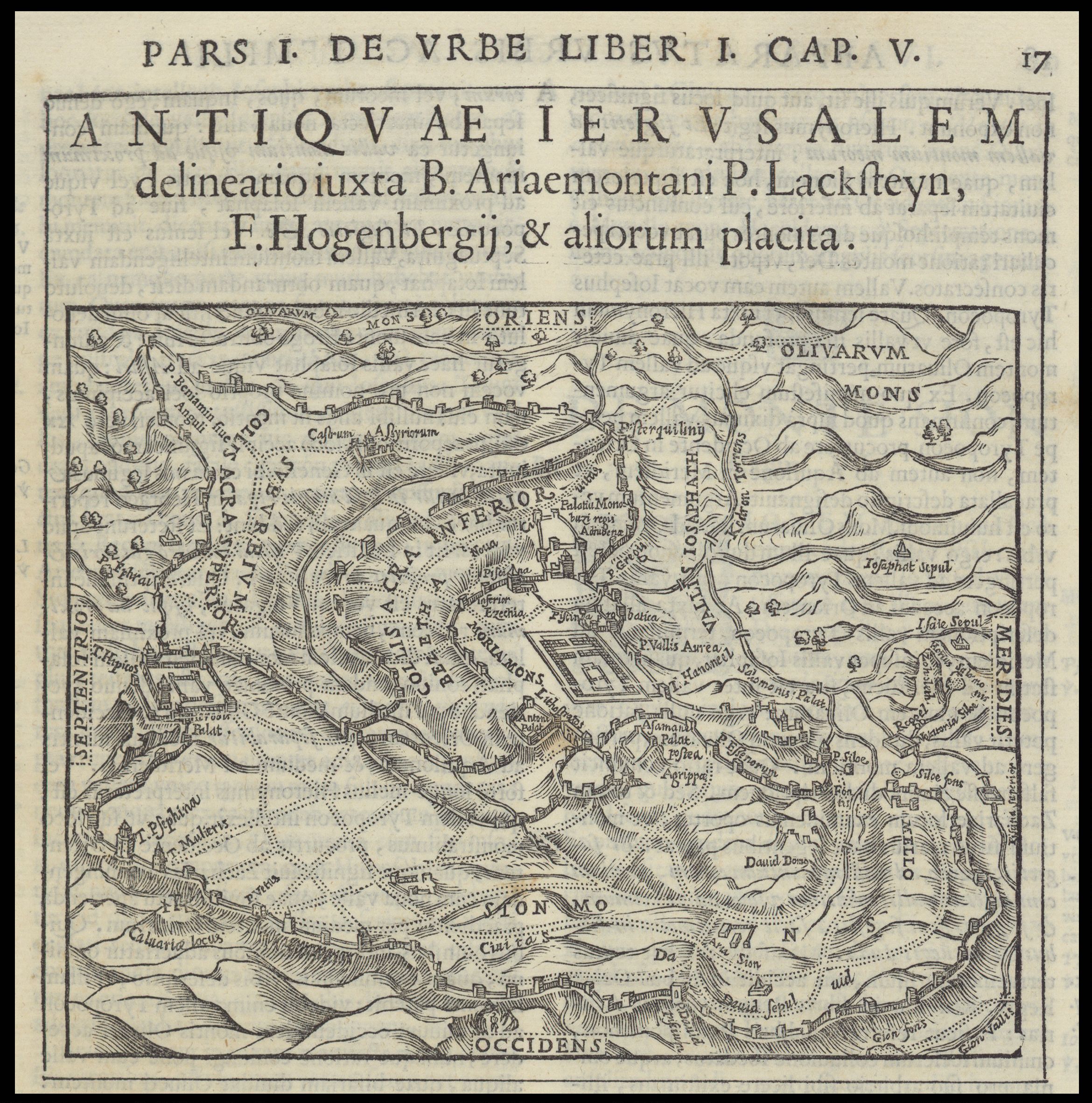
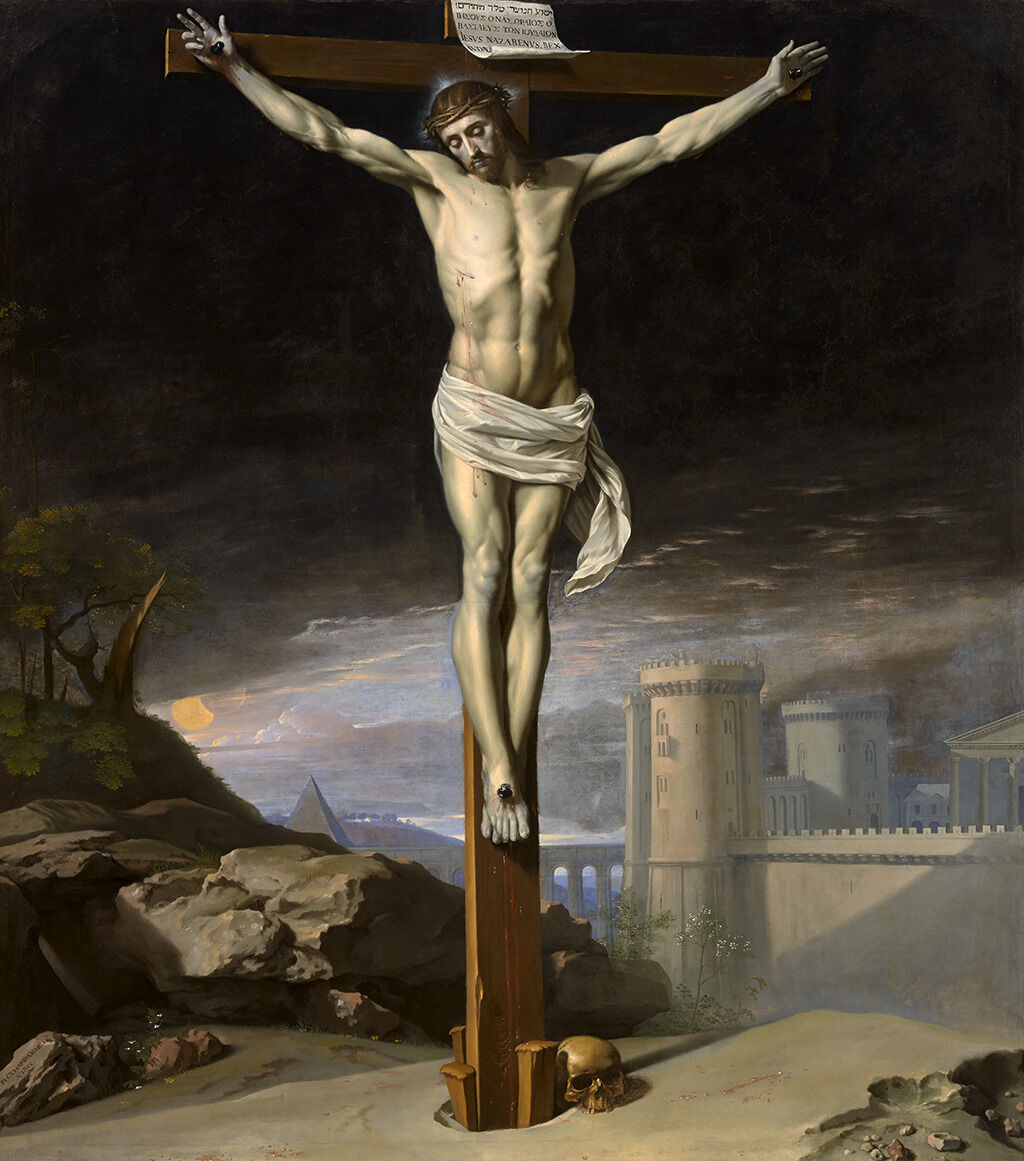
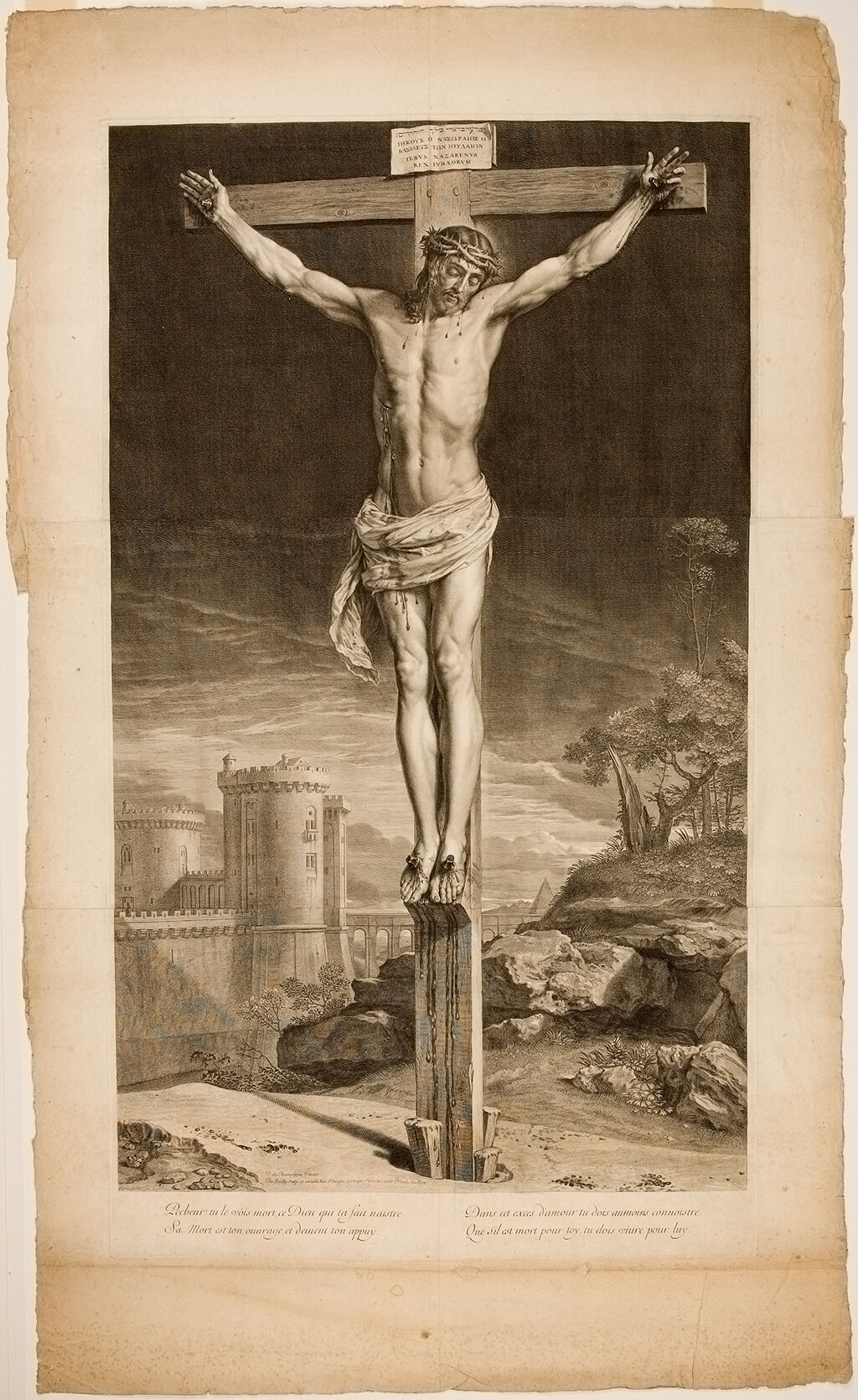
Without sufficient documentary evidence, attempts to clarify the nature of Marie de Champaigne’s religious devotions are speculative at best. Recent studies of beguinages in the Low Countries, however, reveal general trends in their use of religious imagery that might provide some insight. Beguinages were semi-monastic communities where women took temporary vows of chastity and obedience but maintained financial independence and were able to retain property. A study of the art that adorned the homes of Beguines in Antwerp’s Beguinage of St. Catherine discloses a substantial number of scenes from Christ’s PassionPassion of Christ: The sequence of events encompassing Jesus Christ’s triumphal entry into Jerusalem, his suffering, death, and ultimately his resurrection., including several Crucifixions.24Sarah Moran, “Bringing the Counter-Reformation Home: The Domestic Use of Artworks at the Antwerp Beguinage in the Seventeenth Century,” Simiolus 38, no. 3 (2015–2016): 148–51. These range in material from two-dimensional crucifixes to works on paper and a painting by Flemish artist Jan Boeckhorst (ca. 1604–1668). As Sarah Moran points out, the abundance of Passion imagery was not unusual and was wholly in keeping with the beliefs and devotional practices promoted by the Counter-Reformation.25Moran, “Bringing the Counter-Reformation Home,” 151–52. Moran is questioning the argument made by other scholars that Beguines showed a marked preference for works of art and devotional texts that linger on the physical details of Christ’s suffering as a human being. See Xander van Eck, “Between Restraint and Excess: The Decoration of the Church of the Great Beguinage at Mechelen in the Seventeenth Century,” Simiolus 28 (2000–2001): 129–62; Hans Geybels, Vulgaritiner Beghinae: Eight Centuries of Beguine History in the Low Countries (Turnhout, Belgium: Brepols, 2004), 82–85, 125–27.
Notes
-
For an overview on Jansenism and its role in seventeenth-century French cultural and political life, see Henry Phillips, Church and Culture in Seventeenth-Century France (Cambridge: Cambridge University Press, 2010), 16; and F. Ellen Weaver-Laporte, “Jansenism,” in Grove Art Online, 2003, accessed August 6, 2020, https://doi.org/10.1093/gao/9781884446054.article. T043395.
-
“Sa peinture calme, sobre, serrée, sérieuse.” Charles-Augustin Sainte-Beuve, Port Royal, 4th ed. (Paris: Librairie Hachette, 1876), 1:26; quoted in Anne Bertrand, Art and Politics in Counter-Reformation Paris: The Case of Philippe de Champaigne and his Patrons (1621–1674) (PhD diss., University of Pittsburgh, 2001), 79.
-
Bernard Dorival, Philippe de Champaigne, 1602–1676: La vie, l’œuvre, et le catalogue raisonné de l’œuvre (Paris: Léonce Laget Libraire, 1976), 1:160. Indeed, one of the most well-known stories about Champaigne is that his daughter Catherine de Sainte Suzanne was miraculously healed from a paralysis that had lasted for two years when, in 1662, the Abbess at Port-Royal prayed for Catherine’s healing. Champaigne was inspired to commemorate this event by painting Mère Catherine Agnes Arnauld and Soeur Catherine de Sainte Suzanne (1662; Musée du Louvre, Paris).
-
Dorival, Philippe de Champaigne, 1:161; Lorenzo Pericolo, Philippe de Champaigne: “Philippe, homme sage et vertueux”: Essai sur l’art et l’œuvre de Philippe de Champaigne (1602–1674) (Tournai: La Renaissance du Livre, 2002), 228; Alain Tapié, “L’art de l’âme,” in Alain Tapié and Pierre-Nicolas Sainte-Fare-Garnot, eds., Philippe de Champaigne (1602–1674): Entre politique et dévotion, exh. cat. (Paris: Réunion des Musées Nationaux, 2007), 37–47.
-
Marianne Cojannot-Le Blanc, “Le jansénisme et les arts” in Cojannot-Le Blanc, ed., Philippe de Champaigne ou la figure du peintre janséniste: Lecture critique des rapports entre Port-Royal et les arts (Paris: Nolin, 2011), 9.
-
Richard Viladesau, The Pathos of the Cross: The Passion of Christ in Theology and the Arts—The Baroque Era (Oxford: Oxford University Press, 2014), 20, 24–25, 36–39.
-
Wietse de Boer and Christine Göttler, “Introduction: The Sacred and the Senses in an Age of Reform,” in Boer and Göttler, eds., Religion and the Senses in Early Modern Europe (Leiden: Brill, 2015), 1–13; Jeffrey Chipps Smith, Sensuous Worship: Jesuits and the Art of the Early Catholic Reformation in Germany (Princeton, NJ: Princeton University Press, 2002).
-
The body of research on the Council of Trent’s decrees on art and their interpretation by Paleotti and Molanus is vast. Christian Hecht provides a good overview in Katholische Bildertheologie im Zeitalter von Gegenreformation und Barock: Studien zu Traktaten von Johannes Molanus, Gabriele Paleotti und Anderen Autoren (Berlin: Mann, 1997). See also the English edition of Gabrielle Paleotti’s text, which features an introduction by Paoli Prodi: Gabrielle Paleotti, Discourse on Sacred and Profane Images, trans. William McCuaig (Los Angeles: Getty Research Institute, 2012). On Molanus, see David Freedberg, “Johannes Molanus on Provocative Paintings,” Journal of the Warburg and Courtauld Institutes 34 (1971): 115–50.
-
Dorival, Philippe de Champaigne, 1:80–81. For a more extended analysis, see Bernard Dorival, “La bibliothèque de Philippe et de Jean-Baptiste de Champaigne,” Chroniques de Port-Royal 19 (1971): 26, 34. In their reviews of Dorival’s 1976 catalogue raisonné, Ann Sutherland Harris and Anthony Blunt question the plausibility of some of Dorival’s arguments regarding Champaigne’s use of literary sources. Ann Sutherland Harris, review of Philippe de Champaigne, 1602–1676: La vie, l’œuvre, et le catalogue raisonné de l’œuvre, by Bernard Dorival, Art Bulletin 61, no. 2 (June 1979): 320; Anthony Blunt, “A New Book on Philippe de Champaigne,” review of Philippe de Champaigne, 1602–1676: La vie, l’œuvre, et le catalogue raisonné de l’œuvre, by Bernard Dorival,” Burlington Magazine 119, no. 893 (August 1977): 575.
-
Olan A. Rand, “Philippe de Champaigne and the Concept of Archeological Accuracy in Painting,” in Actas del XXIII Congreso Internacional de Historia del Arte (Granada: University of Granada, 1978), 3:213–21.
-
Dorival, Philippe de Champaigne, 1:76–78
-
Dorival, Philippe de Champaigne, 1:74.
-
Pericolo, Philippe de Champaigne, 265–66.
-
Pierre Rosenberg, France in the Golden Age: Seventeenth-Century French Paintings in American Collections, exh. cat. (New York: Metropolitan Museum of Art, 1982), 236.
-
Dorival, Philippe de Champaigne, 2:385–86; Alain Tapié and Nicolas Sainte Fare Garno, Entre politique et dévotion, 244–45.
-
Pericolo, Philippe de Champaigne, 311n20; Gilles Chomer, Peintures françaises avant 1815: La collection du Musée de Grenoble (Paris: Réunion des Musées Nationaux, 2000), 64.
-
According to Émile Mâle, it was common to see three and four nails in Crucifixion scenes. Émile Mâle, L’Art religieux après le Concile de Trente: étude iconographique de la fin du XVIe siècle, du XVIIe, du XVIIIe; Italie, France, Espagne, Flandres (Paris: A. Colin, 1932), 270–71.
-
Alfred Cohen and Ronald Cohen, Trafalgar Galleries XII (London: Trafalgar Fine Art Publications, 1993), 34.
-
The inscription was discovered on June 5, 1969, when the original canvas was relined by Francis Moro, a painting restorer employed by the dealer Frederick Mont, who at the time was in possession of the painting. Although no photograph of the original inscription was found, the conservator transcribed the dedication, which is in both Flemish and French and reads: “Voor myne beminde suster / Marie de Champaigne–Religieuse / Brussel[s?]” (For my beloved sister / Marie de Champaigne–Nun / Brussels).
-
The date of Philippe de Champaigne’s visit is contested. According to his contemporary André Félibien, the Brussels visit took place in 1654. See André Félibien, Entretiens sur les vies et sur les ouvrages des plus excellents peintres anciens et modernes (Paris, 1685), 5:175–76. Pericolo, however, argues that Félibien may have mistaken the date and it should be 1655; see Pericolo, Philippe de Champaigne, 273.
-
“Marie/a Jampaine.” List of Beguines, 1628–1798, no. 21806, church archives of Brabant, Royal Archives, Brussels.
-
The birth and death dates are provided by Anne-Marie Bonenfant-Feytmans, “Un tableau inconnu de Philippe de Champaigne: Proposition d’identification,” Bulletin (Musées Royaux des Beaux-Arts, Brussels) 34–37, nos. 1–3 (1985–1988): 147.
-
Aquarelles et Tableaux Modernes; Dessins et Tableaux Anciens; Objets d’Art et d’Ameublement Principalement du XVIIIe Siècle; Sièges et Meubles des époques Régence—Louis XV–Louis XVI; Tapisseries Anciennes (Paris: Palais Galliera, 1968), unpaginated, as attributed to Philippe de Champaigne, Le Christ sur la croix.
-
Sarah Moran, “Bringing the Counter-Reformation Home: The Domestic Use of Artworks at the Antwerp Beguinage in the Seventeenth Century,” Simiolus 38, no. 3 (2015–2016): 148–51. These range in material from two-dimensional crucifixes to works on paper and a painting by Flemish artist Jan Boeckhorst (ca. 1604–68).
-
Moran, “Bringing the Counter-Reformation Home,” 151–52. Moran is questioning the argument made by other scholars that Beguines showed a marked preference for works of art and devotional texts that linger on the physical details of Christ’s suffering as a human being. See Xander van Eck, “Between Restraint and Excess: The Decoration of the Church of the Great Beguinage at Mechelen in the Seventeenth Century,” Simiolus 28 (2000–2001): 129–62; Hans Geybels, Vulgaritiner Beghinae: Eight Centuries of Beguine History in the Low Countries (Turnhout, Belgium: Brepols, 2004), 82–85, 125–27.
-
See treatment report by Mary Schafer, Nelson-Atkins paintings conservator, November 12, 2012, NAMA conservation files. Schafer removed the modern fingerprints from the varnish layer of the composition.
Technical Entry
Citation
Chicago:
Becca Goodman, “Philippe de Champaigne, Christ on the Cross, ca. 1655,” technical entry in French Paintings and Pastels, 1600–1945: The Collections of the Nelson-Atkins Museum of Art, ed. Aimee Marcereau DeGalan (Kansas City: The Nelson-Atkins Museum of Art, 2026), https://doi.org/10.37764/78973.5.204.2088.
MLA:
Goodman, Becca. “Philippe de Champaigne, Christ on the Cross, ca. 1655,” technical entry. French Paintings and Pastels, 1600–1945: The Collections of The Nelson-Atkins Museum of Art, edited by Aimee Marcereau DeGalan, Nelson-Atkins Museum of Art, 2026. doi: 10.37764/78973.5.204.2088.
Close examination and various imaging techniques yielded insight into Philippe de Champaigne’s execution of the version of Christ on the Cross housed in the Nelson-Atkins Museum of Art. Surviving preparatory sketches and finished paintings offer context to better understand his working methods, while twentieth-century records answer questions about the painting’s conservation history.
Although the verso of the painting lacks historical information due to
the relatively modern lininglining: A procedure used to reinforce a weakened canvas that involves adhering a second fabric support using adhesive, most often a glue-paste mixture, wax, or synthetic adhesive. and stretcherstretcher: A wooden structure to which the painting’s canvas is attached. Unlike strainers, stretchers can be expanded slightly at the joints to improve canvas tension and avoid sagging due to humidity changes or aging., conservation reports from
1969 offered critical findings that ultimately solidified the painting
as an authentic Champaigne. Gertrud Blumel1While occasionally recorded as Gertrude Blumel, the correct spelling of her name is Gertrud Blümel (see her 1933 dissertation, “Die ritterliche Romanillustration in Nordfrankreich und Belgien, ihr Ablauf und ihre entwicklungsgeschichtliche Stellung,” http://biografia
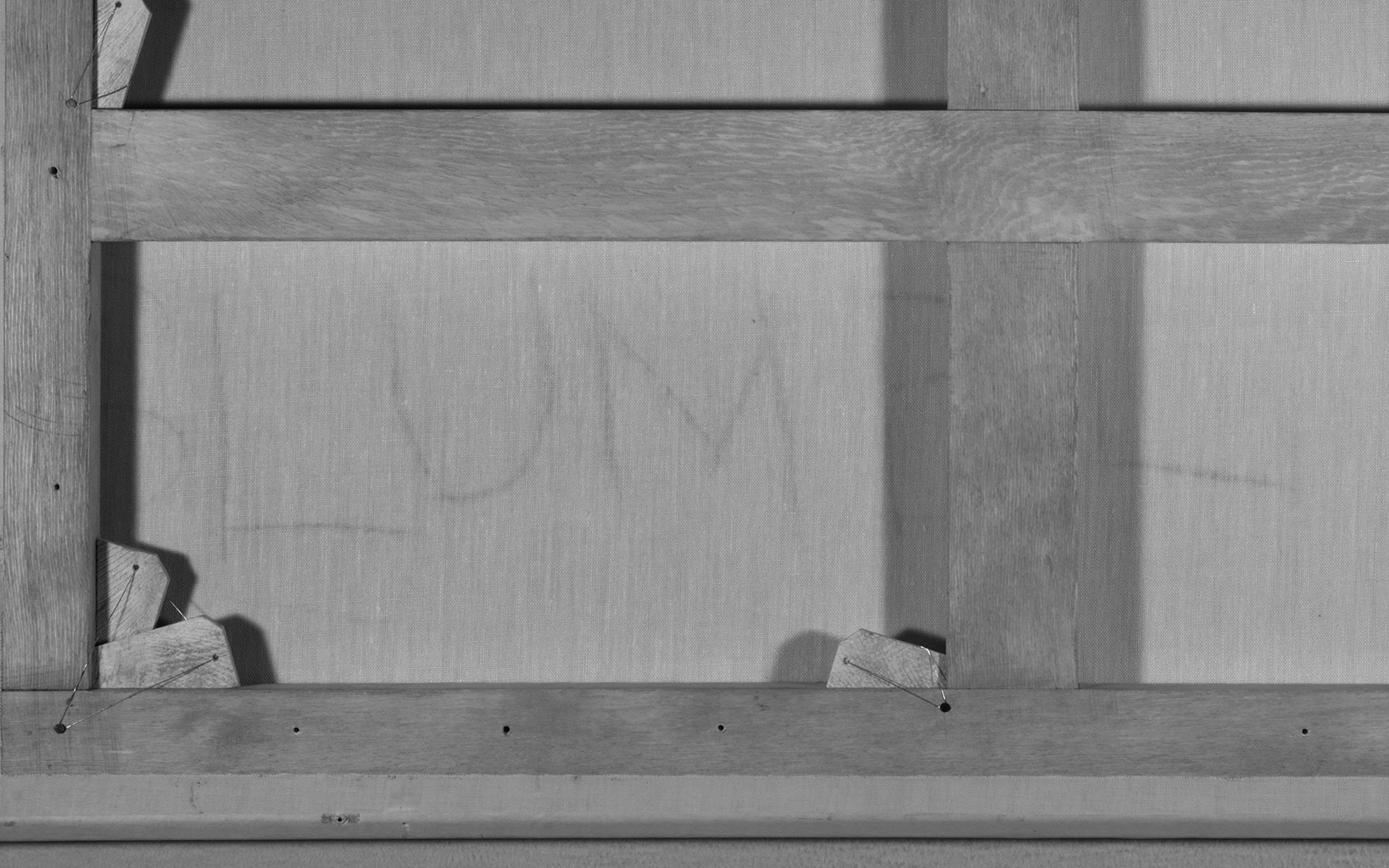
When Moro removed the old lining, in what must have been a spectacular moment, he uncovered a dedication written by Champaigne himself. Because of this finding, the painting graduated from “attributed to Philippe de Champaigne” to an autograph work.5When the painting resurfaced on the market on October 22, 1968, the inscription was covered, and the painting was listed as “attributed to Philippe de Champaigne” rather than an autograph work. See Meghan L. Gray, “Philippe de Champaigne, Christ on the Cross, ca. 1655, working document,” May 22, 2014, NAMA curatorial files. Moro copied the inscription in his notes: “Voor myne beminde suster / Marie de Champaigne–Religieuse / Brussel[s?],” meaning “For my beloved sister / Marie de Champaigne–Nun / Brussels.” He also had the inscription photographed and printed in triplicate by Brenwasser Laboratories. The photos have not been recovered,6The negative has almost certainly been destroyed, and the whereabouts of the three prints are unknown, if they survive at all. See Gray, working document, May 22, 2014, NAMA curatorial file. and at present, no imaging technique can clarify the text.
Moro Studios likely replaced the stretcher at the time of the lining. The treatment notes include, “Matt 5/18/69,” and, according to Zuccari, Matt was the woodworker who made stretchers for Moro.7Zuccari to Gray, December 13, 2013, NAMA curatorial file. Unlike the detailed notes Moro kept about the back of the painting, he recorded no information about the support he replaced. It is possible that this discarded support was not original since the painting had already undergone a lining in the past.
The tacking marginstacking margins: The outer edges of canvas that wrap around and are attached to the stretcher or strainer with tacks or staples. See also tacking edge. have been removed, and the canvas has been cropped slightly. These adjustments likely occurred during one or both of the lining campaigns. Cuspingcusping: A scalloped pattern along the canvas edges that relates to how the canvas was stretched. Primary cusping reveals where tacks secured the canvas to the support while the ground layer was applied. Secondary cusping can form when a pre-primed canvas is re-stretched by the artist prior to painting. is still visible at each edge, but it is less pronounced along the bottom. Based on the cusping pattern, at least 2.5 to 5 centimeters of canvas were probably removed from the bottom edge. Paper tape covers the new tacking margins and extends about 6 millimeters into the picture plane.
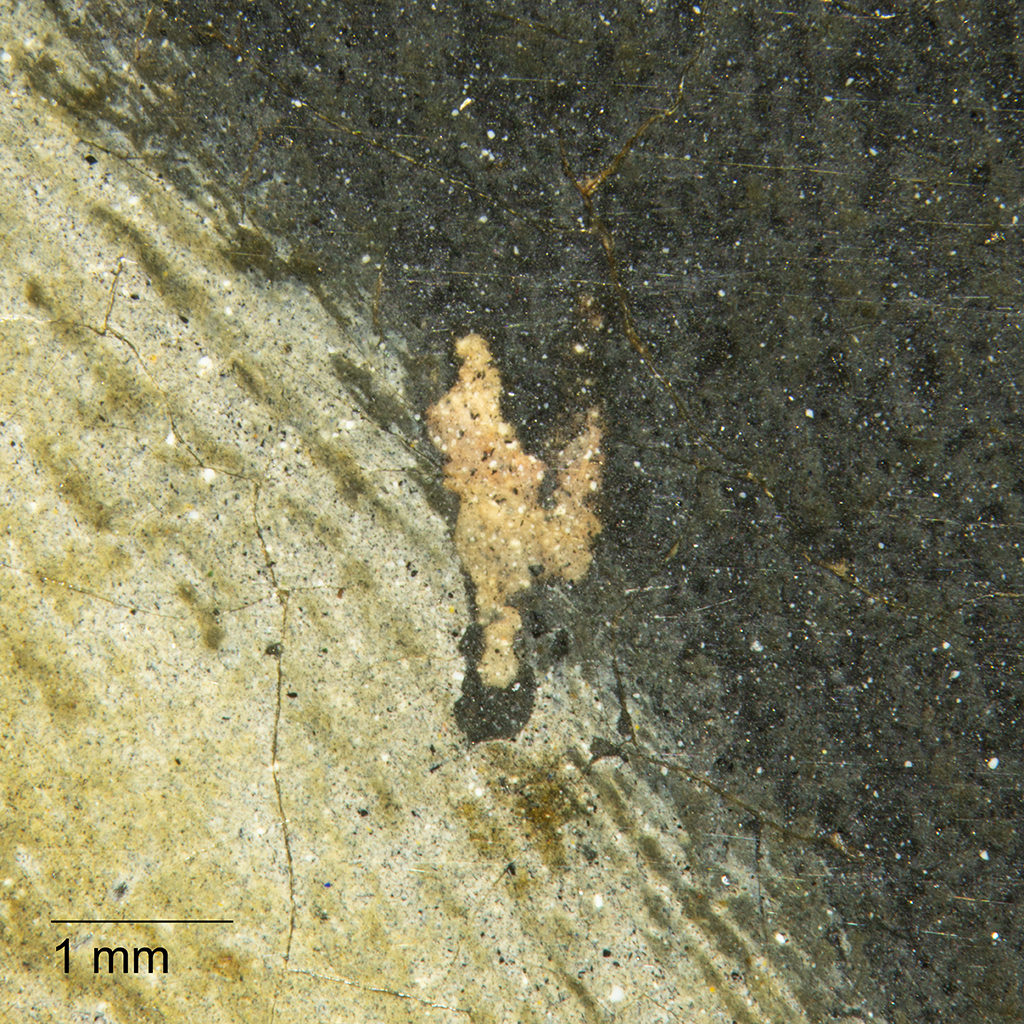
The canvas was initially prepared with a red earth pigmented ground layerground layer: An opaque preparatory layer applied to the support, either commercially or by the artist, to prevent absorption of the paint into the canvas or panel. See also priming layer..
A subsequent gray layer was likely applied across the entire
surface, suggesting a double ground. However, there is an occasional tan
color seen below the paint layers. Either the tan sits above the gray
and serves as selective underpaintingunderpainting: The first applications of paint that begin to block in color and loosely define the compositional elements. Also called ébauche., or both the tan and gray colors
comprise a tonal preparatory sketch above a single red ground layer.8Champaigne typically used a double ground of red and gray. Rare cases of single ground layers of pink or white have also been noted. See Claire Betelu, “Ground Layers in French Paintings from the Second Half of the 17th Century: Colour, Stratigraphy and Function,” in Ground Layers in European Painting 1550–1750, ed. Anne Hack Christensen, Angela Jager, and Joyce H. Townsend (London: Archetype Publications, 2020), 84–92; and Mary Alden and Richard Beresford, “Two Altar-Pieces by Phillippe de Champaigne: Their History and Technique,” Burlington Magazine 131, no. 1035 (June 1989): 395–406, https://www.jstor.org
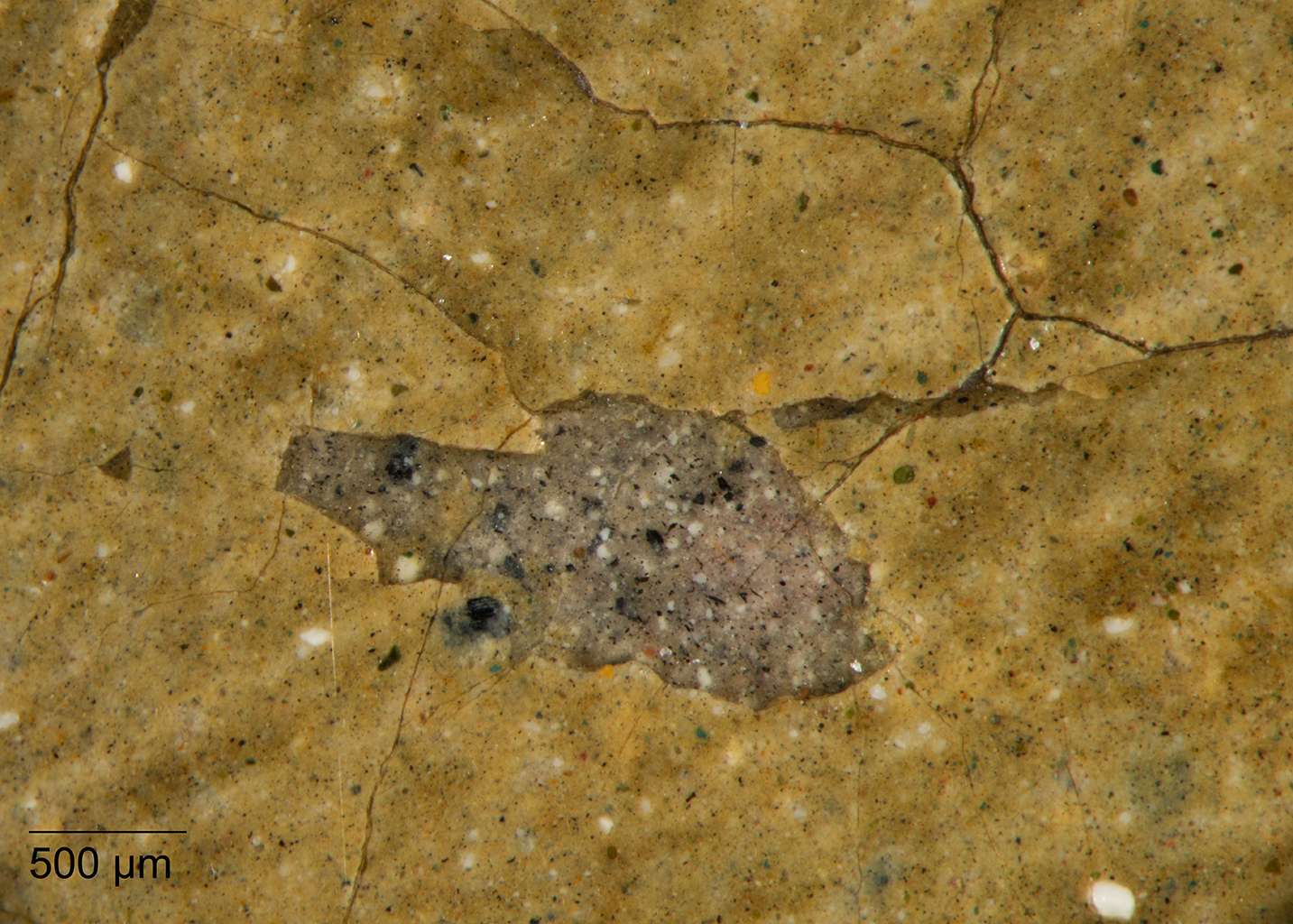 Fig. 7. Photomicrograph of the gray layer, which is likely a second ground layer. It could, however, be part of a tonal preparatory sketch, Christ on the Cross (ca. 1655).
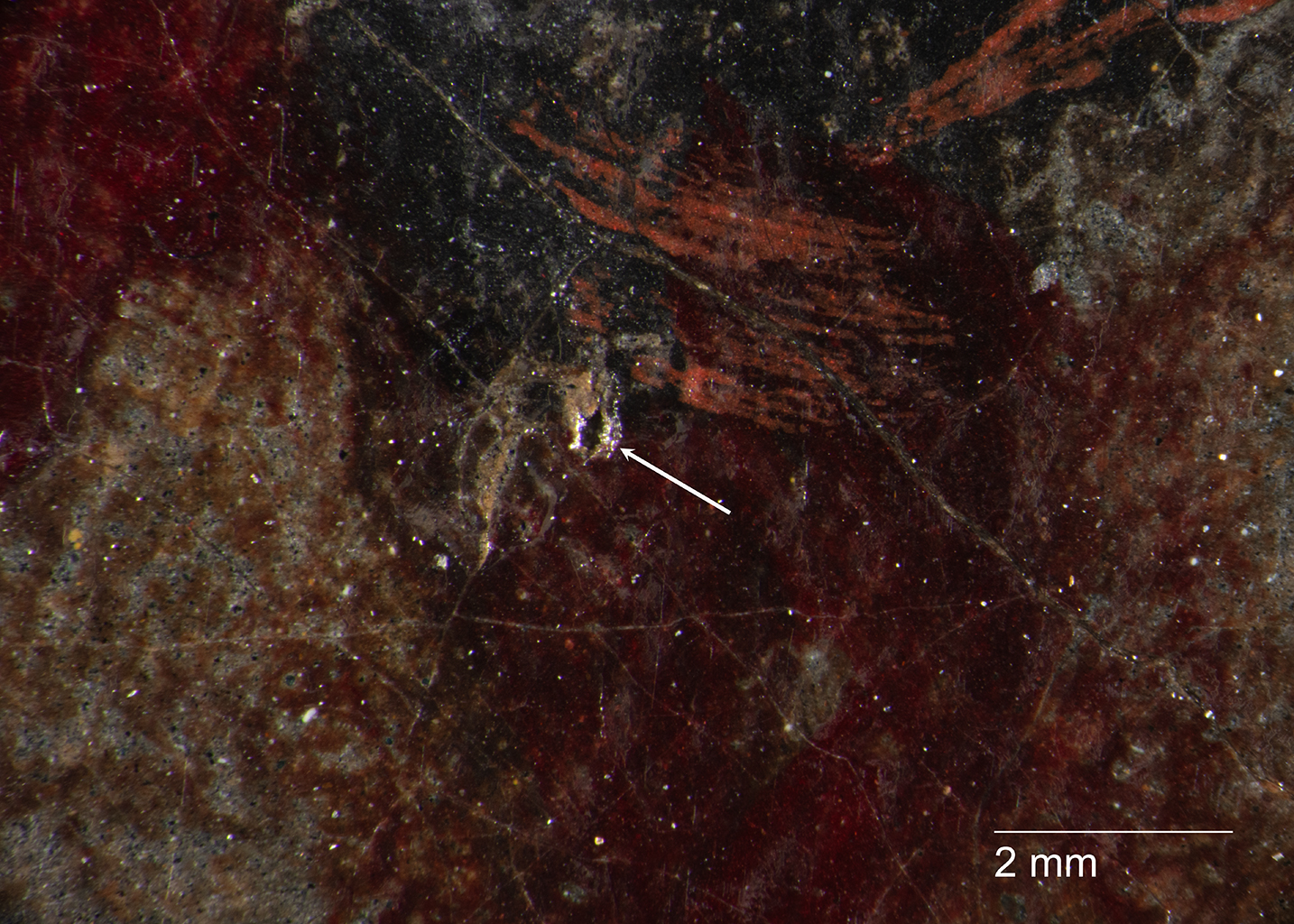 Fig. 8. Photomicrograph of a pinhole in Christ’s proper left hand, Christ on the Cross (ca. 1655)
There appear to be pinholes in Christ’s hands that are likely associated with a tool used for planning perspective (Fig. 8).11For further discussion of perspective planning in works by Nicolas Poussin, Champaigne’s contemporary and occasional collaborator, see Sheila McTighe, “Poussin’s Practice: A New Plea for Poussin as a Painter,” Kermes 27, nos. 94–95 (April–September 2014): 11–15. A central pinhole denoting the vanishing point was not observed, but it may have been covered by subsequent paint.
The Nelson-Atkins painting is regarded as a replica or later iteration of an existing motif that Champaigne had already painted numerous times.12See the accompanying catalogue entry by Rima M. Girnius. Because of Champaigne’s extensive preparatory work and the probability that he had painted this composition previously, major artist-made changes were not expected. Yet the x-radiographX-ray radiography (also referred to as x-radiography or radiography): Radiography is an examination tool analogous to the use of X-rays in medicine whereby denser components of a painted composition can be recorded as an inverted shadow image cast on film or a digital X-ray imaging plate from a source such as an X-ray tube. The method has been used for more than a century and is most effective with dense pigments incorporating metallic elements such as lead or zinc. It can reveal artist changes, underlying compositions, and information concerning the artwork’s construction and condition. The resulting image is called an x-radiograph or radiograph. It differs from the uses of X-ray spectrometry in being dependent on the density of the paint to absorb X-rays before they reach the film or image plate and being non-specific as to which elements are responsible for the resulting shadow image. shows quite a few unexplainable shapes and angles in the background, possibly indicating an unusual moment of experimentation for the artist or reuse of the canvas (Fig. 9). These potential changes or secondary composition have not been interpreted as legible imagery. In a less likely scenario, the lining fabric could have been adhered or treated with some radio-opaque material such as lead whitelead white: The most widely used white pigment from Roman times until well into the industrial period, it consists of cerussite and/or hydrocerussite, mineral names for neutral lead carbonate and basic lead carbonate, respectively. Plumbonacrite, another basic lead carbonate with proportionately less carbonate than hydrocerussite, can sometimes be found, as well. The whitest forms used in painting were historically produced by inducing lead metal to corrode in the presence of vinegar fumes., creating forms in the x-radiograph that are unrelated to the actual composition.
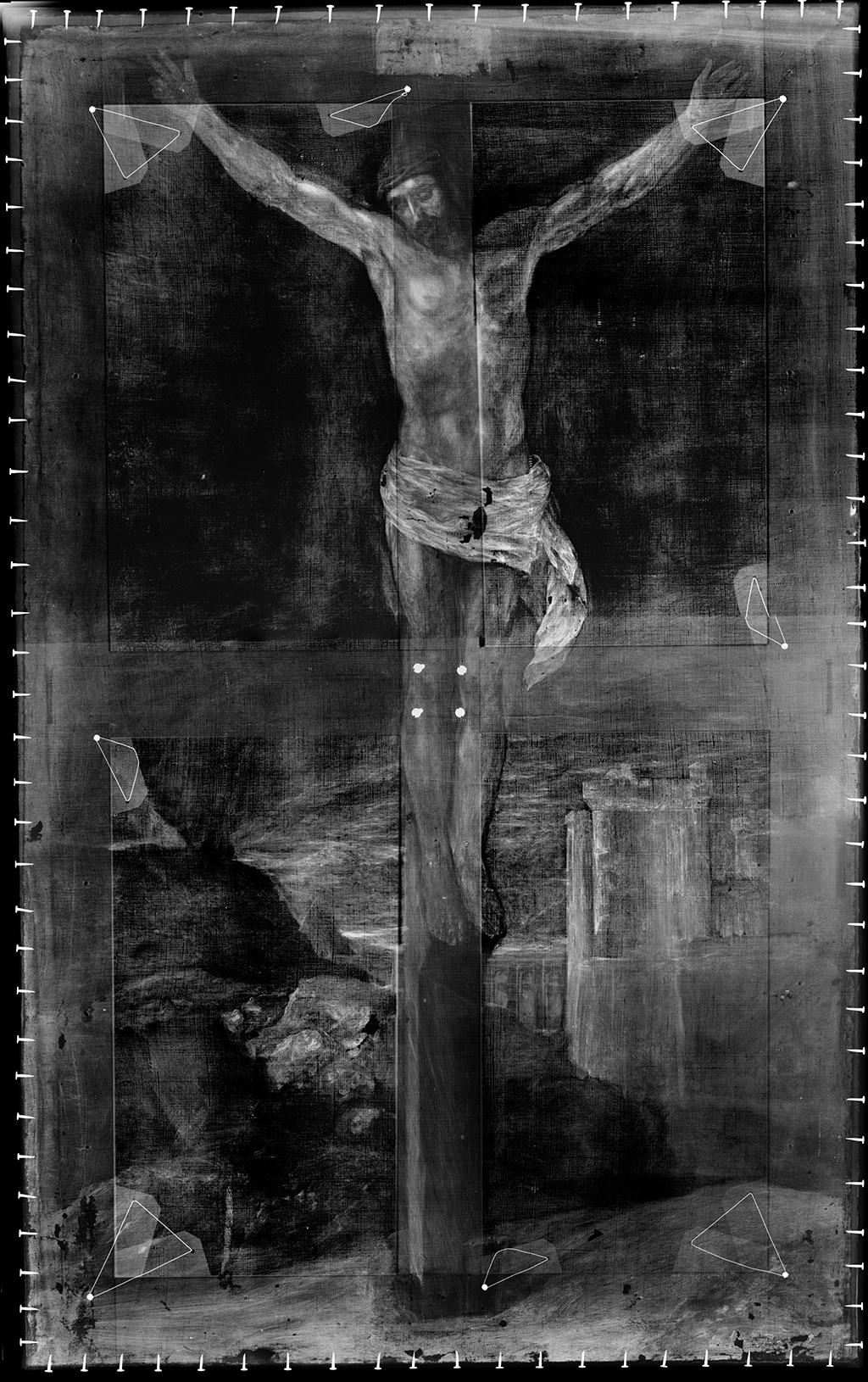
The imagery was built up in careful layers. After presumably mapping the large shapes or value shifts in tonal blocks, Champaigne began modeling Christ’s flesh. He mixed blue, green, and black pigments into the flesh color to achieve a cool, stony skin tone that steals warmth from the tan underlayer. Blue and lavender highlights intermingle with red slashes across his body. The play between the warm and cool colors gives the impression that Christ is actively dying, the color draining from his skin.
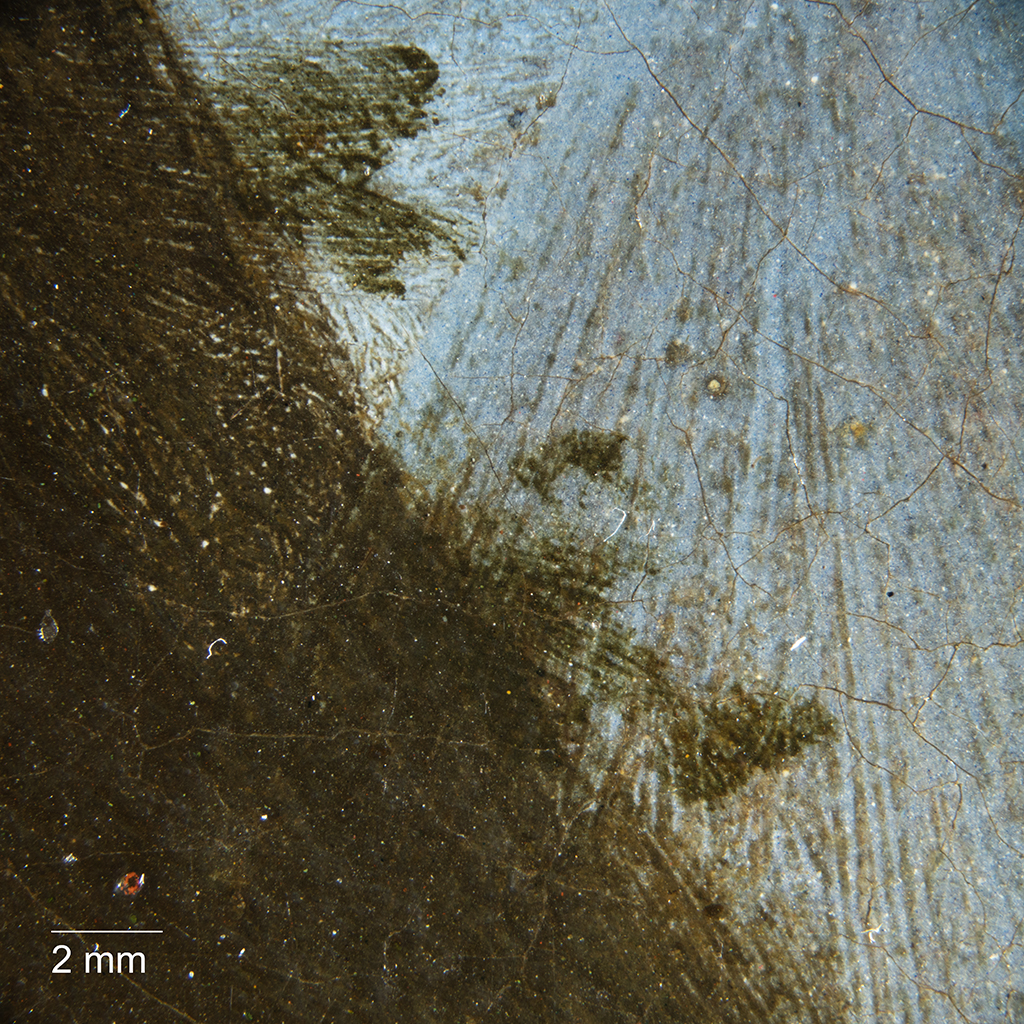
Using somewhat fluid and thick paint, Champaigne laid in the sandy ground beneath the cross and began forming the buildings along the horizon. Once dry, he applied a second layer of light yellow in the foreground and added the rocks and landscape. He let the paint dry again before making slight adjustments to the contours of the pyramid and rocks in the middleground (Fig. 10). The greenery in front of the buildings was painted wet-over-drywet-over-dry: An oil painting technique that involves layering paint over an already dried layer, resulting in no intermixing of paint or disruption to the lower paint strokes., and the vertical brushstrokes of the facades are clearly visible beneath the trees. The sky was added after the rest of the imagery was finished. The vigorous black and blue brushstrokes overlap and refine the contours of Christ’s arms, thighs, and loincloth (Fig. 11), and the sky covers some buildings to the right of the cross that seem to have been painted out. White paint was scumbledscumble: A thin layer of opaque or semi-opaque paint that partially covers and modifies the underlying paint. over the black sky and radiates from behind Christ’s head. The reach of the light was reduced with more black sky on top. Further refinement of the contours is visible near the bottom of the cross, where the edges of the post overlap the fully rendered sky. Finally, a generous application of a deep red glazeglaze: A transparent, oil or resin-rich paint application that influences the tonality of the underlying paint. was added wet-over-dry to render the blood dripping down Christ’s body and from his hands in front of the black sky.
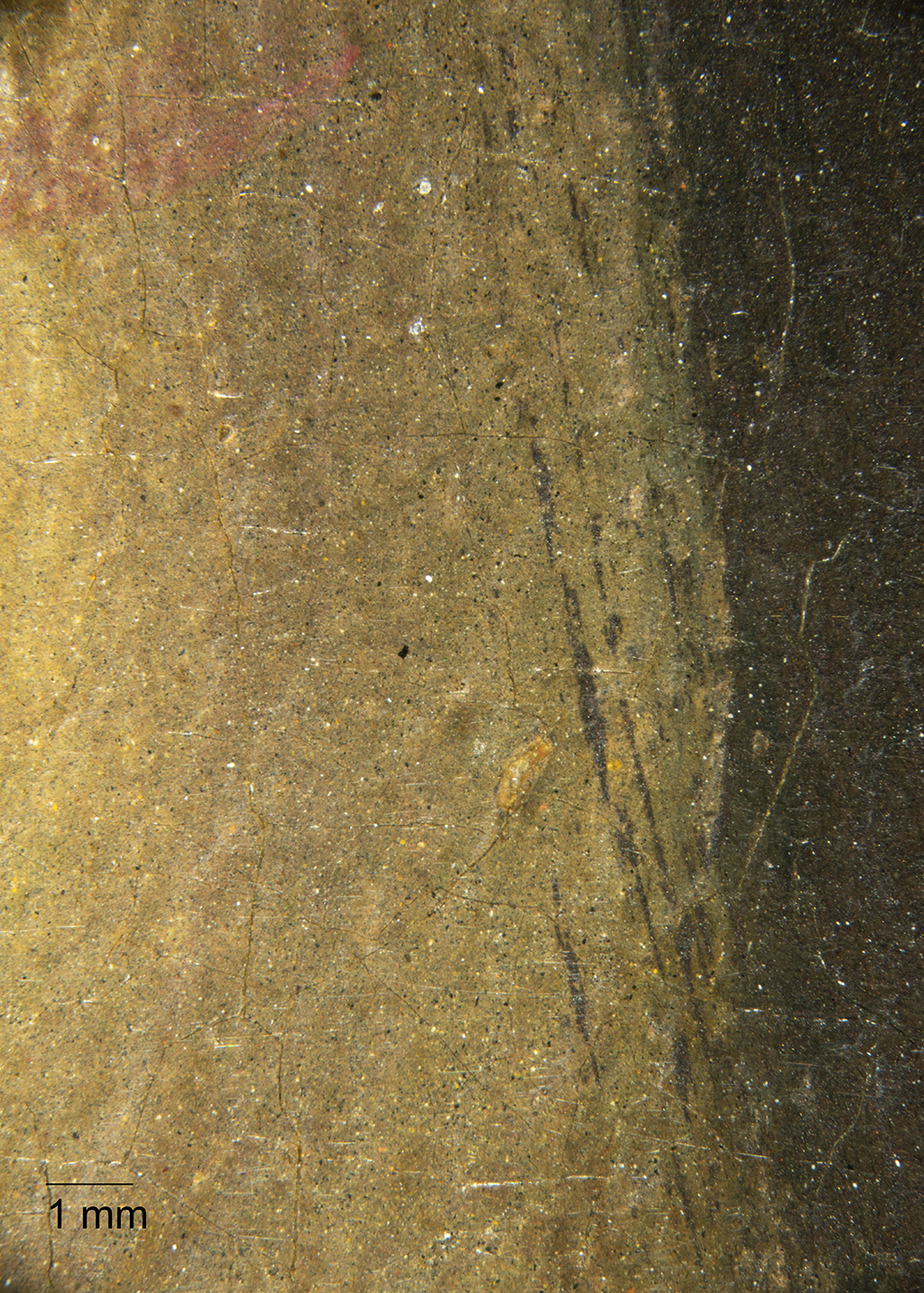 Fig. 11. Photomicrograph of the edge of Christ’s torso, showing the dark background overlaping his body, Christ on the Cross (ca. 1655)
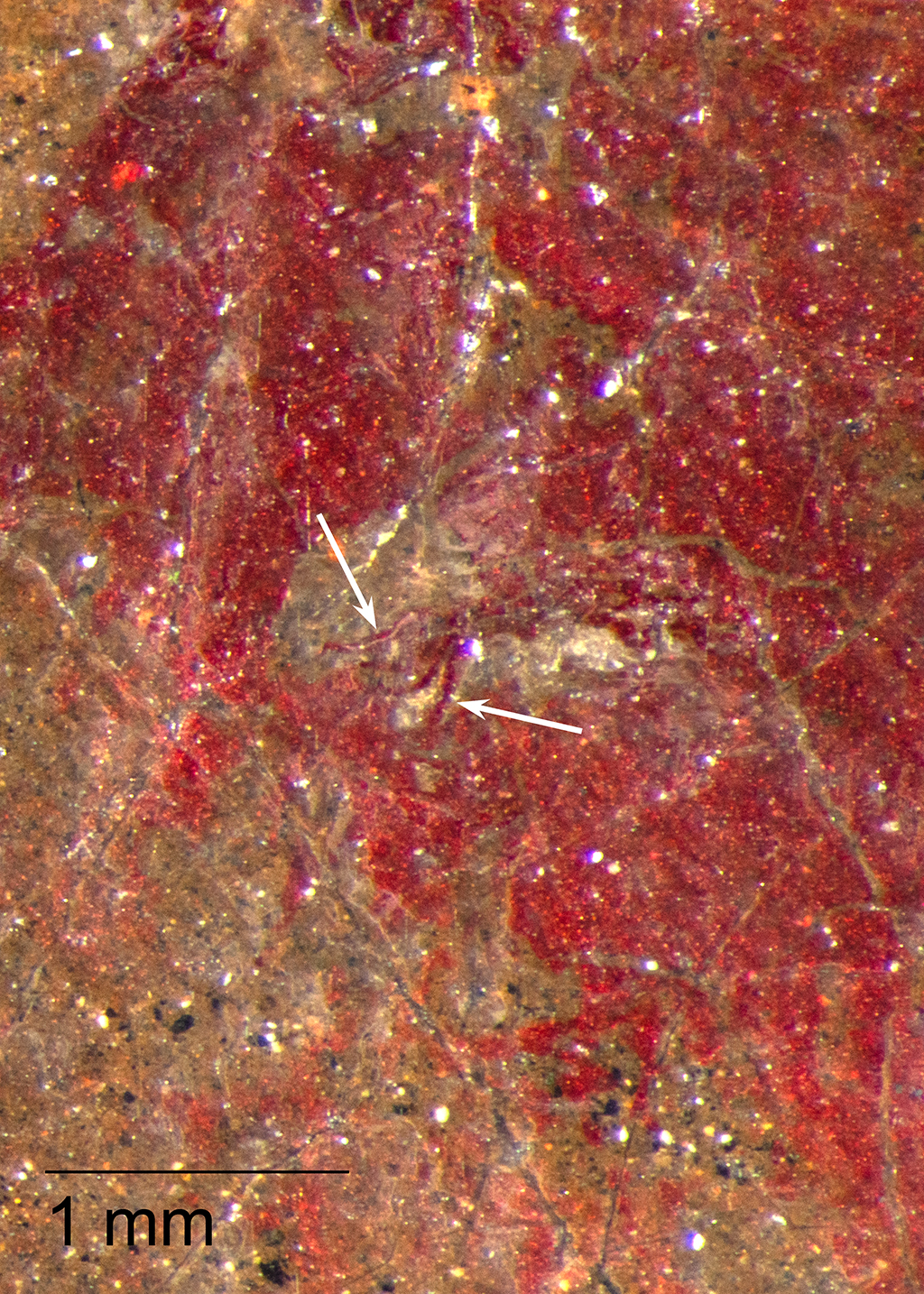 Fig. 12. Photomicrograph of the spidery threads, which are likely artifacts from the process of extracting red dye from textiles, Christ on the Cross (ca. 1655)
The pigments have not been scientifically analyzed, but it is clear
under high magnification that the artist used at least three types of
reds: an earth pigment (probably iron oxide), a bright orangey red
(probably vermilion), and an organic lakelake pigment: An organic pigment manufactured by precipitating a soluble, natural colorant onto a colorless or white, insoluble, inorganic substrate. Historically, natural colorants were extracted from plants and insects. The substrate is traditionally hydrated aluminum oxide, but other substrates such as chalk (calcium carbonate), clay, or gypsum (calcium sulphate) have also been used.. The lake, used primarily for
Christ’s blood, contains occasional tiny threads, suggesting it was made
from a colorant extracted from dyed fabric (Fig. 12). From the
fourteenth to the early seventeenth century, a process of recycling
textiles was one of the main ways artists sourced red lakes made from
insect-derived kermes, cochineal, and lac, and from plant-derived madder
and brazilwood.13It would have been feasible to extract lac and brazilwood from textiles, but it seems the raw materials were often directly used for artists’ materials. Only cochineal, kermes, and likely madder were sourced from the recycling of textile dyes. Jo Kirby, Marika Spring, and Catherine Higgitt, “The Technology of Red Lake Pigment Manufacture: Study of the Dyestuff Substrate,” National Gallery Technical Bulletin 26 (2005): 74–75, https://www.jstor.org
Retouchingretouching: Paint application by a conservator or restorer to cover losses and unify the original composition. Retouching is an aspect of conservation treatment that is aesthetic in nature and that differs from more limited procedures undertaken solely to stabilize original material. Sometimes referred to as inpainting or retouch. is associated with paint losses, the largest of which are present in the Titulus Crucis (the paper sign bearing the inscription “Jesus of Nazareth, King of the Jews” in Greek, Latin, and Hebrew), Christ’s groin, and two vertical sections in the lower left corner. It is possible that the leaves of the rightmost small tree in front of the buildings are a later addition. They are handled in a less refined manner. They appear to be comprised of a mixture of yellow and blue, whereas the other leaves are painted with a true green pigment. Finally, they are painted atop the white blossoms rather than below them (Fig. 13). Compared to four other versions of Christ on the Cross that include the same tree (see Figs. 3-4; Dead Christ on the Cross, ca. 1654, Toledo Museum of Art; and Christ on the Cross, ca. 1655–60, National Gallery of Canada, Ottawa), the Kansas City version has far more leaves, suggesting they were added at a later date by a different hand.
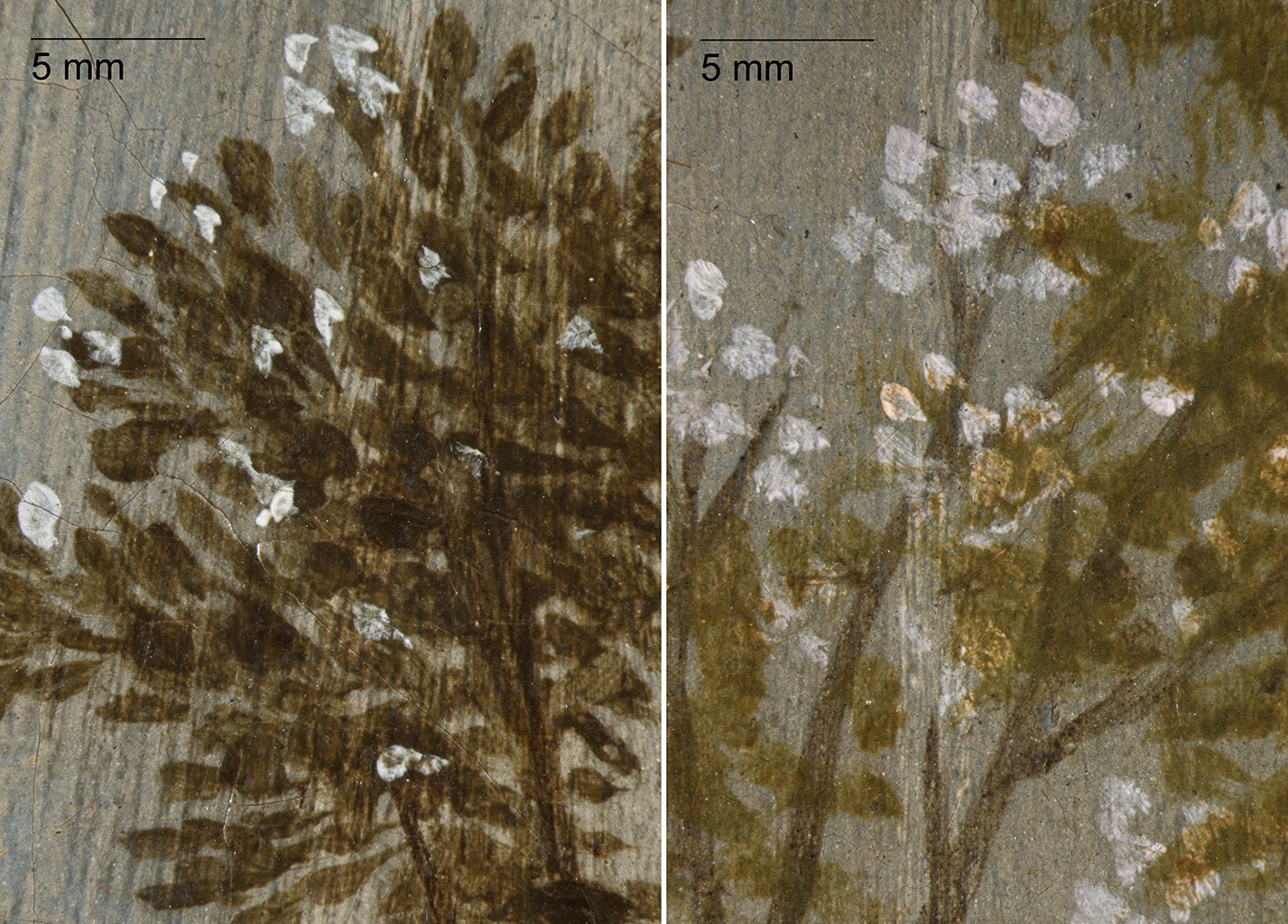
Some of the thin glazes associated with the blood and greenery may have been slightly overcleaned during a previous treatment. Old, discolored varnish is still present in the interstices of the paint, but most of it was removed in 1969. During that treatment, the painting was re-varnished and retouched. Minor treatment was performed in 1988 when the painting was reframed in a frame contemporary to the work. The brown paper tape along the perimeter of the work was retouched so as not to be noticeable in the larger sight size of the new frame.15Roger Ward to Forrest Bailey, June 14, 1988, NAMA conservation file, 70-1.
Notes
-
While occasionally recorded as Gertrude Blumel, the correct spelling of her name is Gertrud Blümel (see her 1933 dissertation, “Die ritterliche Romanillustration in Nordfrankreich und Belgien, ihr Ablauf und ihre entwicklungsgeschichtliche Stellung,” http://biografia
.sabiado ), accessed September 2025 (site inaccessible). She eventually dropped the umlaut but never added a final “e” to her name (see her petition for naturalization in 1956, National Archives, New York, “New York, U.S., Index to Petitions for Naturalization filed in New York City, 1792–1989,” for Gertrud Blumel, digitized on Ancestry.com, 1956, B, no. 7614512, image 541, https://www.ancestry.com.at /bluemel -gertrud/ /search ). She and her husband Ernst came to the United States from Austria, seemingly as displaced persons, in 1949 (see Arolsen Archives, Bad Arolsen, Germany, “Lists of Passengers who emigrated from Europe, Africa, and Asia between 1946 and 1971,” digitized on Ancestry.com as “Free Access: Africa, Asia and Europe, Passenger Lists of Displaced Persons, 1946–1971,” France, Paris, 1949, image 143, https://www.ancestry.com/collections /7733 /records /2651766 /search . She worked out of her apartment located at 134 W. 58th Street, New York (her address is included in her 1956 petition for naturalization; see that she worked from home in Frank Zuccari to Meghan L. Gray, December 13, 2013, NAMA curatorial file). Blumel died in 2006 at the age of 97 (but she was interred on January 19, 2008; see “Cemetery Records,” Interment.net, published November 24, 2016, https://www.interment.net/collections /61704 /records /915561 /data )./us /ny /westchester /ferncliff -cemetery /records -blo -bon .htm -
Sometimes seen as Paul Moro, Inc., this restoration firm was founded by artist-turned-restorer Paul Moro in or before 1931 and was later inherited by his sons, Francis and Thomas. See “Moro, Francis,” obituary in The Journal News (White Plains, New York), March 20, 2002, https://www.newspapers.com
/image ./915933120/ -
Regarding a painting in the collection of the North Carolina Museum of Art, “Again the same New York firm of Paul Moro did the re-lining, whereas the restoration of the paint film was undertaken by Mrs. Gertrude [sic] Blumel. . . . The same two firms were also involved in the restoration of a smaller picture in our collection, Jaques Louis David’s Self Portrait.” “Restoration,” North Carolina Museum of Art Bulletin 6, no. 4 (1963–65): 16, https://archive.org
/details ./bulletinnorthcar47unse /page /n299 /mode /2up -
Zuccari to Gray, December 16, 2013, NAMA curatorial file. The writing may actually be directly on the back of the original canvas; if it were written on the inner face of the lining as Zuccari implied, it would appear backwards when photographing the back of the work. Alternatively, Moro may have written “Blumel” on the back of the lining canvas and erased it so it was no longer apparent in visible light.
-
When the painting resurfaced on the market on October 22, 1968, the inscription was covered, and the painting was listed as “attributed to Philippe de Champaigne” rather than an autograph work. See Meghan L. Gray, “Philippe de Champaigne, Christ on the Cross, ca. 1655, working document,” May 22, 2014, NAMA curatorial files.
-
The negative has almost certainly been destroyed, and the whereabouts of the three prints are unknown, if they survive at all. See Gray, working document, May 22, 2014, NAMA curatorial file.
-
Zuccari to Gray, December 13, 2013, NAMA curatorial file.
-
Champaigne typically used a double ground of red and gray. Rare cases of single ground layers of pink or white have also been noted. See Claire Betelu, “Ground Layers in French Paintings from the Second Half of the 17th Century: Colour, Stratigraphy and Function,” in Ground Layers in European Painting 1550–1750, ed. Anne Hack Christensen, Angela Jager, and Joyce H. Townsend (London: Archetype Publications, 2020), 84–92; and Mary Alden and Richard Beresford, “Two Altar-Pieces by Phillippe de Champaigne: Their History and Technique,” Burlington Magazine 131, no. 1035 (June 1989): 395–406, https://www.jstor.org
/stable ./883905 -
For an example of a chalk sketch on paper, see View of Jerusalem with the Temple of Solomon (17th century; Metropolitan Museum of Art, New York, https://www.metmuseum.org
/art ); for an example of a painted study, see Richelieu’s Immortal Glory (ca. 1635; Musée du Louvre, Paris, https://collections/collection /search /364540 .louvre )..fr /en /ark :/53355 /cl010067327 -
Alden and Beresford, “Two Altar-Pieces by Phillippe de Champaigne,” 402. As Champaigne collaborated with Nicolas Poussin (1594–1665) early in their careers, they may have influenced each other. Indeed, Poussin is known to have executed tonal underpaintings. Helen Glanville, “Nicolas Poussin: Creation and Perception,” Kermes 27, nos. 94–95 (April–September 2014): 16–29.
-
For further discussion of perspective planning in works by Nicolas Poussin, Champaigne’s contemporary and occasional collaborator, see Sheila McTighe, “Poussin’s Practice: A New Plea for Poussin as a Painter,” Kermes 27, nos. 94–95 (April–September 2014): 11–15.
-
See the accompanying catalogue entry by Rima M. Girnius.
-
It would have been feasible to extract lac and brazilwood from textiles, but it seems the raw materials were often directly used for artists’ materials. Only cochineal, kermes, and likely madder were sourced from the recycling of textile dyes. Jo Kirby, Marika Spring, and Catherine Higgitt, “The Technology of Red Lake Pigment Manufacture: Study of the Dyestuff Substrate,” National Gallery Technical Bulletin 26 (2005): 74–75, https://www.jstor.org
/stable ./42616314 -
It is possible that a mixture of dyestuff can be found if the source textiles contained multiple dyes. For example, red threads found on a Titian (Venetian, ca. 1488–1576) painting were analyzed, and the dyestuff was confirmed to be a combination of madder and cochineal. Ulrich Birkmaier, Arie Wallert, and Andrea Rothe, “Technical Examinations of Titian’s Venus and Adonis: A Note on Early Italian Oil Painting Technique,” in Historical Painting Techniques, Materials, and Studio Practice, ed. Arie Wallert, Erma Hermens, and Marja Peek (Los Angeles: Getty Conservation Institute, 1995), 123.
-
Roger Ward to Forrest Bailey, June 14, 1988, NAMA conservation file, 70-1.
Documentation
Citation
Chicago:
Meghan L. Gray, “Philippe de Champaigne, Christ on the Cross, ca. 1655,” documentation in French Paintings and Pastels, 1600–1945: The Collections of The Nelson-Atkins Museum of Art, ed. Aimee Marcereau DeGalan (Kansas City: The Nelson-Atkins Museum of Art, 2022), https://doi.org/10.37764/78973.5.204.4033.
MLA:
Gray, Meghan L. “Philippe de Champaigne, Christ on the Cross, ca. 1655,” documentation. French Paintings and Pastels, 1600–1945: The Collections of The Nelson-Atkins Museum of Art, edited by Aimee Marcereau DeGalan, Nelson-Atkins Museum of Art, 2022. doi: 10.37764/78973.5.204.4033.
Provenance
Citation
Chicago:
Meghan L. Gray, “Philippe de Champaigne, Christ on the Cross, ca. 1655,” documentation in French Paintings and Pastels, 1600–1945: The Collections of The Nelson-Atkins Museum of Art, ed. Aimee Marcereau DeGalan (Kansas City: The Nelson-Atkins Museum of Art, 2022), https://doi.org/10.37764/78973.5.204.4033.
MLA:
Gray, Meghan L. “Philippe de Champaigne, Christ on the Cross, ca. 1655,” documentation. French Paintings and Pastels, 1600–1945: The Collections of The Nelson-Atkins Museum of Art, edited by Aimee Marcereau DeGalan, Nelson-Atkins Museum of Art, 2022. doi: 10.37764/78973.5.204.4033.
Given by the artist to his sister, Marie de Champaigne (1606–65), Brussels, by December 11, 1665 [1];
Sale, Aquarelles et Tableaux Modernes, Dessins et Tableaux Anciens, Objets d’Art et d’Ameublement Principalement du XVIIIe Siècle, Sièges et Meubles des époques Régence—Louis XV—Louis XVI, Tapisseries Anciennes, Palais Galliera, Paris, October 22, 1968, lot 42, as attributed to Philippe de Champaigne, Le Christ sur la croix;
With Frederick Mont, Inc., New York, by May 15, 1969–70 [2];
Purchased from Mont by The Nelson-Atkins Museum of Art, Kansas City, MO, 1970.
Notes
[1] According to an inscription on the verso of the original canvas, which was subsequently covered by relining, the artist gave the painting to his sister, Marie de Champaigne, a Beguine nun in Brussels. The inscription, which reads, “Voor myne beminde suster / Marie de Champaigne–Religieuse / Brussels,” was transcribed by Francis Moro, a painting restorer employed by Frederick Mont, Inc., at the time he lined the painting on June 5, 1969. See Nelson-Atkins curatorial files.
[2] Letter from Frederick Mont, Inc., to the Nelson-Atkins on December 11, 1969, states the painting was purchased in Paris by “Fritz” (per Nancy Yeide, National Gallery of Art, Washington, D.C., this was probably Frederick Mont, né Adolf Fritz Mondschein, Vienna, 1894–1994; letter to Meghan Gray, The Nelson-Atkins, December 3, 2012). A restoration record from Paul Moro, Inc., New York, indicates that the painting was owned by Mont when the painting was brought to Moro for restoration on May 15, 1969. See Nelson-Atkins curatorial files.
Related Works
Citation
Chicago:
Meghan L. Gray, “Philippe de Champaigne, Christ on the Cross, ca. 1655,” documentation in French Paintings and Pastels, 1600–1945: The Collections of The Nelson-Atkins Museum of Art, ed. Aimee Marcereau DeGalan (Kansas City: The Nelson-Atkins Museum of Art, 2022), https://doi.org/10.37764/78973.5.204.4033.
MLA:
Gray, Meghan L. “Philippe de Champaigne, Christ on the Cross, ca. 1655,” documentation. French Paintings and Pastels, 1600–1945: The Collections of The Nelson-Atkins Museum of Art, edited by Aimee Marcereau DeGalan, Nelson-Atkins Museum of Art, 2022. doi: 10.37764/78973.5.204.4033.
Variants with Christ looking down or dead
Philippe de Champaigne, Le Christ mort sur la croix (Christ Dead on the Cross), 17th century, oil on panel, 66 15/16 x 36 5/8 in. (170 x 93 cm), private collection, Toulouse.
Philippe de Champaigne, Christ en croix (Christ on the Cross), 1635–38, oil on canvas, 32 x 22 1/4 in. (81.3 x 56.5 cm), private collection, São Paulo, Brazil.
Philippe de Champaigne, Le Christ mort sur la Croix (Christ Dead on the Cross), ca. 1654, oil on canvas, 37 x 27 1/2 in. (94 x 70 cm), Toledo Museum of Art, 2020.5.
Philippe de Champaigne, Le Christ mort sur la croix (Christ Dead on the Cross), 1655, oil on canvas, 89 3/8 x 79 1/2 in. (227 x 202 cm), Musée de Grenoble.
Philippe de Champaigne, Christ on the Cross, ca. 1655–60, oil on canvas, 33 3/16 x 24 15/16 in. (84.3 x 63.3 cm), National Gallery of Canada, Ottawa.
Variants with Christ looking up
Philippe de Champaigne, Le Christ en croix implorant Le Père (Christ on the Cross Imploring the Father), ca. 1674, oil on canvas, 196 7/8 x 118 1/8 in. (500 x 300 cm), Eglise Saint Pierre, Chaumes-en-Brie (Seine-et-Marne), France.
Philippe de Champaigne, Le Christ en Croix (Christ on the Cross), 1674, oil on canvas, 89 3/4 x 60 1/4 in. (228 x 153 cm), Musée du Louvre, Paris.
Exhibitions
Citation
Chicago:
Meghan L. Gray, “Philippe de Champaigne, Christ on the Cross, ca. 1655,” documentation in French Paintings and Pastels, 1600–1945: The Collections of The Nelson-Atkins Museum of Art, ed. Aimee Marcereau DeGalan (Kansas City: The Nelson-Atkins Museum of Art, 2022), https://doi.org/10.37764/78973.5.204.4033.
MLA:
Gray, Meghan L. “Philippe de Champaigne, Christ on the Cross, ca. 1655,” documentation. French Paintings and Pastels, 1600–1945: The Collections of The Nelson-Atkins Museum of Art, edited by Aimee Marcereau DeGalan, Nelson-Atkins Museum of Art, 2022. doi: 10.37764/78973.5.204.4033.
France in the Golden Age: Seventeenth-Century French Paintings in American Collections, Galeries Nationales du Grand Palais, Paris, January 29–April 26, 1982; The Metropolitan Museum of Art, New York, May 26-August 22, 1982; The Art Institute of Chicago, September 18–November 28, 1982, no. 17, as Christ on the Cross.
References
Citation
Chicago:
Meghan L. Gray, “Philippe de Champaigne, Christ on the Cross, ca. 1655,” documentation in French Paintings and Pastels, 1600–1945: The Collections of The Nelson-Atkins Museum of Art, ed. Aimee Marcereau DeGalan (Kansas City: The Nelson-Atkins Museum of Art, 2022), https://doi.org/10.37764/78973.5.204.4033.
MLA:
Gray, Meghan L. “Philippe de Champaigne, Christ on the Cross, ca. 1655,” documentation. French Paintings and Pastels, 1600–1945: The Collections of The Nelson-Atkins Museum of Art, edited by Aimee Marcereau DeGalan, Nelson-Atkins Museum of Art, 2022. doi: 10.37764/78973.5.204.4033.
Aquarelles et Tableaux Modernes; Dessins et Tableaux Anciens; Objets d’Art et d’Ameublement Principalement du XVIIIe Siècle; Sièges et Meubles des époques Régence—Louis XV—Louis XVI; Tapisseries Anciennes (Paris: Palais Galliera, 1968), unpaginated, (repro.), as attributed to Philippe de Champaigne, Le Christ sur la croix.
“La Chronique des Arts (Supplément à la “Gazette des Beaux-Arts”),” Gazette des Beaux-Arts, 77, no. 1225 (February 1971): 73, (repro.), as Crucifixion.
“Recent Accessions of American and Canadian Museums: July–September 1970,” Art Quarterly 34, no. 1 (Spring 1971): 126, 131, (repro.), as Crucifixion.
Bernard Dorival, “Recherches sur les sujets sacrés et allégoriques gravés au XVIIe et au XVIIIe siècle d’après Philippe de Champaigne,” Gazette des Beaux-Arts 80, nos. 1242–43 (July–August 1972): 33.
Ralph T. Coe, “The Baroque and Rococo in France and Italy,” Apollo, 96, no. 130 (December 1972): 530–531, 533–534, (repro.) [repr., in Denys Sutton, ed., William Rockhill Nelson Gallery, Atkins Museum of Fine Arts, Kansas City (London: Apollo Magazine, 1972), 62–63, 65–66, (repro.)], as Crucifixion.
Ross E. Taggart and George L. McKenna, eds., Handbook of the Collections in The William Rockhill Nelson Gallery of Art and Mary Atkins Museum of Fine Arts, Kansas City, Missouri, vol. 1, Art of the Occident, 5th ed. (Kansas City, MO: William Rockhill Nelson Gallery of Art and Mary Atkins Museum of Fine Arts, 1973), 108, 128, (repro.), as Crucifixion.
Bernard Dorival, Philippe de Champaigne, 1602–1676: La vie, l’œuvre, et le catalogue raisonné de l’œuvre (Paris: Léonce Laget Libraire, 1976), no. 2044, pp. 1:25n15 (erroneously as no. 2043), 74, 77, 79, 81, 117, 137 (erroneously as no. 90), 138, 141–42, 150 (erroneously as no. 2043), 159 (erroneously as no. 2043), 171; 2:46 (erroneously as no. 2043), 385–86, 516, (repro.), as Le Christ Mort en Croix.
Pierre Rosenberg, France in the Golden Age: Seventeenth-Century French Paintings in American Collections, exh. cat. (New York: Metropolitan Museum of Art, 1982), 159, 235–36, 349, 378, (repro.), as Christ on the Cross.
Claudette Hould, “Lettre de Paris: La peinture française du 17e siècle dans les collections américaines,” Vie des Arts 27, no. 107 (Summer 1982): 15, (repro.), as Le Christ en croix.
Tom L. Freudenheim, ed., American Museum Guides: Fine Arts; A Critical Handbook to the Finest Collections in the United States (New York: Collier, 1983), 112, as Crucifixion.
Anne-Marie Bonenfant-Feytmans, “Un tableau inconnu de Philippe de Champaigne. Proposition d’identification,” Bulletin (Musées Royaux des Beaux-Arts de Belgique, Brussels) 34–37, no. 1–3 (1985–1988): 147, as Christ en croix.
Christopher Wright, The French Painters of the Seventeenth Century (Boston: Little, Brown, 1985), 154, as Christ on the Cross.
Myron Laskin, Jr. and Michael Pantazzi, eds., European and American Painting, Sculpture, and Decorative Arts, vol. 1, 1300–1800/Text (Ottawa: National Gallery of Canada, 1987), 69–70, 355.
Bernard Dorival, Jean-Baptiste de Champaigne (1631–1681): La vie, l’homme et l’art (Paris: Bernard Dorival, 1992), 9, as Christ en croix.
Christopher Wright, The World’s Master Paintings: From the Early Renaissance to the Present Day (London: Routledge, 1992), 1:233, as Crucifixion, and 2:122.
Alfred Cohen, Ronald Cohen, and W. J. Van der Watering, Trafalgar Galleries XII (London: Trafalgar Fine Art Publications, [1993]), 34, 35n1, (repro.).
Roger Ward and Patricia J. Fidler, eds., The Nelson-Atkins Museum of Art: A Handbook of the Collection (New York: Hudson Hills Press, in association with Nelson-Atkins Museum of Art, 1993), 170, (repro.), as Christ on the Cross.
Ronald Cohen and Alfred Cohen, Trafalgar Galleries at Maastricht, exh. cat. (London: Trafalgar Fine Art Publications, 1999), 22–23, (repro.).
J. Bradley Chance and Milton P. Horne, Rereading the Bible: An Introduction to the Biblical Story (Upper Saddle River, NJ: Prentice Hall, 2000), 323, (repro.), as Christ on the Cross.
Gilles Chomer, Peintures françaises avant 1815: La collection du Musée de Grenoble (Paris: Réunion des Musées Nationaux, 2000), 64, as Christ mort sur la croix.
Emmanuel Coquery and Anne Piéjus, eds., Figures de la Passion, exh. cat. (Paris: musée de la musique, 2001), 131n6.
Lorenzo Pericolo, Philippe de Champaigne: “Philippe, homme sage et vertueux:” Essai sur l’art et l’œuvre de Philippe de Champaigne (1602–1674) (Tournai, Belgium: La Renaissance du Livre, 2002), 311n20, as Christ en croix.
Lorenzo Pericolo, “Une ‘Crucifixion’ inédite de Philippe de Champaigne,” Paragone 56, no. 59 (January 2005): 77n4.
Alain Tapié and Nicolas Sainte Fare Garnot, Philippe de Champaigne (1602–1674): Entre politique et dévotion, exh. cat. (Paris: Réunion des musées nationaux, 2007), 244–45, (repro.), as Le Christ mort sur la Croix.
Deborah Emont Scott, ed., The Nelson-Atkins Museum of Art: A Handbook of the Collection, 7th ed. (Kansas City, MO: Nelson-Atkins Museum of Art, 2008), 78, (repro.), as Christ on the Cross.