Chicago
Aimee Marcereau DeGalan, Editor, French Paintings and Pastels, 1600–1945: The Collections of the Nelson-Atkins Museum of Art (Kansas City: The Nelson-Atkins Museum of Art, 2021–2025), https://doi.org/10.37764/78973.
MLA
Marcereau DeGalan, Aimee. Editor. French Paintings and Pastels, 1600–1945: The Collections of the Nelson-Atkins Museum of Art. The Nelson-Atkins Museum of Art, 2021–2025. doi: 10.37764/78973.
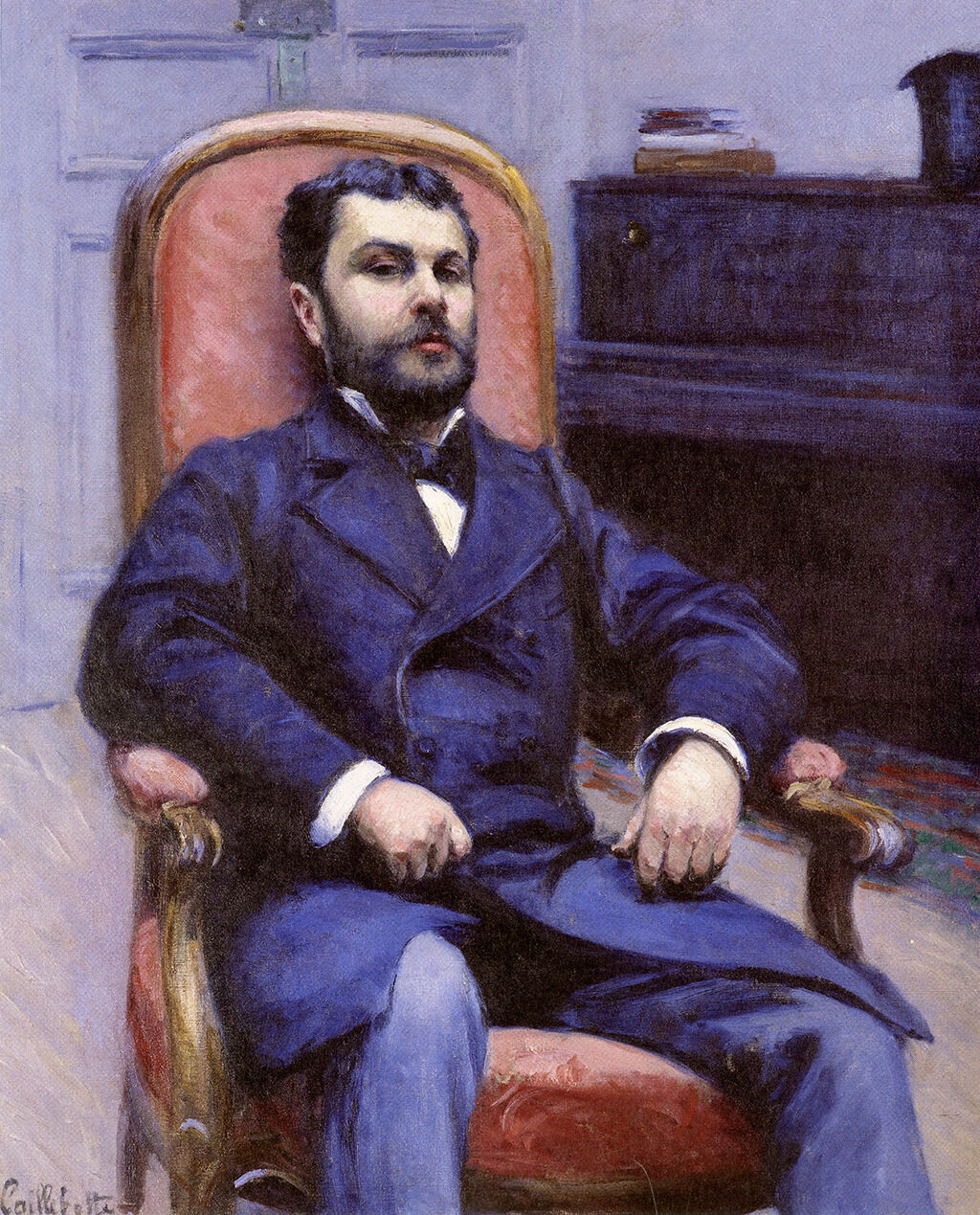
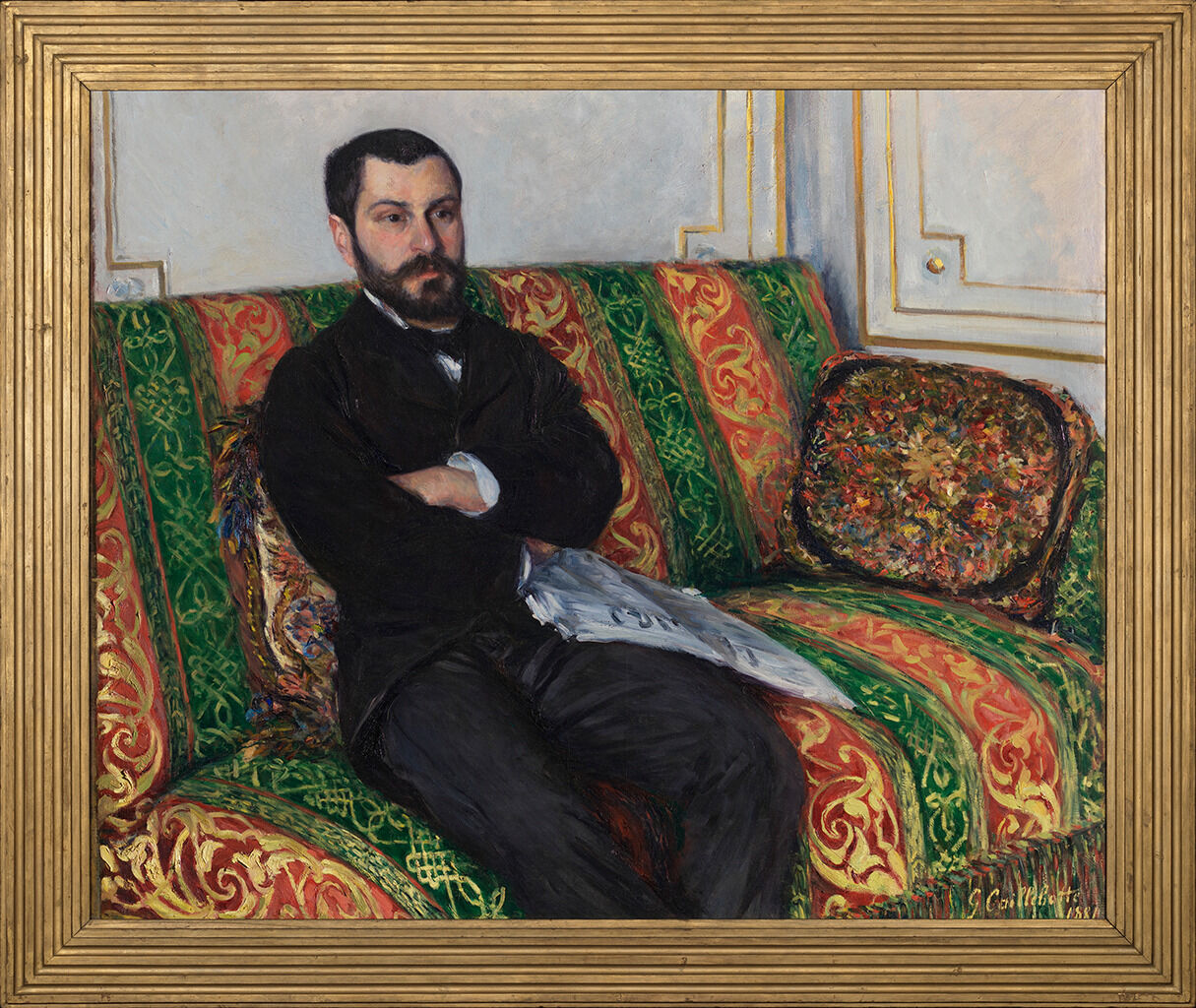
Gustave Caillebotte, Portrait of Richard Gallo, 1881, oil on canvas, 38 1/4 x 45 7/8 in. (97.2 x 116.5 cm), Purchase: William Rockhill Nelson Trust, 89-35
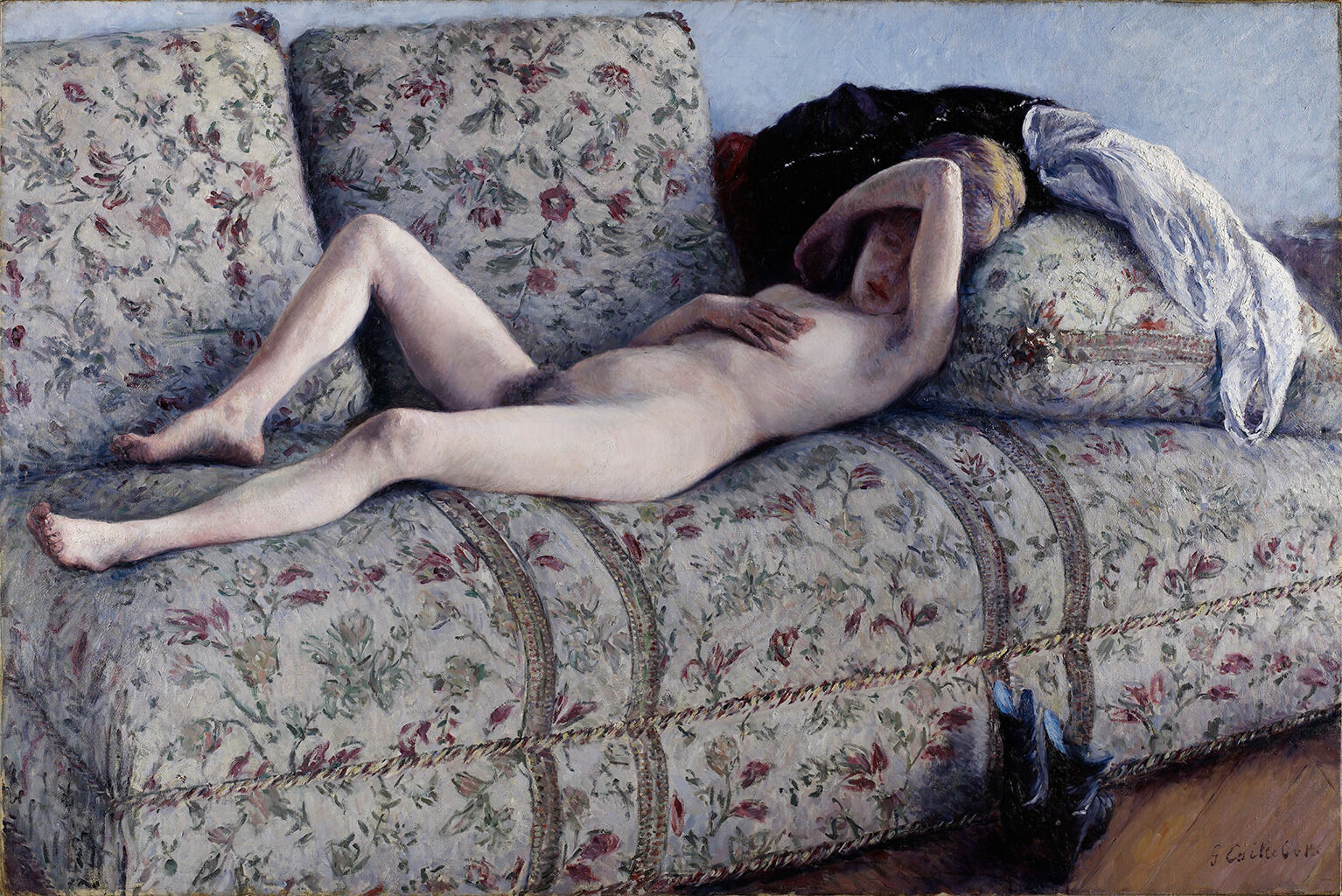
Fig. 1. Gustave Caillebotte, Nude on a Couch, ca. 1880, oil on canvas, 51 x 77 in. (129.5 x 195.6 cm), Minneapolis Institute of Arts. The John R. Van Derlip Fund, 67.67
Toggle Caption
Toggle Dual View
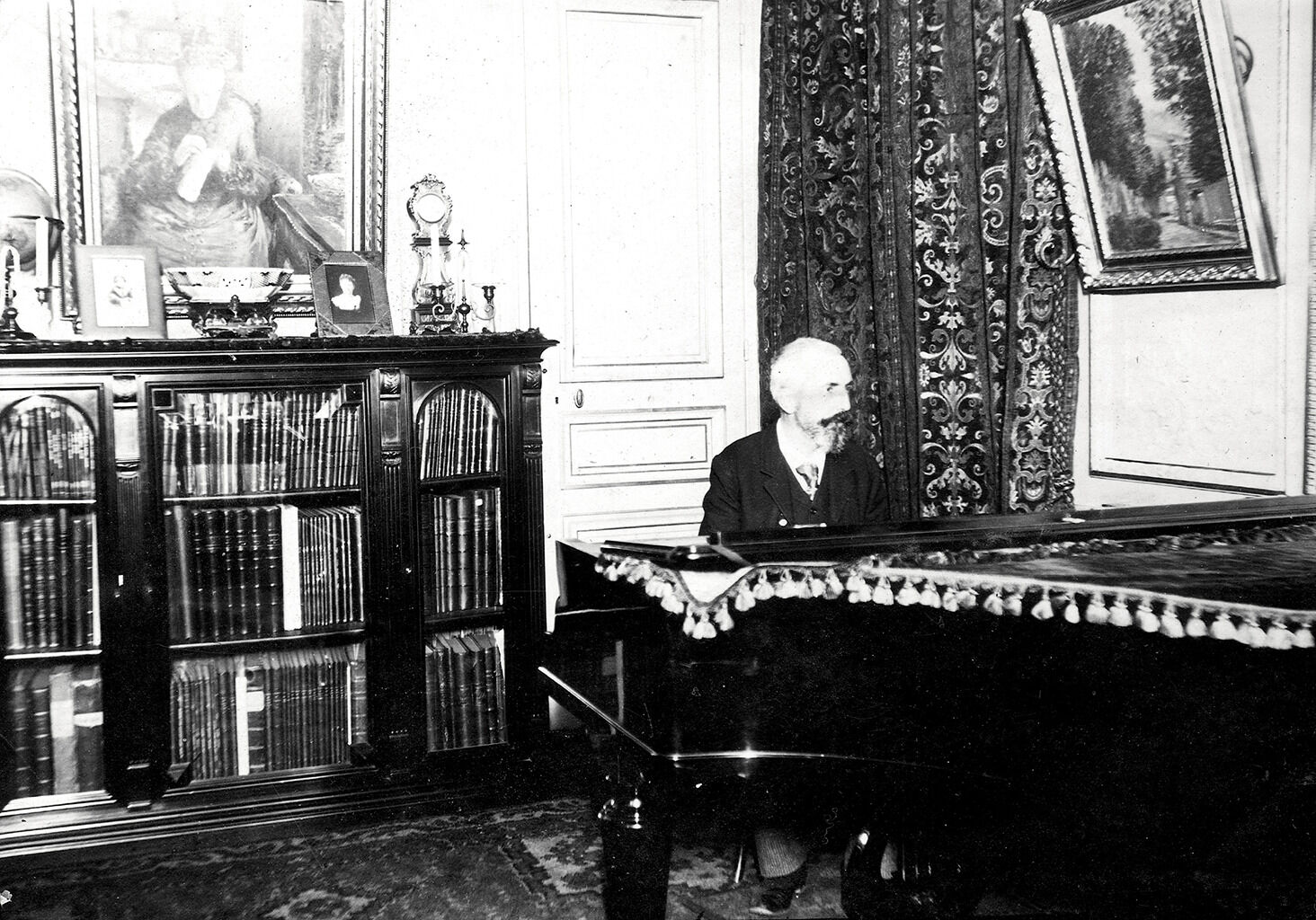
Fig. 2. Martial Caillebotte, Martial Caillebotte at Home, 9 rue Scribe (Petit Salon), gelatin silver print, 1895–96, private collection
Toggle Caption
Toggle Dual View
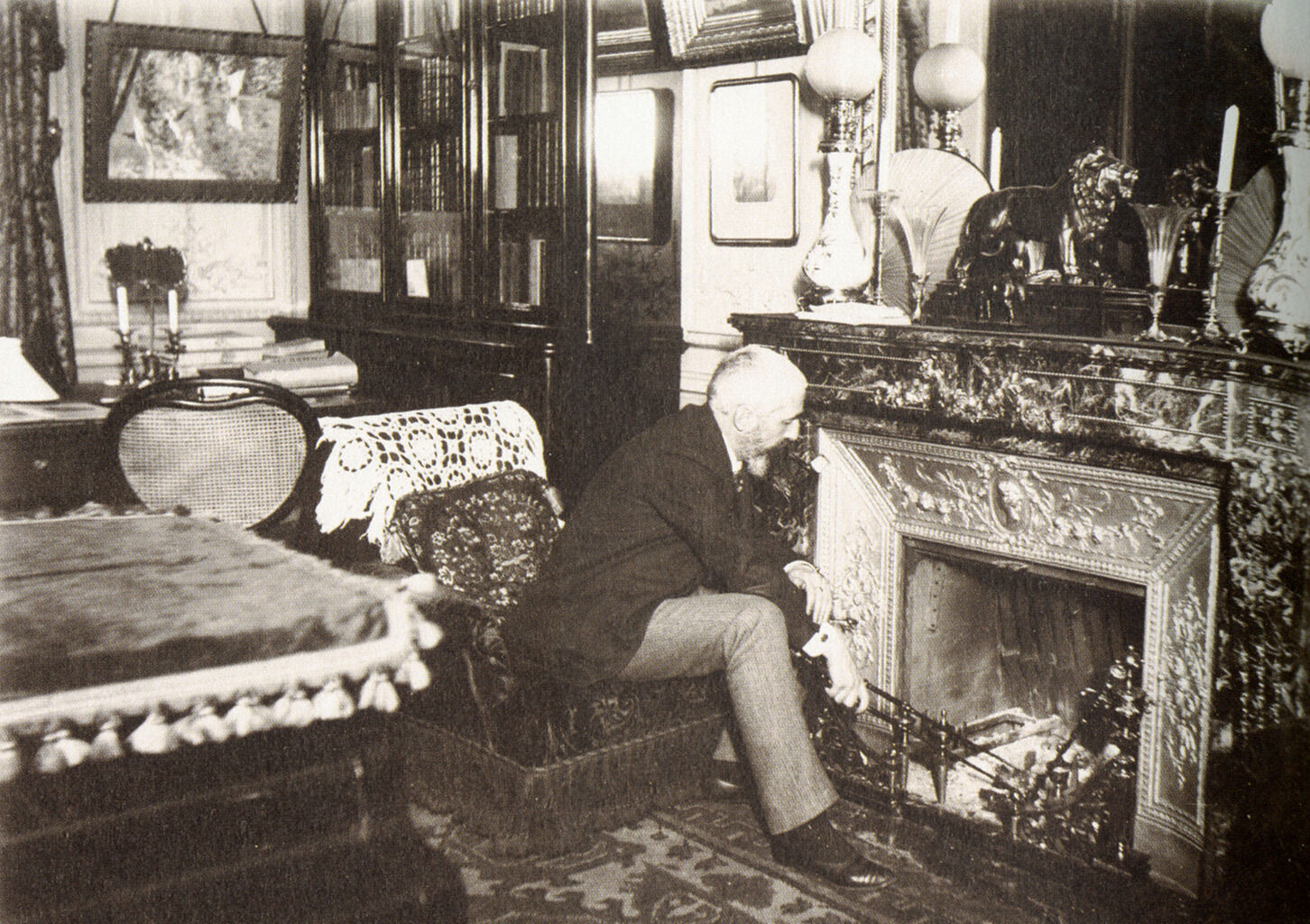
Fig. 3. Martial Caillebotte, Martial Caillebotte in Front of his Fireplace, 9 rue Scribe (Petit Salon), gelatin silver print, ca. 1895–96, private collection; repro. in Serge Lemoine, Dans l’intimité des frères Caillebotte: peintre et photographe, exh. cat. (Paris: Culturespaces, 2011)
Toggle Caption
Toggle Dual View
Fig. 4. Gustave Caillebotte, Portrait of Richard Gallo, 1878, oil on canvas, 31 1/2 x 25 9/16 in. (80 x 65 cm), private collection
Toggle Caption
Toggle Dual View
Fig. 5. Gustave Caillebotte, Portrait of Richard Gallo, 1881, in its original frame
Toggle Caption
Toggle Dual View
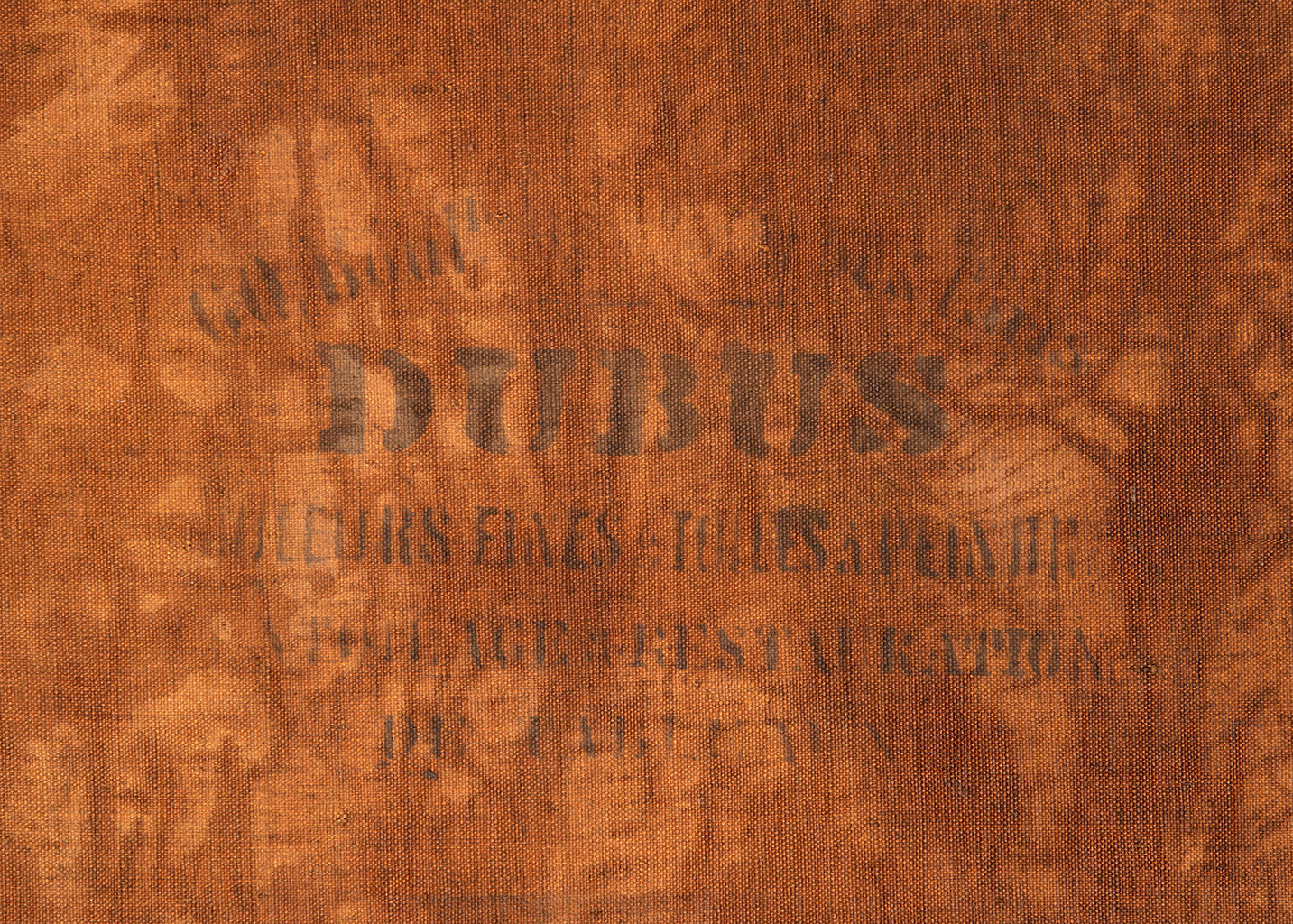
Fig. 6. Detail of the canvas reverse, Portrait of Richard Gallo (1881). The Dubus supplier stamp is located on the proper left quadrant, oriented 90 degrees counterclockwise from the portrait.
Toggle Caption
Toggle Dual View
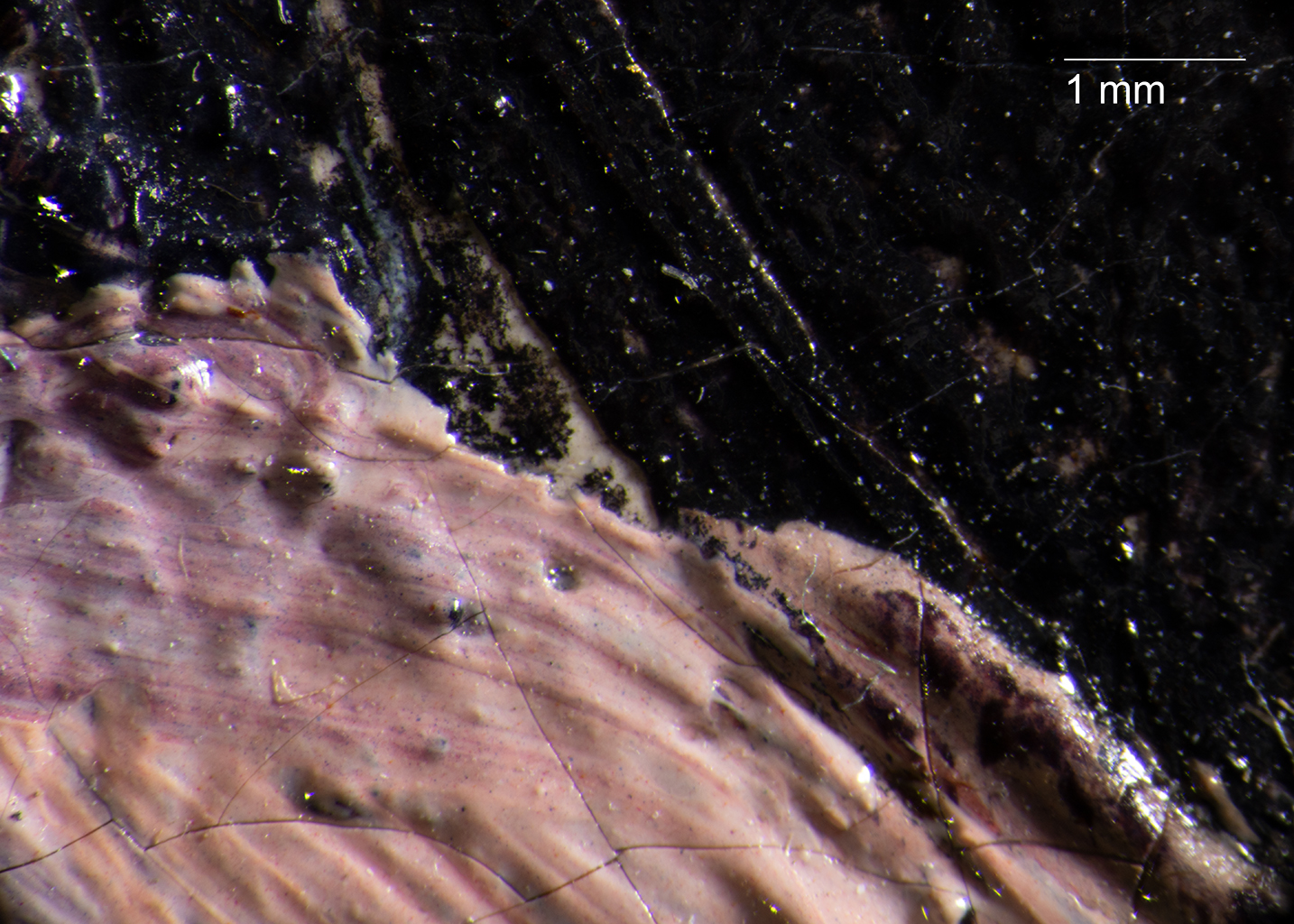
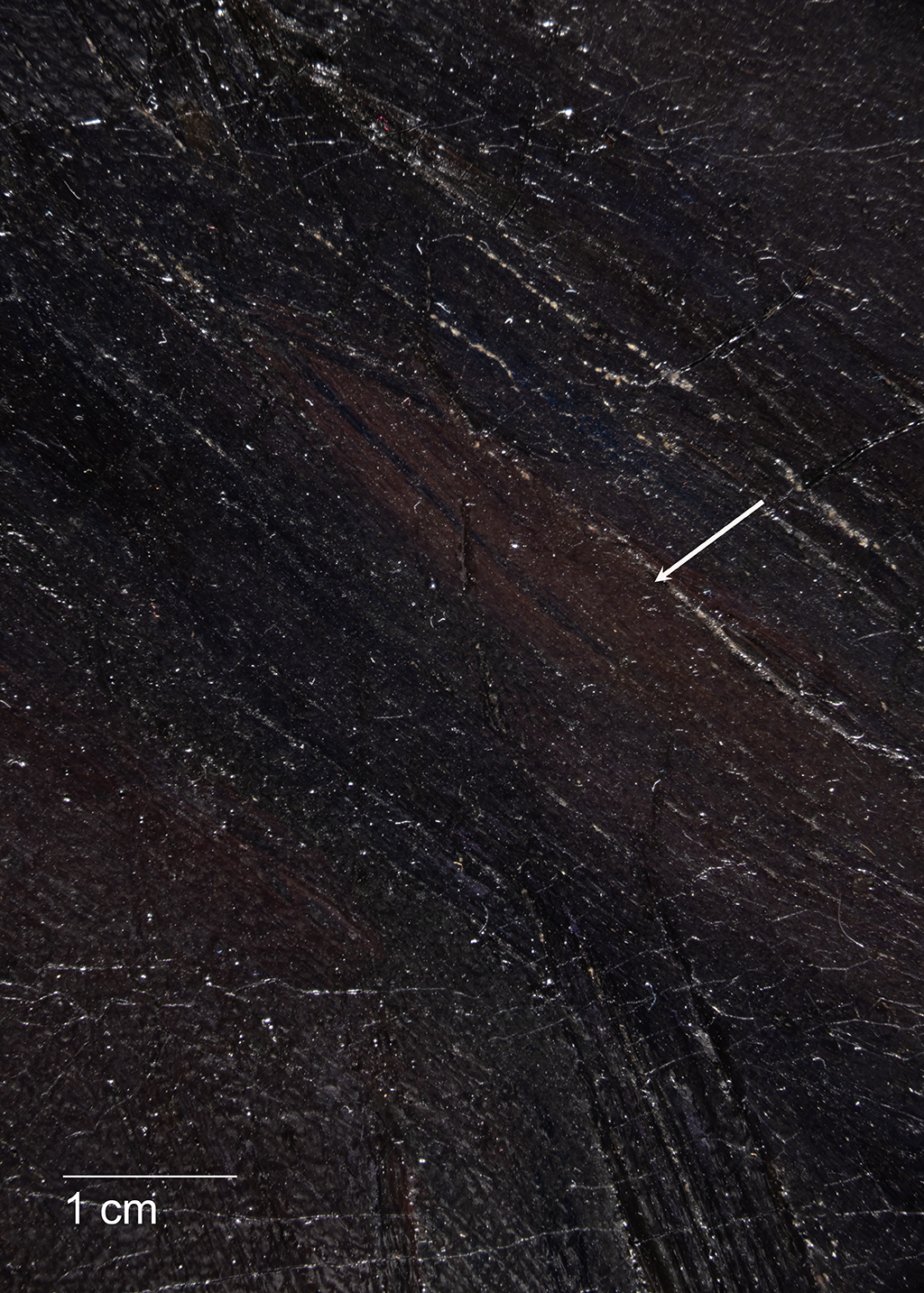
Fig. 7. Photomicrograph of black, dry media, which is likely related to an underdrawing, at the intersection of the sitter’s hair and proper right ear, Portrait of Richard Gallo (1881)
Toggle Caption
Toggle Dual View
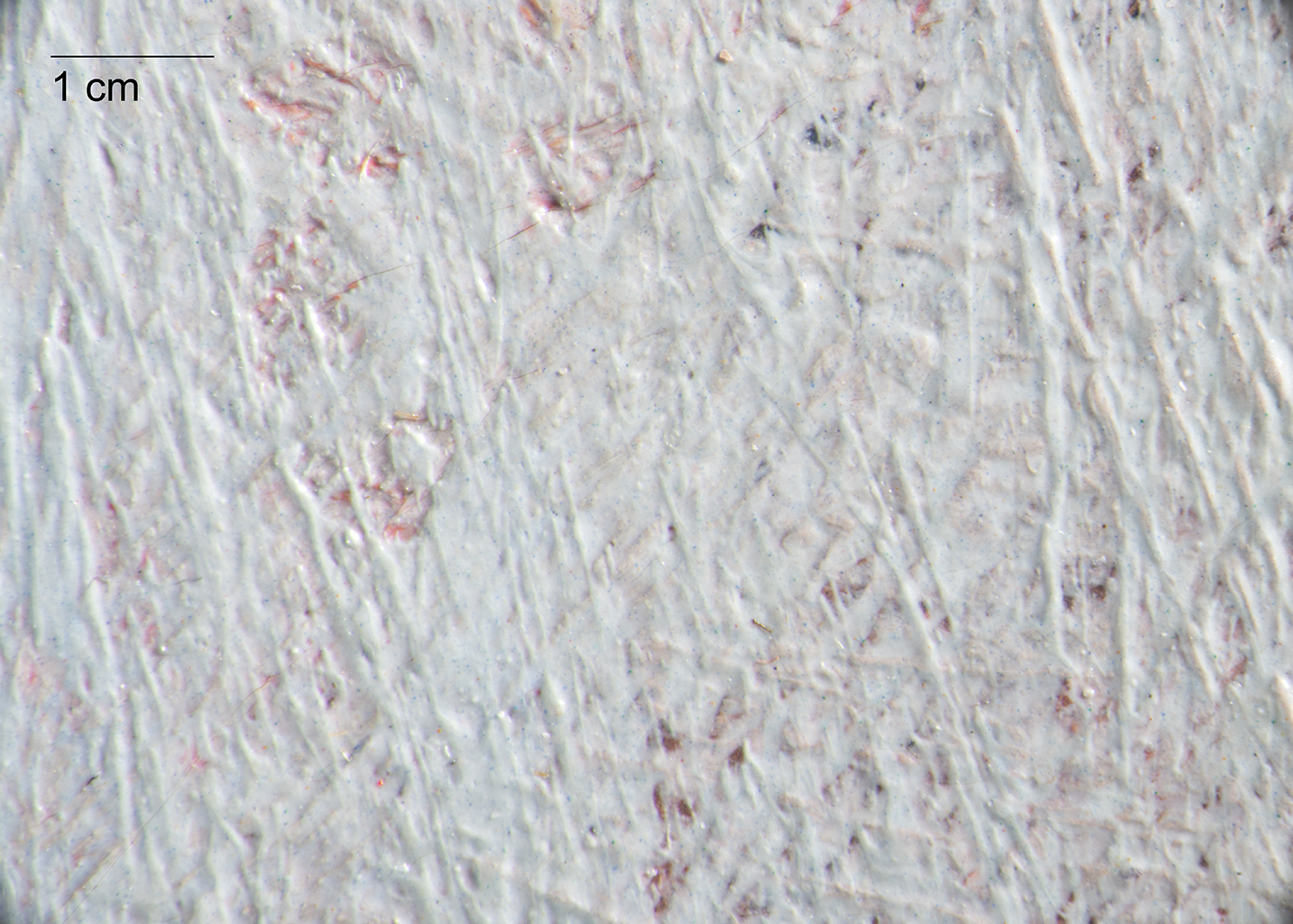
Fig. 8. Photomicrograph of the dark purple wash visible at the outer edge of Gallo’s thigh, Portrait of Richard Gallo (1881). The wash has a scraped or rubbed appearance that exposes dots of white ground on the high points of the canvas.
Toggle Caption
Toggle Dual View
Fig. 9. Detail of the subtle magenta and blue paint colors within the dark suit of Portrait of Richard Gallo (1881). The image has been overexposed to make the color variation more apparent.
Toggle Caption
Toggle Dual View
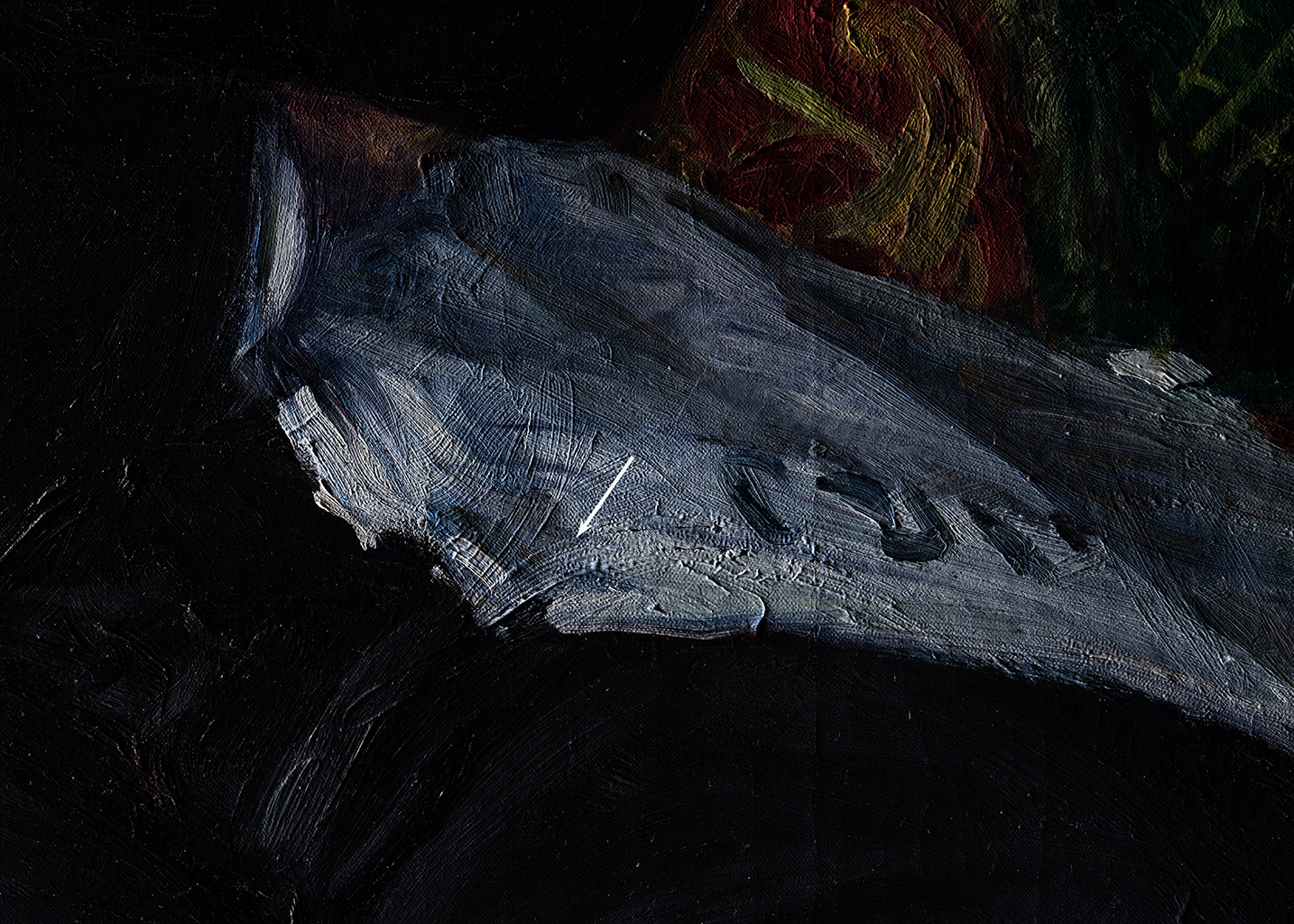
Fig. 10. Detail of Gallo’s thigh and newspaper with raking illumination, Portrait of Richard Gallo (1881). Underlying thick, curving paint strokes confirm that the sitter’s thigh was painted before the newspaper was added.
Toggle Caption
Toggle Dual View
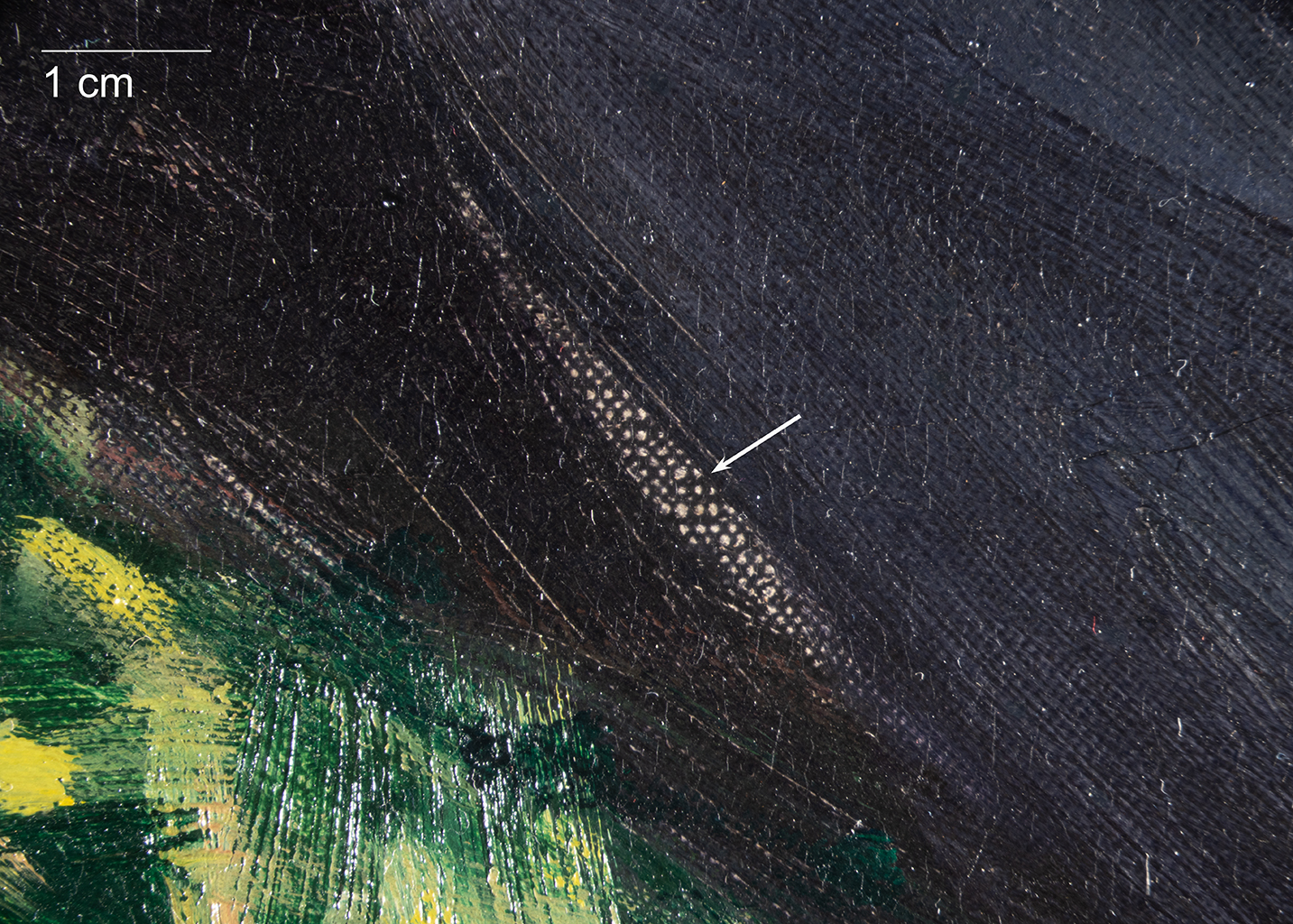
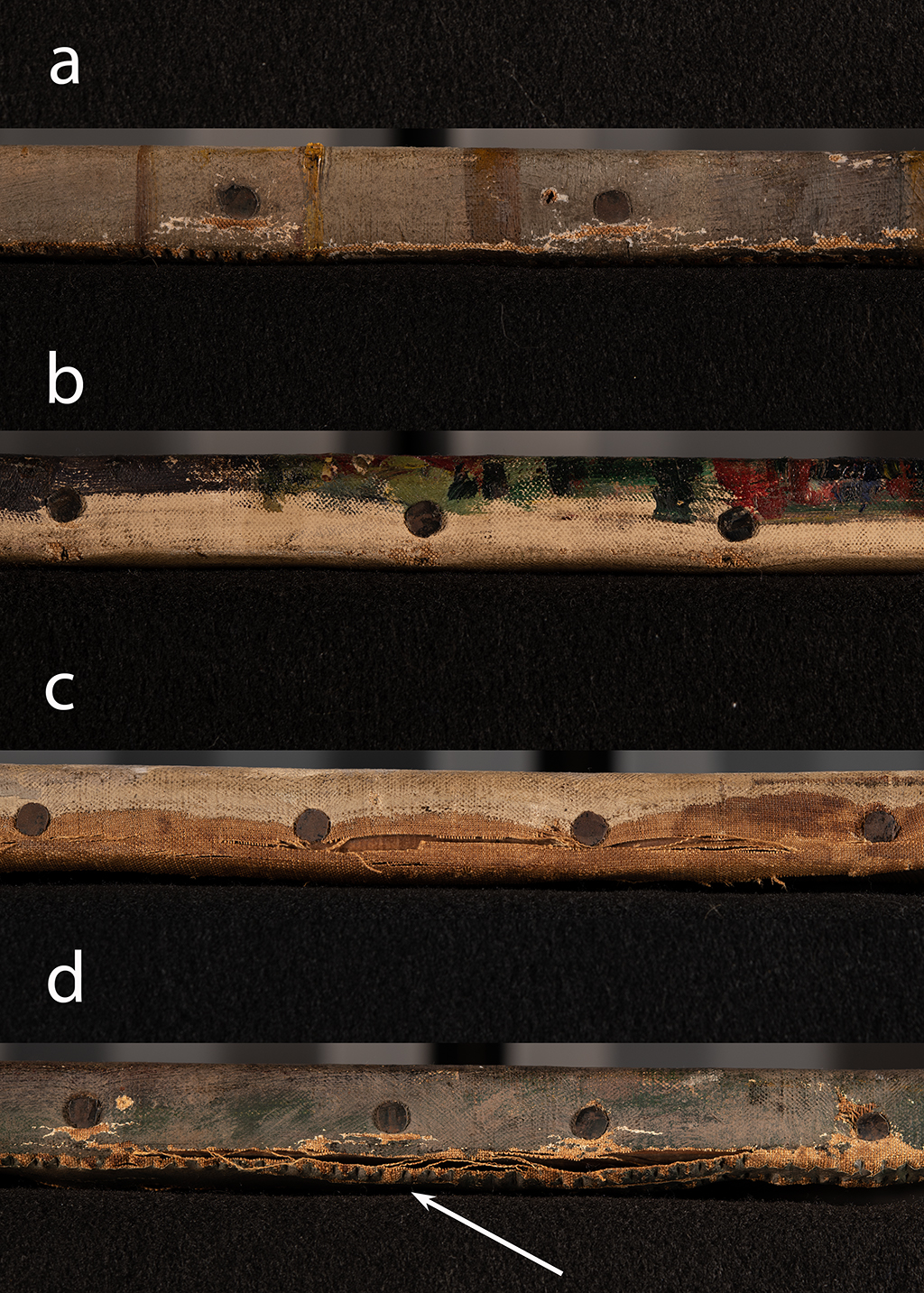
Fig. 11. Four details of Portrait of Richard Gallo (1881), showing the top (a), bottom (b), right (c), and left (d) tacking margins. An arrow marks the crimping pattern on the left tacking margin (d).
Toggle Caption
Toggle Dual View
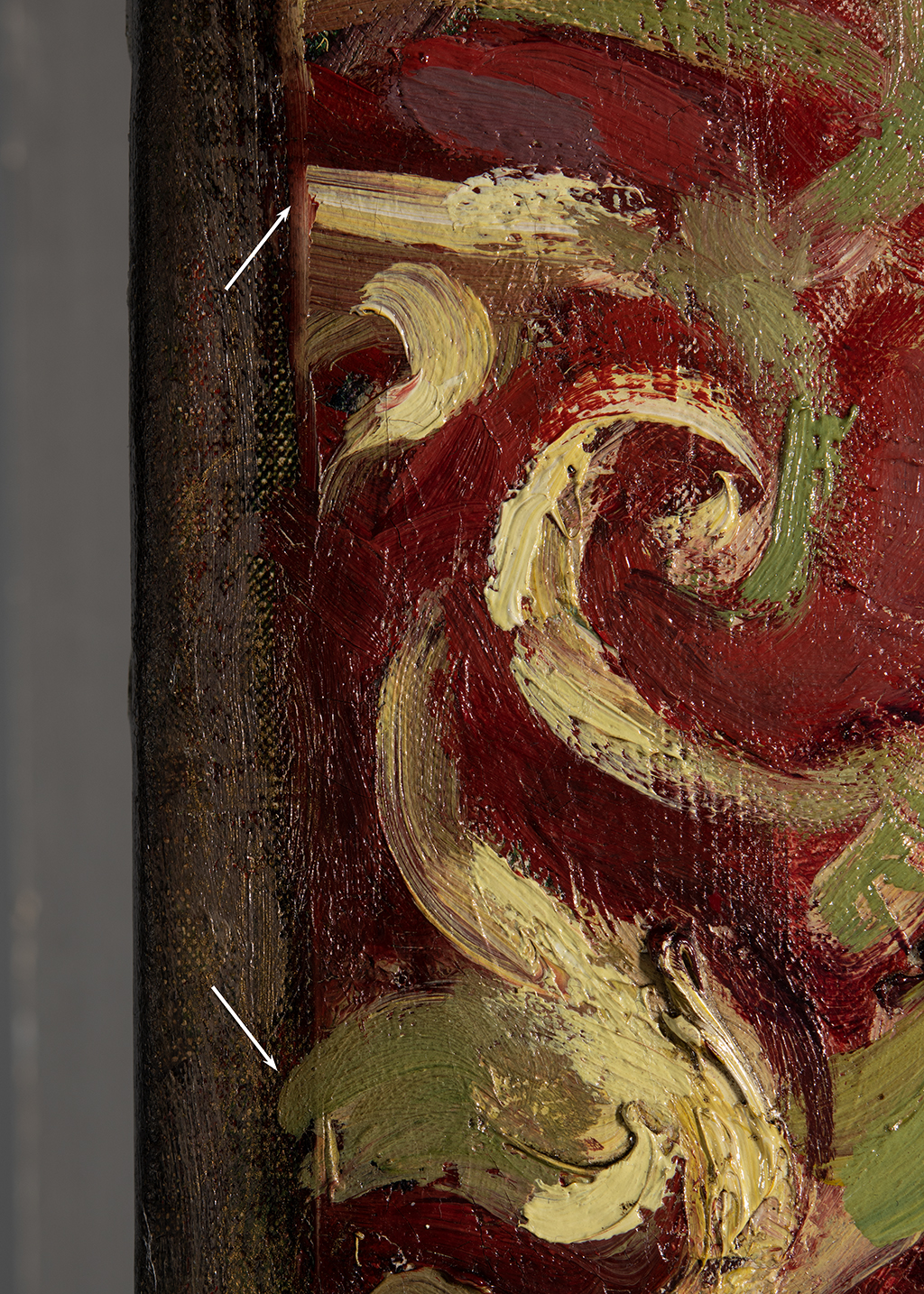
Fig. 12. Detail of the left edge of Portrait of Richard Gallo (1881). The scraped band of paint and resulting ridge of paint are evident (upper arrow). Following the format changes to the canvas, Caillebotte continued painting, as later additions of dull yellow-green paint, applied wet-over-dry, pass over the ridge of paint (lower arrow).
Original frame: 45 x 52 7/8 x 1 1/4 in. (114.3 x 134.3 x 3.2 cm) 38 1/4 x 45 7/8 in. (97.2 x 116.5 cm)
Signature
Signed and dated lower right: G Caillebotte, 1881
Credit Line
The Nelson-Atkins Museum of Art. Purchase: William Rockhill Nelson Trust through the generosity of Mrs. George C. Reuland through the W. J. Brace Charitable Trust and through exchange of the bequests of Mr. and Mrs. William James Brace and Frances Logan; the gifts of Harold Woodbury Parsons, Mr. and Mrs. Henry W. Bloch, and the Laura Nelson Kirkwood Residuary Trust; and other Trust properties, 89-35
Megan Seiler, “Gustave Caillebotte, Portrait of Richard Gallo, 1881,” catalogue entry in French Paintings and Pastels, 1600–1945: The Collections of The Nelson-Atkins Museum of Art, ed. Aimee Marcereau DeGalan (Kansas City: The Nelson-Atkins Museum of Art, 2024), https://doi.org/10.37764/78973.5.610.5407.
MLA:
Seiler, Megan. “Gustave Caillebotte, Portrait of Richard Gallo, 1881,” catalogue entry. French Paintings and Pastels, 1600–1945: The Collections of The Nelson-Atkins Museum of Art, edited by Aimee Marcereau DeGalan, Nelson-Atkins Museum of Art, 2024. doi: 10.37764/78973.5.610.5407.
Gustave Caillebotte’s Portrait of Richard Gallo is a puzzling
composition. The subject sits slightly left of center, arms crossed, on
a boldly patterned sofa that appears to defy perspectival logic. The way
in which Caillebotte curves the left end of the sofa—with a bold black
line where the backrest and bottom cushion meet—is subtle yet
unsettling. The right end of the backrest recedes in size, creating a
distortion between the viewer’s world and the one Caillebotte creates.
This kind of ocular manipulation appears frequently in Caillebotte’s
work, but the decorative elements of this painting set it apart. The
rich gold, green, and red pattern of the sofa alongside the highly
pigmented pillow, created with more thickly applied paint, compete with the figure
for the viewer’s attention and almost overshadow him. Caillebotte
challenges traditional concepts of portraiture by utilizing such
decorative elements in innovative and psychologically impactful ways.
In Portrait of Richard Gallo, Caillebotte
carefully selected every component of the composition, creating a
complex painting that explores modern life in late nineteenth-century
Paris.
Contemporary art critic and novelist Edmund Duranty argued in his essay
“La Nouvelle Peinture,” published in 1876, that the interior space of a
portrait should reflect a sitter’s identity:
Fig. 1. Gustave Caillebotte, Nude on a Couch, ca. 1880, oil on canvas, 51 x 77 in. (129.5 x 195.6 cm), Minneapolis Institute of Arts. The John R. Van Derlip Fund, 67.67
fullscreen
Fig. 1. Gustave Caillebotte, Nude on a Couch, ca. 1880, oil on canvas, 51 x 77 in. (129.5 x 195.6 cm), Minneapolis Institute of Arts. The John R. Van Derlip Fund, 67.67
Previously, scholars thought that the sofa in Portrait of Richard
Gallo was unique in Caillebotte’s œuvre8Elizabeth Benjamin, “All the Discomforts of Home,” in Gustave Caillebotte: The Painter’s Eye, exh. cat. (Chicago: University of Chicago Press, 2015), 94, 261n41.; however, this author believes it to
be the same divan used in Nude on a Couch. At the bottom
left foreground in Portrait of Richard Gallo, Caillebotte shows where
the back of the sofa meets the base. Rather than a separate pillow,
there appears to be a crumpled fold where the two parts come together
near Gallo’s legs. It is not a clean partition typically found on a
manufactured piece of furniture; instead, it appears that Caillebotte
laid a piece of fabric over the divan. The sofa lacks any clear vertical
separation between the cushions resting behind Gallo, which are
typically found on this type of sofa. The divan often pictured in
Caillebotte’s compositions had three back pillows, a common number with
this style, which would mean at least two creases would be visible on
the back of the sofa, but here it appears as one continuous cushion.
Although it is possible Gallo blocks a crease with his body, it is more
likely that Caillebotte is not using a new piece of furniture but
refashioning one he already owned. This also may explain what looks like
an armrest at far right, which could be excess fabric held up by the pillow,
although this is unclear.
A deliberate choice by Caillebotte either way, the green and gold material
alongside the pillow adds to the visual noise and unsettling composition
for the viewer. A photograph from inside the home of
Caillebotte’s brother Martial, once the shared home of the two brothers
(Fig. 2), features curtains whose patterns and stripes bear a
resemblance to the divan in Portrait of Richard Gallo.9Although this photograph dates from 1895–96, after Gustave Caillebotte’s death, it documents the shared apartment they moved into in 1878–79.
Unfortunately, Caillebotte’s brother and the piano obstruct the view of
the bottom of the curtain. It is therefore impossible to know if the
curtains themselves had fringe, which would align with the style of the
time, or if Caillebotte might have added a painted fringe as a visual element to
guide the linear perspective and ground the sofa within the composition.
Fig. 2. Martial Caillebotte, Martial Caillebotte at Home, 9 rue Scribe (Petit Salon), gelatin silver print, 1895–96, private collection
fullscreen
Fig. 2. Martial Caillebotte, Martial Caillebotte at Home, 9 rue Scribe (Petit Salon), gelatin silver print, 1895–96, private collection
In addition to the bold fabric on the divan, Caillebotte creates more
visual noise by including two colorfully tasseled pillows: one partially
hidden behind the sitter’s back and the other placed at the far right
side of the sofa, seemingly truncating the couch. Caillebotte adds
visual weight to the pillows’ surfaces using thickly applied paint, in stark
contrast to the more refined elements like the smooth walls and black
suit worn by Gallo. The slanted position of the pillow at right almost mirrors that of
Gallo and feels out of place as it clashes with the divan’s pattern.
Just like the curtains, this pillow
also appears in a photograph of Martial Caillebotte’s home (Fig. 3). The
other pillow, positioned behind Gallo’s right arm, has a white
background with gold, pinks, blues, and purples swirling in an arabesque
pattern similar to that in the sofa’s stripes. The tassels are made up
of all the colors seen in the pattern and fall softly around the square
shape of the pillow’s body.
Fig. 3. Martial Caillebotte, Martial Caillebotte in Front of his Fireplace, 9 rue Scribe (Petit Salon), gelatin silver print, ca. 1895–96, private collection; repro. in Serge Lemoine, Dans l’intimité des frères Caillebotte: peintre et photographe, exh. cat. (Paris: Culturespaces, 2011)
fullscreen
Fig. 3. Martial Caillebotte, Martial Caillebotte in Front of his Fireplace, 9 rue Scribe (Petit Salon), gelatin silver print, ca. 1895–96, private collection; repro. in Serge Lemoine, Dans l’intimité des frères Caillebotte: peintre et photographe, exh. cat. (Paris: Culturespaces, 2011)
While one might assume the pillow was placed there for Gallo’s benefit,
it does nothing to relax him; his posture is controlled and firm. While
the sofa and pillows vie for the viewer’s attention, the luxurious
fabrics provide little comfort to Gallo. Caillebotte places him slightly
off-center, and his solid black suit disrupts the pattern. The visual
chaos constructed by contrasting decorative elements, intertwined with
the sitter’s austere attire, produces a sense of disjunction within the
canvas.
Fig. 4. Gustave Caillebotte, Portrait of Richard Gallo, 1878, oil on canvas, 31 1/2 x 25 9/16 in. (80 x 65 cm), private collection
fullscreen
Fig. 4. Gustave Caillebotte, Portrait of Richard Gallo, 1878, oil on canvas, 31 1/2 x 25 9/16 in. (80 x 65 cm), private collection
Fig. 5. Gustave Caillebotte, Portrait of Richard Gallo, 1881, in its original frame
fullscreen
Fig. 5. Gustave Caillebotte, Portrait of Richard Gallo, 1881, in its original frame
By identifying, isolating, and expanding on the decorative elements in
Portrait of Richard Gallo, an argument could be made that this
painting is not really a portrait, but rather a genregenre: Figural scenes of ordinary people engaged in the activities of everyday life.
scene, despite Caillebotte exhibiting it as Portrait de M. G. at the Seventh Impressionist
exhibition in 1882. Few, if
any, elements point directly to Gallo, except perhaps the newspaper,
which only hints at the sitter’s identity. Even then, the featured
newspaper is Le Figaro and not Gallo’s paper, Le Constitutionnel.
The painting elicits a strong sense of interior discomfort as
Caillebotte rejects Duranty’s call for the interior to reflect its
occupier. Rather than providing understanding of an individual, he
generates a snapshot of interior life in the broader sense.
Although Portrait of Richard Gallo does not mirror Duranty’s directive
to populate interiors with an array of decorative items that remind one
of the sitter’s station, Caillebotte’s own sense of interior decorating
did. Photographs show that he filled his home with artwork and other
possessions that reflected his interests. One scholar suggests that
Portrait of Richard Gallo, with its minimal décor, is an example of
Caillebotte “thumbing his nose” at the decorative trends of the time,
but this theory neglects Caillebotte’s own maximalist decorative taste
and, in a way, dismisses the artist’s clever and deliberate use of the
ornamental in his œuvre.15Elizabeth Benjamin, “The Modern Interior Stripped Bare: Gustave Caillebotte’s Interieur Demeuble,” in Anca I. Lasc, ed., Visualizing the Nineteenth-Century Home: Modern Art and the Decorative Impulse (London: Routledge, 2016), 131. Rather than seeing Caillebotte’s sparse
room as a commentary on decorating taste, it seems more prudent to
interpret what was included and how those elements impact the viewer.
Marie Berhaut, Gustave Caillebotte: Catalogue raisonné des
peintures et pastels (Paris: Wildenstein, 1994), 113, 124, 127, 144, 231.
Caillebotte painted him in seven paintings: Portrait of
Richard Gallo (1878; private collection, Paris), Self Portrait at
the Easel (1879; private collection, Paris), The Bezique Game
(1880; private collection, Paris), Interior, Woman at the Window
(1880; private collection, Paris), Interior: Woman Reading (1880;
private collection, Paris), Portrait of Richard Gallo (1881;
Nelson-Atkins Museum of Art), and Richard Gallo Walking His Dog
Dick (1884; private collection, Paris).
Roldophe Rapetti, “Portrait of M. Richard Gallo, Also Known as
Richard Gallo and His Dog Dick, at Petit Gennevilliers,” in Anne
Distel et al., Gustave Caillebotte: Urban Impressionist, exh. cat.
(Chicago: Art Institute of Chicago, 1995), 280. Rapetti cites the
Gallo descendants as providing this information.
Berhaut, Gustave Caillebotte, 144.
Edmond Duranty, La Nouvelle Peinture: Á propos du Groupe d’Artistes
qui expose dans les Galeries Durand-Ruel (Paris: E. Dentu, 1876), 24, 27–28; English translation
from “The New Painting,” in The New Painting: Impressionism
1874–1886, ed. Charles S. Moffett, exh. cat. (San Francisco: Fine
Arts Museum of San Francisco, 1986), 43–44. For more on Duranty and
his ideas of the interior as a reflection of the man, see Pamela J.
Warner, Interior Portraiture and Masculine Identity in France,
1789–1914 (Surrey: Ashgate, 2011), esp. 160.
I use this term to refer to how many items are in the painting;
it is not to be confused with the design style of “minimalism,” which was
not developed until post-World War II.
Although the Oxford English Dictionary defines sofa as “a long, stuffed
seat with a back and ends or end,” and divan as “a low bed or couch with
no back or ends,” period descriptions classify a divan as a type of sofa,
and I am using the terms interchangeably here. Berhaut, Gustave Caillebotte, 124, 127, 144, 150. The paintings
Nude on a Couch, Bezique Game, Self-Portrait, and Woman
Reading include this divan.
Elizabeth Benjamin, “The Unhomely Home: Caillebotte’s Interior
Paris” (PhD diss., Northwestern University, 2016), 106–7.
Elizabeth Benjamin, “All the Discomforts of Home,” in Gustave
Caillebotte: The Painter’s Eye, exh. cat. (Chicago: University of
Chicago Press, 2015), 94, 261n41.
Although this photograph dates from 1895–96, after Gustave
Caillebotte’s death, it documents the shared apartment they moved
into in 1878–79.
Debra Mancoff, Fashion in Impressionist Paris (London: Merrell,
2012), 50. The style of suit and coat appear repeatedly in
Caillebotte’s paintings.
Michael Zakim, “Customizing the Industrial Revolution: The
Reinvention of Tailoring in the Nineteenth Century,” Winterthur
Portfolio 33, no. 1 (Spring 1998): 42.
D. G. Karraker, Looking at European Frames: A Guide to Terms,
Styles, and Techniques (Los Angeles: J. Paul Getty Museum, 2014),
5–6. Edgar Degas (1834–1917) also created his own frames; for example, see Degas’s Junior Milliners, Fig. 10, in this catalogue.
See conservation record of treatment by Kate Garland, June 7,
2016, NAMA curatorial files.
Hollis Clayson makes a similar statement about two of
Caillebotte’s other images in her essay, “Threshold Space: Parisian
Modernism Betwixt and Between (1869 to 1891),” in Janet McLean, ed.,
Impressionist Interiors (Dublin: Colorman, 2009), 20–22.
Elizabeth Benjamin, “The Modern Interior Stripped Bare: Gustave
Caillebotte’s Interieur Demeuble,” in Anca I. Lasc, ed.,
Visualizing the Nineteenth-Century Home: Modern Art and the
Decorative Impulse (London: Routledge, 2016), 131.
Catalogue de la 7me Exposition des Artistes Indépendants,
exh. cat. (Paris: Morris père et fils, 1882), unpaginated [repr.
in, Theodore Reff, ed., Modern Art in Paris: Two-Hundred Catalogues
of the Major Exhibitions Reproduced in Facsimile in Forty-Seven
Volumes, vol. 23, Impressionist Group Exhibitions (New York:
Garland, 1981), unpaginated], as Portrait de M. G.
Berhaut, Gustave Caillebotte, 144.
Berhaut (Gustave Caillebotte, 138) names a Maurice Rolland as
the original inheritor of the painting, but my research shows a
marriage certificate between Paul Antione Marius Rolland and Marthe
Grandguillot on August 8, 1898, and a death announcement on August
11, 1965, for Marthe Grandguillot, where Maurice Rolland is listed
first, indicating that Maurice Rolland was her son. See
NAMA curatorial files provenance records for both the
marriage certificate and death announcement.
Henri Malcor, “Richard Gallo,” unpublished manuscript, May 20,
1988, copy in the NAMA curatorial files.
See Acquisition Proposal, December 15, 1989, and Board Meeting
Minutes, Fall 1989, the NAMA curatorial files.
See Acquisition Proposal, December 15, 1989, and Board Meeting
Minutes, Fall 1989, the NAMA curatorial files, under “Works
in Other U.S. Collections.”
Mary Schafer, “Gustave Caillebotte, Portrait of Richard Gallo, 1881,” technical entry in French Paintings and Pastels, 1600–1945: The Collections of the Nelson-Atkins Museum of Art, ed. Aimee Marcereau DeGalan (Kansas City: The Nelson-Atkins Museum of Art, 2026), https://doi.org/10.37764/78973.5.610.2088.
MLA:
Schafer, Mary. “Gustave Caillebotte, Portrait of Richard Gallo, 1881,” technical entry. French Paintings and Pastels, 1600–1945: The Collections of The Nelson-Atkins Museum of Art, edited by Aimee Marcereau DeGalan, Nelson-Atkins Museum of Art, 2026. doi: 10.37764/78973.5.610.2088.
The overlap of paint at the edges of forms provides some indication of
Caillebotte’s focus as he worked across the canvas, executing the sitter
first, before moving to the sofa and wall. Gallo’s face was carefully
modeled using a variety of warm and cool paint colors—pink, bright
peach, yellow, lavender, and gray—applied with round and flat brushes.
Unlike other areas of the portrait, soft blending of the brush
integrated paint strokes between the face, beard, and hairline.
The painting was well developed when Caillebotte decided to reformat the
portrait, cropping the canvas and shifting paint from the picture planepicture plane: The two-dimensional surface where the artist applies paint.
to what is now the left, top, and bottom tacking marginstacking margins: The outer edges of canvas that wrap around and are attached to the stretcher or strainer with tacks or staples. See also tacking edge. (Fig. 11a-d).
The top and bottom edges were cropped by 25.4 and 6.4 mm, respectively.
The right tacking edge remained unchanged with a single set of tacks,
but paint on the entire left tacking margin confirms that this edge was
reduced by an unknown amount. Caillebotte marked the location of the new
left edge by scraping the wet paint, forming a smooth vertical band and
thick ridge of paint that remains evident on the current picture plane
(Fig. 12). Caillebotte moved inward as he scraped down the canvas,
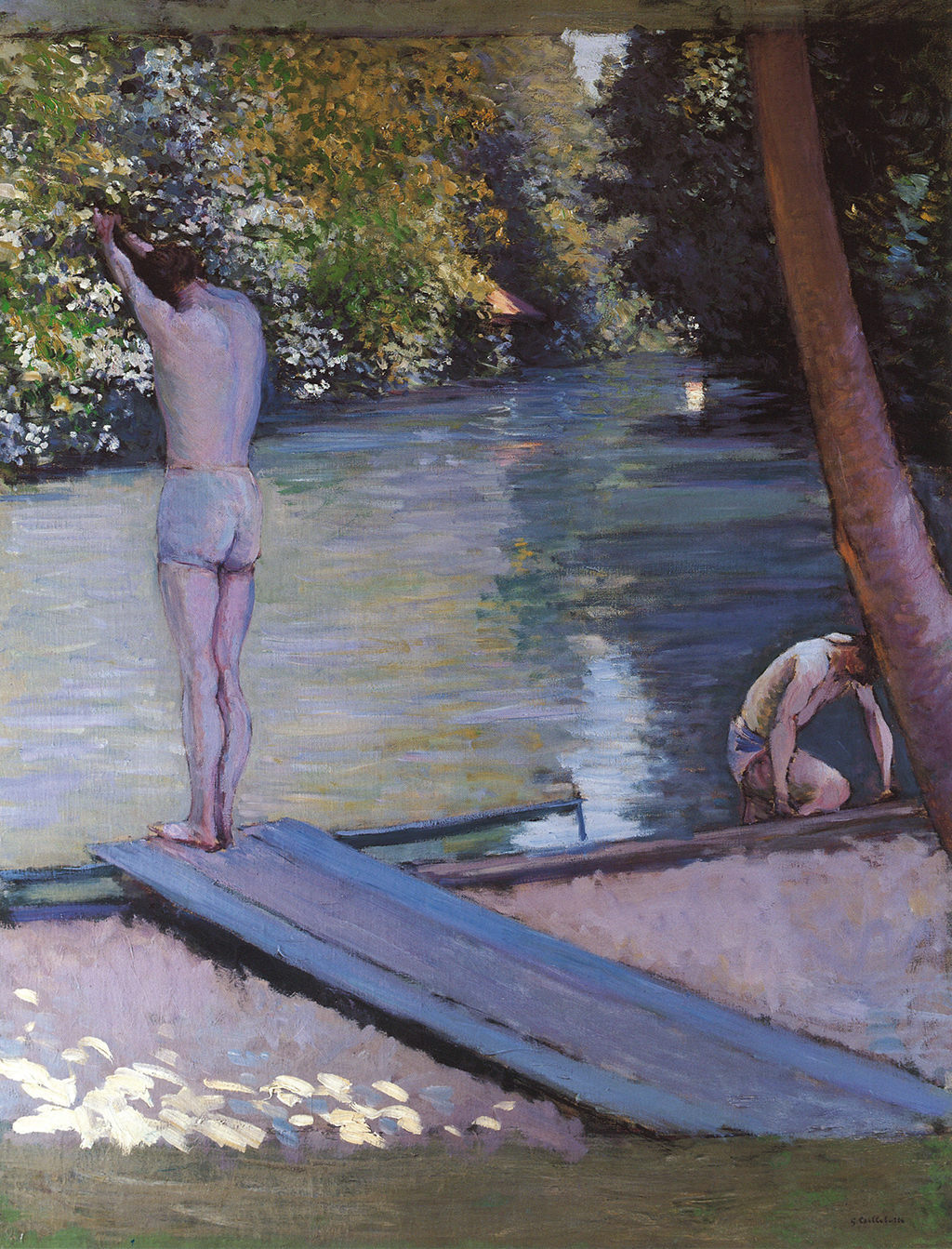
widening this band to 1.6 cm at the bottom edge. He may have used a
similar method to reformat Bather Preparing to Dive, Banks of the
Yerres (1878; private collection), as a slightly angled section of
scraped paint is present across the top edge of the picture plane,
interrupting the vertical trees of the composition (Fig. 13). Likewise
in the execution of Paris Street; Rainy Day (1877; Art Institute of
Chicago), Caillebotte made significant revisions, which included
scraping of paint and relocating the right edge of the painting at least
twice.4Keegan, “Cat. 2 Paris Street; Rainy Day, 1877,” para 66 and 70, https://publications.artic.edu/caillebotte/reader/paintingsanddrawings/section/574/p-574-69.
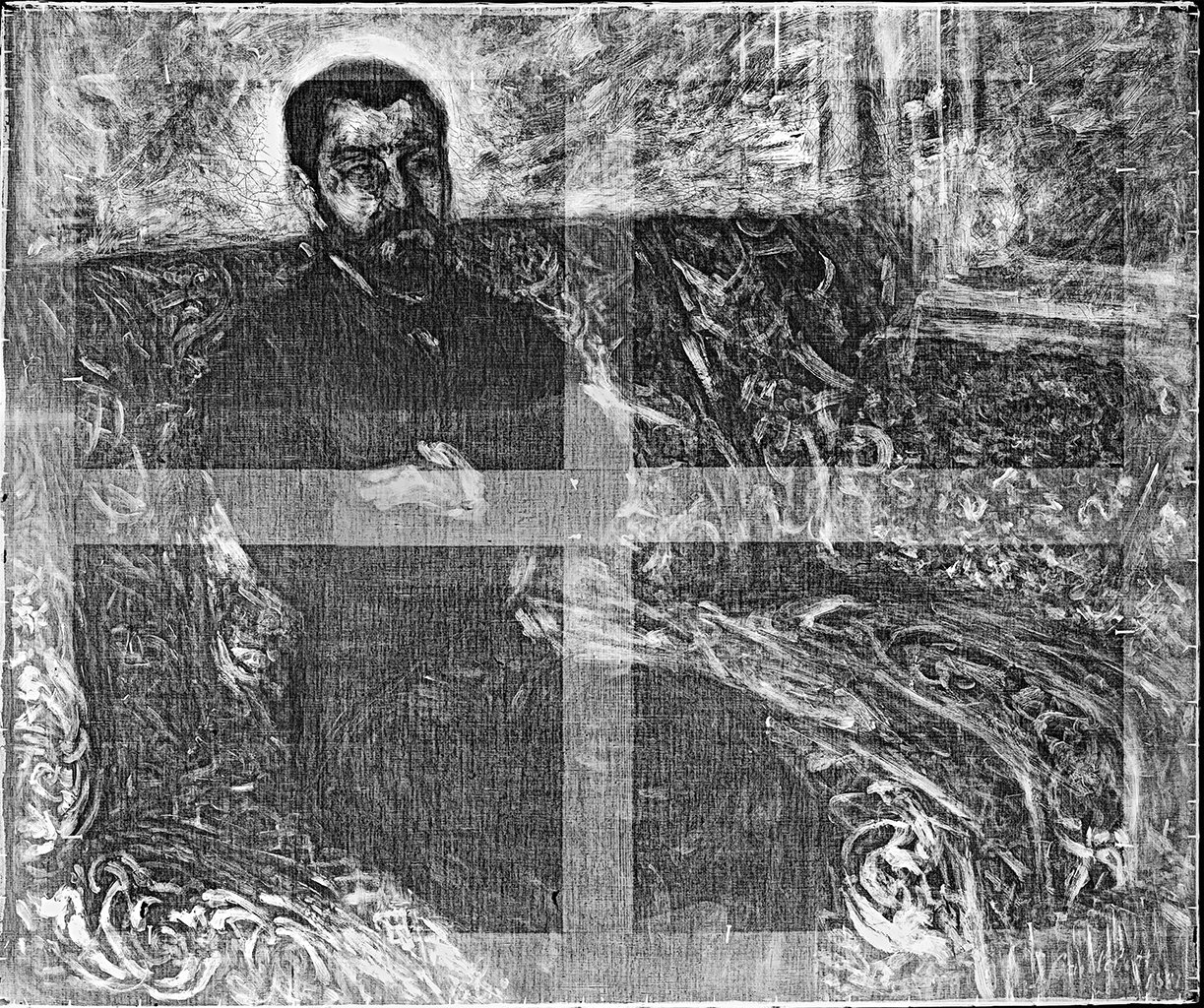
Fig. 14. X-radiograph of Portrait of Richard Gallo (1881)
fullscreen
Fig. 14. X-radiograph of Portrait of Richard Gallo (1881)
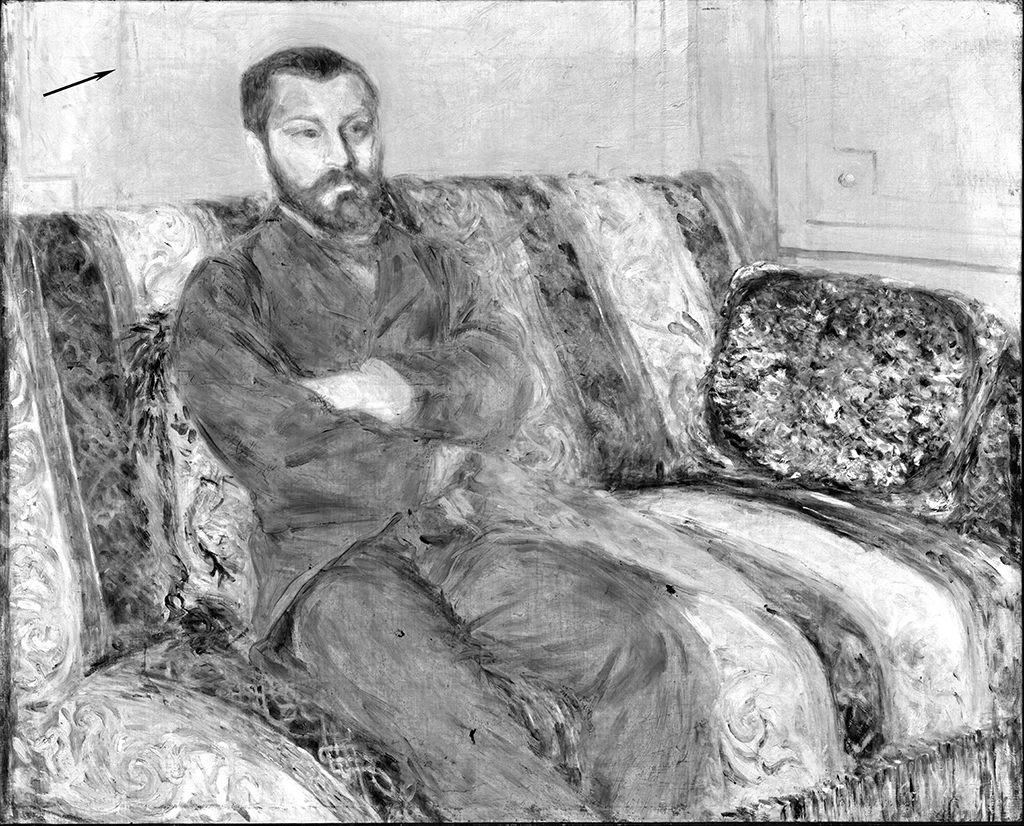
In addition to the reformatting of the portrait, underlying magenta
paint and a vertical stroke of black paint are visible beneath the pale
blue of the upper left wall, perhaps related to a drape or some other
vertical element that was eliminated from the composition (Figs. 15 and
16). Other minor adjustments were made to the sitter’s head, the sofa, and
the right pillow.
The canvas stencil is located on the upper left quadrant, oriented
ninety degrees counterclockwise from the painted portrait: “60,
B[oul.D Malesherbe]s Paris / DUBUS / [CO]ULEURS FINES & TOILES
à PEINDR[E] / [REN]TOILAGE & RESTAURATION / DE TABLEAUX.”
Documentary evidence shows that Dubus supplied canvas, paint
materials, and restoration services from this address between 1877
and 1897. “Dubus,” Guide Labreuche: Le guide des fournisseurs de
matériel pour artistes, France, XVIIIe–XXe siècles, 2014,
https://www.guide-labreuche.com/collection/commerces/dubus. For
additional examples, see Sandra Webber, “Colormen and their Marks: A
Survey of Nineteenth-Century European Paintings in the Clark Art
Institute,” Art Conservator 9, no. 2 (Fall 2014): 19–22.
The underlying black material visible with magnification aligns
with charcoal underdrawings documented in other works by
Caillebotte: Boat Moored on the Seine at Argenteuil (ca. 1886–91;
Nelson-Atkins Museum of Art) and Calf’s Head and Ox Tongue (ca.
1882; Art Institute of Chicago). See Diana M. Jaskierny, “Gustave
Caillebotte, Boat Moored on the Seine at Argenteuil, ca.
1886‒1891,” technical entry in this catalogue,
https://doi.org/10.37764/78973.5.612.2088,
and Kelly Keegan and Kirk Vuillemot, “Cat. 3 Calf’s Head and Ox
Tongue, c. 1882: Technical Report,” in Caillebotte Paintings and
Drawings at the Art Institute of Chicago (Chicago: Art Institute
of Chicago, 2015), para 27–28,
https://publications.artic.edu/caillebotte/reader/paintingsanddrawings/section/467/p-467-28.
The 2024 treatment involved removing the canvas from the stretcher
to perform an edge-lining. At this time, a single set of holes was
noted on the outer edges of the current stretcher. Mary Schafer,
treatment report, April 29, 2024, NAMA conservation file, 89-35.
David Bomford, Jo Kirby, John Leighton, and Ashok Roy, Art in the
Making: Impressionism (London: Yale University Press, 1991), 46.
Iris Schaefer, Caroline von Saint-George, and Katja Lewerentz,
Painting Light: The Hidden Techniques of the Impressionists
(Milan: Skira, 2008), 90.
See digital x-radiographs, no. 595, NAMA conservation file, 89-35.
Anthea Callen, The Art of Impressionism: Painting Technique and
the Making of Modernity (New Haven: Yale University Press, 2000), 197.
John Twilley, “Original Finishes on the Frame from Gustave
Caillebotte’s, Portrait of Richard Gallo,” May 9, 2012,
unpublished report, NAMA conservation file, 89-35.
An 1894 photograph of Pont de l’Europe (1876; Association des
Amis du Petit Palais, Geneva) shows the painting unframed with a
faint line of discolored varnish. This feature indicates that the
painting was varnished while framed, and Caillebotte was amenable to
varnishing during this period. See Claude P. J. Ghez, Caroline von
Saint-George, Iris Schafer, and Theresa Neuhoff, “Appendix:
Historical Photograph and Restoration of the Work,” in Gustave
Caillebotte: An Impressionist and Photography, ed. Karin Sagner and
Max Hollein, exh. cat. (Munich: Schirn Kunsthalle
Frankfurt/Hirmer, 2012), 100–04; cited in Keegan, “Cat. 2 Paris
Street; Rainy Day, 1877,” para 96, figure 9B,
https://publications.artic.edu/caillebotte/reader/paintingsanddrawings/section/574/p-574-96.
Megan Seiler, “Gustave Caillebotte, Portrait of Richard Gallo, 1881,” documentation in French Paintings and Pastels, 1600–1945: The Collections of The Nelson-Atkins Museum of Art, ed. Aimee Marcereau DeGalan (Kansas City: The Nelson-Atkins Museum of Art, 2024), https://doi.org/10.37764/78973.5.610.4033.
MLA:
Seiler, Megan. “Gustave Caillebotte, Portrait of Richard Gallo, 1881,” documentation. French Paintings and Pastels, 1600–1945: The Collections of The Nelson-Atkins Museum of Art, edited by Aimee Marcereau DeGalan, Nelson-Atkins Museum of Art, 2024. doi: 10.37764/78973.5.610.4033.
Megan Seiler, “Gustave Caillebotte, Portrait of Richard Gallo, 1881,” documentation in French Paintings and Pastels, 1600–1945: The Collections of The Nelson-Atkins Museum of Art, ed. Aimee Marcereau DeGalan (Kansas City: The Nelson-Atkins Museum of Art, 2024), https://doi.org/10.37764/78973.5.610.4033.
MLA:
Seiler, Megan. “Gustave Caillebotte, Portrait of Richard Gallo, 1881,” documentation. French Paintings and Pastels, 1600–1945: The Collections of The Nelson-Atkins Museum of Art, edited by Aimee Marcereau DeGalan, Nelson-Atkins Museum of Art, 2024. doi: 10.37764/78973.5.610.4033.
Given by the artist to the sitter, Richard Gallo (1849‒1936), Paris,
probably 1881‒1907 [1];
His gift to his niece, Marthe Rolland (née Grandguillot, 1877‒1965),
Paris, 1907‒1965 [2];
By descent to her son, Maurice Rolland (1904‒1988), Paris,
1965‒1988;
By inheritance to his sister, Jeanne Janette Malcor (née Rolland,
1901‒1995), Paris, 1988 [3];
Purchased from Malcor by Paul (1950‒2013) and Ellen Melas Kyriazi
Josefowitz, London and Lausanne, August 25‒November 26, 1988 [4];
Purchased from Paul and Ellen Josefowitz by the dealer David Ramus,
Atlanta and New York, on joint account with Hirschl and Adler, New
York, stock no. 6852/2, November 26, 1988‒1989 [5];
Purchased from David Ramus and Hirschl and Adler by The Nelson-Atkins
Museum of Art, Kansas City, MO, 1989.
Notes
[1] In a statement on the painting’s history, dated May 20, 1988,
Richard Gallo’s grand-nephew-in-law, Henri Malcor, wrote that Gallo
collected a number of paintings from Impressionist artists, to whom he
was introduced by his friend Gustave Caillebotte. Ultimately, Gallo only
kept the five paintings Caillebotte gave to him, three of which
represented Gallo. See “Richard Gallo” by Henri Malcor, May 20, 1988,
copy in NAMA curatorial files.
[2] The Caillebotte catalogue raisonné indicates that the painting passed
to Gallo’s nephew, Maurice Rolland, at the time of Gallo’s death in 1936. However, Maurice Rolland was actually Gallo’s grand-nephew, and
according to Henri Malcor’s statement on Richard Gallo (see note 1),
Gallo gave the painting to his niece Marthe in 1907, when Gallo moved to
Alexandria, Egypt. The painting then passed to Marthe’s son Maurice
Rolland. See Marie Berhaut, Gustave Caillebotte: catalogue raisonné des
peintures et pastels (Paris: Wildenstein Institute, 1994), no. 182, p.
144, and “Richard Gallo” by Henri Malcor, May 20, 1988, copy in NAMA
curatorial files.
[3] Carole Bonzon-Vachette, Jeanne Malcor’s great-granddaughter,
confirmed the family’s sale of the painting following Maurice Rolland’s
death in correspondence with Megan Seiler, NAMA, May 27, 2020, NAMA
curatorial files.
[4] According to Ellen Josefowitz, in an email to MacKenzie Mallon,
NAMA, June 8, 2020, NAMA curatorial files.
[5] See email from Gregory Hedberg, Hirschl and Adler, New York, to
Nicole Myers, NAMA, May 11, 2015, and email from Ellen Josefowitz to
MacKenzie Mallon, NAMA, June 8, 2020, NAMA curatorial files.
Megan Seiler, “Gustave Caillebotte, Portrait of Richard Gallo, 1881,” documentation in French Paintings and Pastels, 1600–1945: The Collections of The Nelson-Atkins Museum of Art, ed. Aimee Marcereau DeGalan (Kansas City: The Nelson-Atkins Museum of Art, 2024), https://doi.org/10.37764/78973.5.610.4033.
MLA:
Seiler, Megan. “Gustave Caillebotte, Portrait of Richard Gallo, 1881,” catalogue entry. French Paintings and Pastels, 1600–1945: The Collections of The Nelson-Atkins Museum of Art, edited by Aimee Marcereau DeGalan, Nelson-Atkins Museum of Art, 2024. doi: 10.37764/78973.5.610.4033.
Gustave Caillebotte, Portrait of Richard Gallo, 1878, oil on canvas,
31 1/2 x 25 3/5 in. (80 x 65 cm), private collection, France.
Gustave Caillebotte, Self Portrait in Front of the Easel, 1879, oil on
canvas, 35 3/7 x 45 2/7in. (90 x 115 cm), private collection, Paris.
Gustave Caillebotte, Game of Bezique, 1880, oil on canvas, 47 5/8 x 63
2/5 in. (121 x 161 cm), private collection, Paris.
Gustave Caillebotte, Interior, Reading Woman, 1880, oil on canvas, 25
3/5 x 31 1/2 in. (65 x 80 cm), private collection, Paris.
Gustave Caillebotte, Interior, Woman at the Window, 1880, oil on
canvas, 45 2/3 x 35 in. (116 x 89 cm), private collection, Paris.
Gustave Caillebotte, Richard Gallo and his Dog at Petit Gennevilliers,
1884, oil on canvas, 35 x 45 2/3 in. (89 x 116 cm), private collection,
Paris.
Gustave Caillebotte, Paul the Dog, ca. 1886, oil on canvas, 25 3/4 x 21 3/4 in. (65.4 x 54.2 cm), sold at Masterpieces from the Collection of Sam Josefowitz: A Lifetime of Discovery and Scholarship, Christie’s, London, lot 3, as Le chien “Paul”.
Exhibitions
Citation
Chicago:
Megan Seiler, “Gustave Caillebotte, Portrait of Richard Gallo, 1881,” documentation in French Paintings and Pastels, 1600–1945: The Collections of The Nelson-Atkins Museum of Art, ed. Aimee Marcereau DeGalan (Kansas City: The Nelson-Atkins Museum of Art, 2024), https://doi.org/10.37764/78973.5.610.4033.
MLA:
Seiler, Megan. “Gustave Caillebotte, Portrait of Richard Gallo, 1881,” documentation. French Paintings and Pastels, 1600–1945: The Collections of The Nelson-Atkins Museum of Art, edited by Aimee Marcereau DeGalan, Nelson-Atkins Museum of Art, 2024. doi: 10.37764/78973.5.610.4033.
7me Exposition des Artistes Indépendants [7th Impressionist
Exhibition], 251 rue Saint-Honoré, Paris, March 1‒31, 1882, no. 5,
as Portrait de M. G.
Exposition Rétrospective d’Œuvres de G. Caillebotte, Galerie
Durand-Ruel, Paris, June 4‒16, 1894, no. 81, as Portrait de M. R.
G.
Gustave Caillebotte: The Unknown Impressionist, Royal Academy of Arts,
London, March 28‒June 23, 1996, no. 26, as Portrait of Richard
Gallo.
Gustave Caillebotte: The Painter’s Eye, The National Gallery of Art,
Washington, DC, June 28‒October 4, 2015; Kimbell Art Museum, Fort
Worth, TX, November 8, 2015‒February 14, 2016, no. 25, as Portrait
of Richard Gallo.
Megan Seiler, “Gustave Caillebotte, Portrait of Richard Gallo, 1881,” documentation in French Paintings and Pastels, 1600–1945: The Collections of The Nelson-Atkins Museum of Art, ed. Aimee Marcereau DeGalan (Kansas City: The Nelson-Atkins Museum of Art, 2024), https://doi.org/10.37764/78973.5.610.4033.
MLA:
Seiler, Megan. “Gustave Caillebotte, Portrait of Richard Gallo, 1881,” documentation. French Paintings and Pastels, 1600–1945: The Collections of The Nelson-Atkins Museum of Art, edited by Aimee Marcereau DeGalan, Nelson-Atkins Museum of Art, 2024. doi: 10.37764/78973.5.610.4033.
Catalogue de la 7me Exposition des Artistes Indépendants, exh. cat.
(Paris: Morris père et fils, 1882), unpaginated [repr. in, Theodore
Reff, ed., Modern Art in Paris: Two-Hundred Catalogues of the Major
Exhibitions Reproduced in Facsimile in Forty-Seven Volumes, vol. 23,
Impressionist Group Exhibitions (New York: Garland, 1981),
unpaginated], as Portrait de M. G.
Gaston d’Alq., “Art et bibelots: L’Exposition des Peintres
indépendants,” La Liberté (March 2, 1882): 3.
Possibly Fichtre, “L’Actualité: L’Exposition des peintres indépendants,”
Le Réveil (March 2, 1882): 1.
Possibly La Fare, “Exposition des Impressionnistes,” Le Gaulois 15,
no. 901 (March 2, 1882): 2.
Jacques Durand, “Échos du jour: Paris,” La Presse 47, no. 61 (March
3, 1882): 1.
Charles Flor, “Deux Expositions,” Le National 14, no. 4735 (March 3,
1882): 2.
Possibly A. Hustin, “L’Exposition des Peintres Indépendants,”
L’Estafette (March 3, 1882): 3.
Possibly A. Hustin, “L’Exposition des impressionnistes,” Moniteur des
Arts 25, no. 1402 (March 10, 1882): 1.
Henri Rivière, “Aux indépendants,” Le chat noir (April 8, 1882): 4.
Exposition Rétrospective d’Œuvres de G. Caillebotte, exh. cat. (Paris:
Galeries Durand-Ruel, 1894), 6, as Portrait de M. R. G.
Marie Berhaut, Gustave Caillebotte, 1848‒1894: Catalogue des
peintures et pastels (Paris: Wildenstein, 1951), no. 127, unpaginated,
as Portrait de M. G. . . .
Marie Berhaut, Caillebotte, Sa Vie et Son Œuvre: Catalogue Raisonné des
Peintures et Pastels (Paris: Fondation Wildenstein, 1978), no. 167, pp.
110, 125, 138, 179, 249, (repro.), as Portrait de Richard Gallo.
Charles S. Moffett, ed., The New Painting, Impressionism, 1874–1886,
exh. cat. (Geneva, Switzerland: Richard Burton SA, Publishers, 1986),
379, 394, as Portrait de M. G.
Kirk Varnedoe, Gustave Caillebotte (1987; repr., New Haven, CT: Yale
University Press, 2000), 196.
Victor Volland, “Traveling Impressionist Exhibit,” St. Louis
Post-Dispatch (May 21, 1989): 2D.
Janet Majure, “How Art Galleries Stay Competitive: Museums’ Practice of
Buying, Selling Under Intense Scrutiny in Today’s Market,” Kansas City
Star 110, no. 240 (June 10, 1990): I10.
Laura Caruso, “Caillebotte Joins Ranks at Nelson: Museum Pays its
Highest Price Ever for Portrait by Impressionist,” Kansas City Star
111, no. 6 (September 23, 1990): J[1], J4, (repro.), as Portrait of
M. Richard Gallo.
“New at the Nelson: Impressionist Masterpiece,” Newsletter (The
Nelson-Atkins Museum of Art) (October 1990): 2‒3, (repro.), as
Portrait of Richard Gallo.
Roger Ward, “Selected Acquisitions of European and American Paintings at
the Nelson-Atkins Museum of Art, Kansas City, 1986‒1990,”
Burlington Magazine, 133, no. 1055 (February 1991): 153, 156,
(repro.).
Alice Thorson, “The Nelson Celebrates its 60th: Museum built its
reputation, collection virtually ‘from scratch’,” Kansas City Star
113, no. 304 (July 18, 1993): J5.
Roger Ward and Patricia Fidler, eds., The Nelson-Atkins Museum of Art:
Handbook of the Collection (New York: Hudson Hills Press, 1993), 45,
130, 210, (repro.), as Portrait of Richard Gallo.
Marie Berhaut, Gustave Caillebotte: catalogue raisonné des peintures et
pastels (Paris: Wildenstein Institute, 1994), no. 182, p. 144, (repro.)
as Portrait de Richard Gallo.
Gustave Caillebotte: 1848‒1894, exh. cat. (Paris: Éditions de la
Réunion des musées nationaux, 1994), 220‒21, 237, 240, 242, 292,
358, 373, 375, (repro.), as Portrait de Richard Gallo [repr.,
Gustave Caillebotte: The Unknown Impressionist, exh. cat. (London:
Royal Academy of Arts, 1996), 105‒06, 123, 128‒29, 137, 212,
(repro.), as Portrait of Richard Gallo].
Ruth Berson, The New Painting: Impressionism 1874–1886;
Documentation (San Francisco: Fine Arts Museums of San Francisco,
1996), no. VII-5, pp. 1:377, 379, 386‒87, 389, 395, 398, 401, 409;
2:201, 215, (repro.), as Portrait de M. G.
Gustave Caillebotte, 1848–1894: Dessins, Pastels et Peintures,
exh. cat. (Paris: Brame et Lorenceau, 1998), 19, as Portrait de M. G.
Patrick Shaw Cable, “Questions of Work, Class, Gender, and Style in the
Art and Life of Gustave Caillebotte” (Ph.D. diss., Case Western Reserve
University, 2000), vii, 48, 179‒80, 180n312, 259, (repro.), as
Portrait of M. G.
Impressionist and Modern Art Evening Sale (London: Christie’s,
February 6, 2001), 34, as Portrait de Richard Gallo.
Alice Thorson, “Nelson curator of European art heading to Florida,”
Kansas City Star (August 19, 2001): I4.
Impressionist and Modern Art Day Sale (London: Christie’s, February 5,
2002), 34.
Caillebotte: Au cœur de l’impressionnisme, exh. cat. (Lausanne:
Bibliothèque des Arts, 2005), 177, as Portrait de M. G.
Alice Thorson, “Nelson Makeover: Euro Edition,” Kansas City Star 126,
no. 281 (June 25, 2006): G7, as Portrait of Richard Gallo.
Anne-Birgitte Fonsmark, Dorothee Hansen, and Gry Hedin, Gustave
Caillebotte, exh. cat. (Ostfildern, Germany: Hatje Cantz, 2008), 87n6.
Deborah Emont Scott, ed., The Nelson-Atkins Museum of Art: A Handbook
of the Collection, 7th ed. (Kansas City, MO: Nelson-Atkins Museum of
Art, 2008), 35, 122, (repro.), as Portrait of Richard Gallo.
Karin Sagner, Gustave Caillebotte: Neue Perspektiven des
Impressionismus (Munich: Hirmer Verlag, 2009), 10, 73, 102, 142, 176,
(repro.), as Porträt Richard Gallo.
Shimbata Yasuhide, Gustave Caillebotte: Impressionist in Modern Paris,
exh. cat. (Tokyo: Bridgestone Museum of Art, 2013), 76, 258.
Mary Morton and George T. M. Shackelford, Gustave Caillebotte: The
Painter’s Eye, exh. cat. (Washington: National Gallery of Art, 2015),
16, 36, 40‒41, 53, 154, 164‒65, 174‒75, 277, (repro.), as
Portrait of Richard Gallo.
Sylvain Amic and Diederik Bakhuÿs, Scènes de la vie impressionniste:
Manet, Renoir, Monet, Morisot, exh. cat. (Rouen: Musée des Beaux-Arts,
2016), 76, 93, as Portrait de Richard Gallo.
Catherine Futter et al., Bloch Galleries: Highlights from the
Collection of the Nelson-Atkins Museum of Art (Kansas City, MO:
Nelson-Atkins Museum of Art, 2016), 65, (repro.).
Michael Marrinan, Gustave Caillebotte: Painting the Paris of
Naturalism, 1872‒1887 (Los Angeles: Getty Research Institute,
2016), 265, 266, 281n55, (repro.), as Portrait of Richard Gallo.
Lexie Sharabianlou, “Why audio tours still work: storytelling that
immerses, excites, and inspires listeners,” Blooloop.com (August 13,
2019): http://blooloop.com/guru-audio-tours-still-work/., (repro.), as
Portrait of Richard Gallo.
Impressionist and Modern Art Evening Sale (New York: Sotheby’s,
November 12, 2019), (repro.) as Portrait of Richard Gallo.