
Eugène Fromentin, A Ravine: Souvenir of Algeria, 1874
| Artist | Eugène Fromentin, French, 1820–76 |
| Title | A Ravine: Souvenir of Algeria |
| Object Date | 1874 |
| Alternate and Variant Titles | Un Ravin: Souvenir d’Algérie; The Chiffa-Pass; Arab Encampment—Gorges of Chiffa |
| Medium | Oil on wood panel |
| Dimensions (Unframed) | 47 7/16 x 41 5/16 in. (120.5 x 104.9 cm) |
| Signature | Signed and dated lower right: _Eug. _ Fromentin. _ 1874 _ |
| Credit Line | The Nelson-Atkins Museum of Art. Purchase: William Rockhill Nelson Trust, 34-103 |
Catalogue Entry
Citation
Chicago:
Asher Ethan Miller, “Eugène Fromentin, A Ravine: Souvenir of Algeria, 1874,” catalogue entry in French Paintings and Pastels, 1600–1945: The Collections of The Nelson-Atkins Museum of Art, ed. Aimee Marcereau DeGalan (Kansas City: The Nelson-Atkins Museum of Art, 2022), https://doi.org/10.37764/78973.5.406.5407.
MLA:
Miller, Asher Ethan. “Eugène Fromentin, A Ravine: Souvenir of Algeria, 1874,” catalogue entry. French Paintings and Pastels, 1600–1945: The Collections of The Nelson-Atkins Museum of Art, edited by Aimee Marcereau DeGalan, Nelson-Atkins Museum of Art, 2022. doi: 10.37764/78973.5.406.5407.
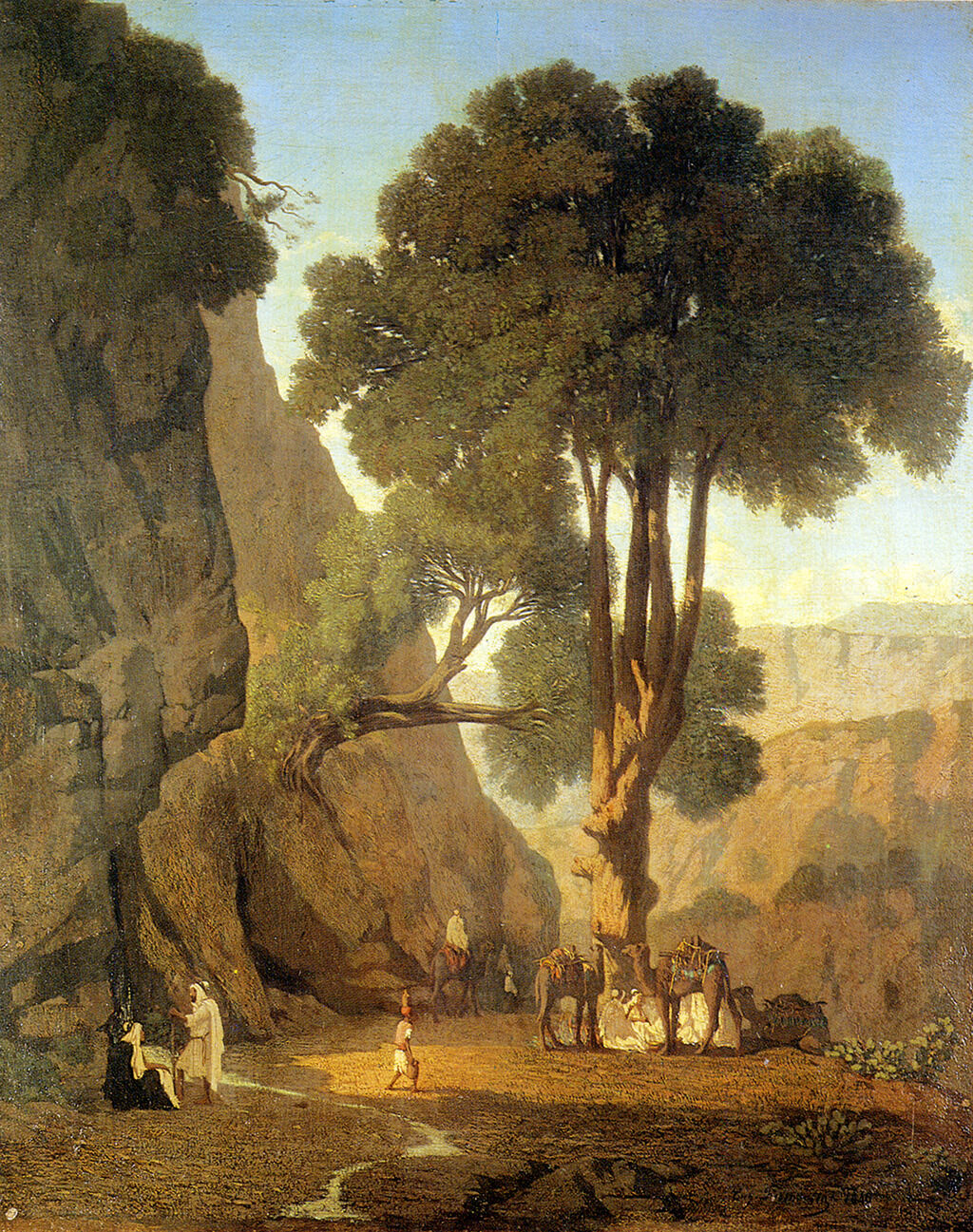
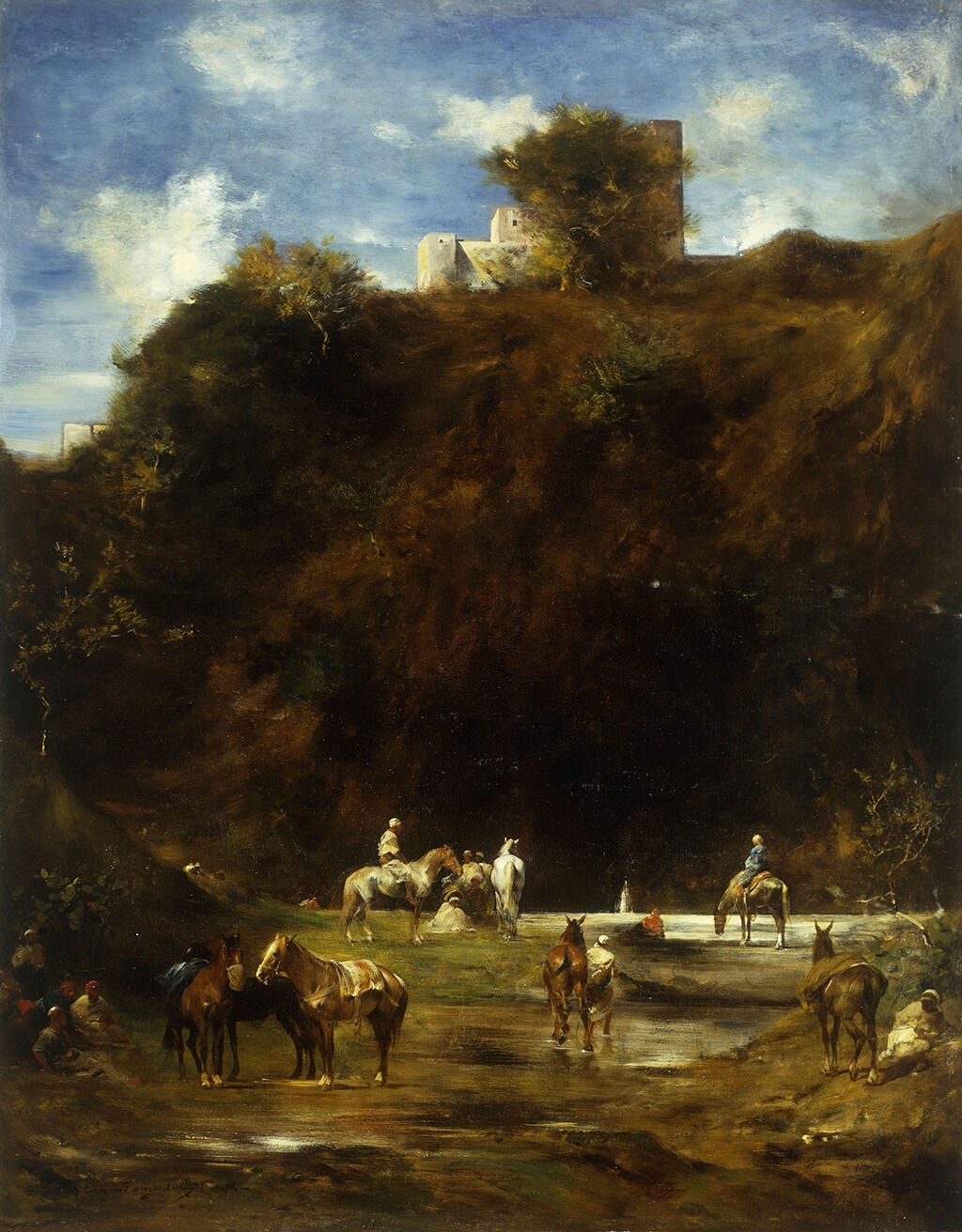
One of the defining features of A Ravine is the immense backdrop of the ravine walls relative to the scale of the figures. Fromentin had employed a vertical format since the outset of his career—for example, in View in the Gorges of Chiffa—to emphasize the height of the cliffs. The use of the word souvenir in the title underscores the role played by memory in the picture’s conception, a conceit most commonly associated, in landscape painting, with the late work of Jean-Baptiste-Camille Corot (1796–1875).7Fromentin had described the function of memory as part of his creative process as early as 1843, when he described it as an “admirable optical instrument.” See Eugène Fromentin, Lettres de jeunesse, ed. Pierre Blanchon (Paris: Plon-Nourrit et Cie, 1909), 94, as quoted in translation in James Thompson, The East Imagined, Experienced, Remembered: Orientalist Nineteenth Century Painting, exh. cat. (Dublin: National Gallery of Ireland, 1988), 79n4. On the ubiquity of the souvenir as a genre of painting and literature rooted in reminiscence, see Gary Tinterow, “Le Père Corot: The Very Poet of Landscape,” in Gary Tinterow, Michael Pantazzi, and Vincent Pomarède, Corot, 1796–1875, exh. cat (New York: Metropolitan Museum of Art, 1996), 262. The term signaled that the artist’s intent was to evoke rather than describe, despite the artist’s characteristic use of naturalistic details.
The critic Louis Gonse devoted an extended discussion to Fromentin in a review of the Salon of 1874, published in the influential periodical Gazette des Beaux-Arts (he would be named its editor the following year).8See the biographical entry on Gonse by Rémi Labrusse in Dictionnaire critique des historiens de l’art actifs en France de la Révolution à la Première Guerre mondiale, accessed December 2, 2019, https://www.inha.fr/fr/ressources/publications/publications-numeriques/dictionnaire-critique-des-historiens-de-l-art/gonse-louis.html. Gonse praises both paintings as “ravishing,” writing:
“The Ravine will remain at the forefront of his work, and is among his most complete and brilliant paintings. It reigns, in truth, with a delicious freshness. What calmness and subtlety of effect! In the middle of a beautiful dark ocher cliff, crowned by a few tufts of mastic and olive trees, is the opening of a large grotto. From the depths of its dark and transparent shadow, whose indefinable velvetiness is reminiscent of a bat’s wing, a spring emerges in a thin stream of silver.”9“Le Ravin restera au premier rang dans son œuvre, parmi ses tableaux les plus complets et les plus brillants. Il y règne, en vérité, une délicieuse fraîcheur. Quel calme et quelle discrétion d’effet! Au milieu d’une belle falaise ocreuse et sombre, que couronnent quelques touffes de lentisques et d’oliviers, s’ouvre une large grotte. Du fond de son ombre obscure et transparente, dont le velouté indéfinissable fait penser à l’aile de la chauve-souris, une source s’échappe en un mince filet d’argent.” Louis Gonse, “Salon de 1874,” Gazette des Beaux-Arts 10, no. 205 (July 1, 1874): 48. Much of the review is reprinted in Louis Gonse, Eugene Fromentin: Peintre et écrivain (Paris: A. Quantin, 1881), 96–97.
He then rhetorically asks whether the artist had been inspired by a passage in Une Année dans le Sahel, describing the environs of the city of Blida, which he quotes at length:
Today we hiked to the bottom of the ravine of Oued-el-Khebir. Oued-el-Khebir, despite its great name, is a very small river—in France one would call it a stream—which the winter rains and melting snows turn suddenly into a torrent. Reduced to its own resources, it is hardly anything at all. It begins at the bottom of a narrow ravine, shallow, and, like all mountain rivers at the source, it is first caught laughing in a cradle of rock, carpeted with leaves, reeds, and oleanders; it is born there, in the cool shade, in refuge and silence, like thoughts in the peaceful mind of a recluse. The mountain is rocky, steep, and frequently hollowed out by deep landslides. There are few trees, except, here and there, a few old olive trees planted horizontally on the embankments.10“Aujourd’hui nous avons fait une course au fond du ravin de l’Oued-el-Khebir. L’Oued-el-Khebir, malgré son nom de grande, est une toute petite rivière,—en France on dirait un ruisseau,—dont les pluies d’hiver et la fonte des neiges font tout à coup un torrent. Réduite à ses propres ressources, elle n’est plus rien. Elle prend naissance au fond d’un ravin étroit, peu profond, et, comme toutes les rivières montagneuses à leur origine, on la surprend d’abord dans un riant berceau à fond de roche, tapissé de feuillages, de roseaux et de lauriers-roses; elle y naît dans la fraîcheur de l’ombre, dans la retraite et dans le silence, comme les idées dans le paisible cerveau d’un solitaire. La montagne est rocheuse, escarpée et fréquemment creusée par de profonds éboulements. On y voit peu d’arbres, excepté de loin en loin quelques vieux oliviers plantés horizontalement dans les talus.” Eugène Fromentin, Une Année dans le Sahel (Paris: Michel Lévy Frères, 1859), 193; and Eugene Fromentin, Œuvres complètes, ed. Guy Sagnes (Paris: Éditions Gallimard, 1984), 285. The passage is dated “Blida, March [1853].”
Blida is situated on the Oued-el-Khebir, near where it flows from the Chiffa Gorge.11Oued is Arabic for river. Oued-el-Khebir was named after Sid Ahmed el Kebir, who founded Blida under Ottoman rule in 1535. Fromentin must have been keenly aware that Blida held out against French domination for nearly a decade before it was brought fully under control in 1839. Thus, if the text excerpted here did serve as a point of departure for A Ravine, then its subject is also related to the 1846 Salon painting illustrated here.
The critics were generally positive, though none of the others matched Gonse’s absorption in Fromentin’s exhibits. Jules-Antoine Castagnary, who ranked Fromentin highly—contrasting him favorably to the academic painter of idealized nudes Alexandre Cabanel (1823–89)—wrote of the “brilliance and vivacity” of the artist’s souvenirs.12“l’éclat et la vivacité”: [Jules-Antoine] Castagnary, Salons, vol. 2, 1872–1879 (Paris: Bibliothèque-Charpentier, 1892), 117. Paul de Saint-Victor was more measured:
The Ravine is an oasis of freshness and limpid shade. Little horses drink at the spring that flows lightly between the cracks of a rocky vault. Their variously colored rumps throw flashes of color onto the soft shading of their velvety forms. A single fault: these beautiful rocks, dressed in a hue so rich and so fine, are absolutely lacking in solidity. They are like tapestries nailed to a void; a gust of wind would blow them away.13“Le Ravin est une oasis de fraîcheur et d’ombre limpide. De petits chevaux boivent à la source ruisselante entre les fissures d’une voûte de rochers. Leurs croupes diaprées jettent comme des éclairs de couleur sur les douces ténèbres que versent leurs masses veloutées. Un seul défaut: ces beaux rochers, revêtus d’une teinte si riche et si fine, manquent tout à fait de solidité. Ce sont des tapisseries clouées sur le vide; un coup de vent les emporterait.” Paul de Saint-Victor, “Le Salon de 1874: Les Paysagistes,” L’Artiste: Histoire de l’art contemporain 2 (August 1, 1874): 80.
This last criticism was echoed by the pseudonymous female writer Marc de Montifaud, who had nothing favorable to say: “If one has to choose between M. Fromentin and one or two other Orientalists this year, it won’t be M. Fromentin who will prevail. His Souvenir d’Algerie is limp and flabby, and the cliff looks like nothing more than an animal hide spread out in the background.”14“S’il faut choisir cette année entre M. Fromentin et un ou deux autres orientalistes, ce ne sera pas M. Fromentin qui l’emportera. Son Souvenir d’Algérie est mou et flasque, le rocher ressemble tout simplement à une peau de bête étalée dans le fond.” Marc de Montifaud, “Le Salon de 1874: Paysage,” L’Artiste: Histoire de l’art contemporain 2 (July 1, 1874): 16. Marc de Montifaud was the pseudonym of Marie-Amélie Chartroule (1845–1912), who in 1864 had married comte Jean François Quivogne de Luna. Montifaud’s criticism of Fromentin was no less withering than her assessment of Monet’s Impression, Sunrise (Musée d’Orsay, Paris), on view at the first Impressionist exhibition (April 15–May 15, 1874), which overlapped with the Salon: “The impression of a Sunrise has been dealt with by the immature hand of a schoolboy who spreads pigment for the first time across whatever” (“Exposition du Boulevard des Capucines,” L’Artiste [May 1874]: 308–9; trans. in Anne Distel et al., Impressionism: A Centenary Exhibition, exh. cat. [New York: Metropolitan Museum of Art, 1974], 108).
Notes
-
Translations are by the author unless otherwise noted. James Thompson and Barbara Wright, La vie et l’œuvre d’Eugène Fromentin (Paris: ACR Édition, 1987), 64, 69–71; and James Thompson and Barbara Wright, Eugène Fromentin, 1820–1876: Visions d’Algérie et d’Egypte, new ed. (Paris: ACR Édition, 2008), 62–66. The Salon opened on March 16, 1847. In addition to the painting exhibited as no. 664, Vue prise dans les gorges de la Chiffa (Province d’Alger), illustrated here as Fig. 1, Fromentin showed Une ferme aux environs de la Rochelle (A Farm near La Rochelle; no. 662, location unknown) and Mosquée près d’Alger (Mosque near Algiers; no. 663, location unknown).
-
See James P. Thompson’s biographical entry on Fromentin in Jane Turner, ed., The Grove Dictionary of Art (London: Macmillan, 1996), 11:801.
-
After 1874, both titles appeared under multiple imprints; they were collected together in a single volume titled Sahara et Sahel: I. Un Été dans le Sahara; II. Une Année dans le Sahel, published by Plon in 1887 and included in Eugène Fromentin, Œuvres complètes, ed. Guy Sagnes (Paris: Éditions Gallimard, 1984). There are other editions as well. Fromentin’s most influential literary endeavor was his study of Dutch and Flemish masters, Les maîtres d’autrefois (Paris: E. Plon, 1876).
-
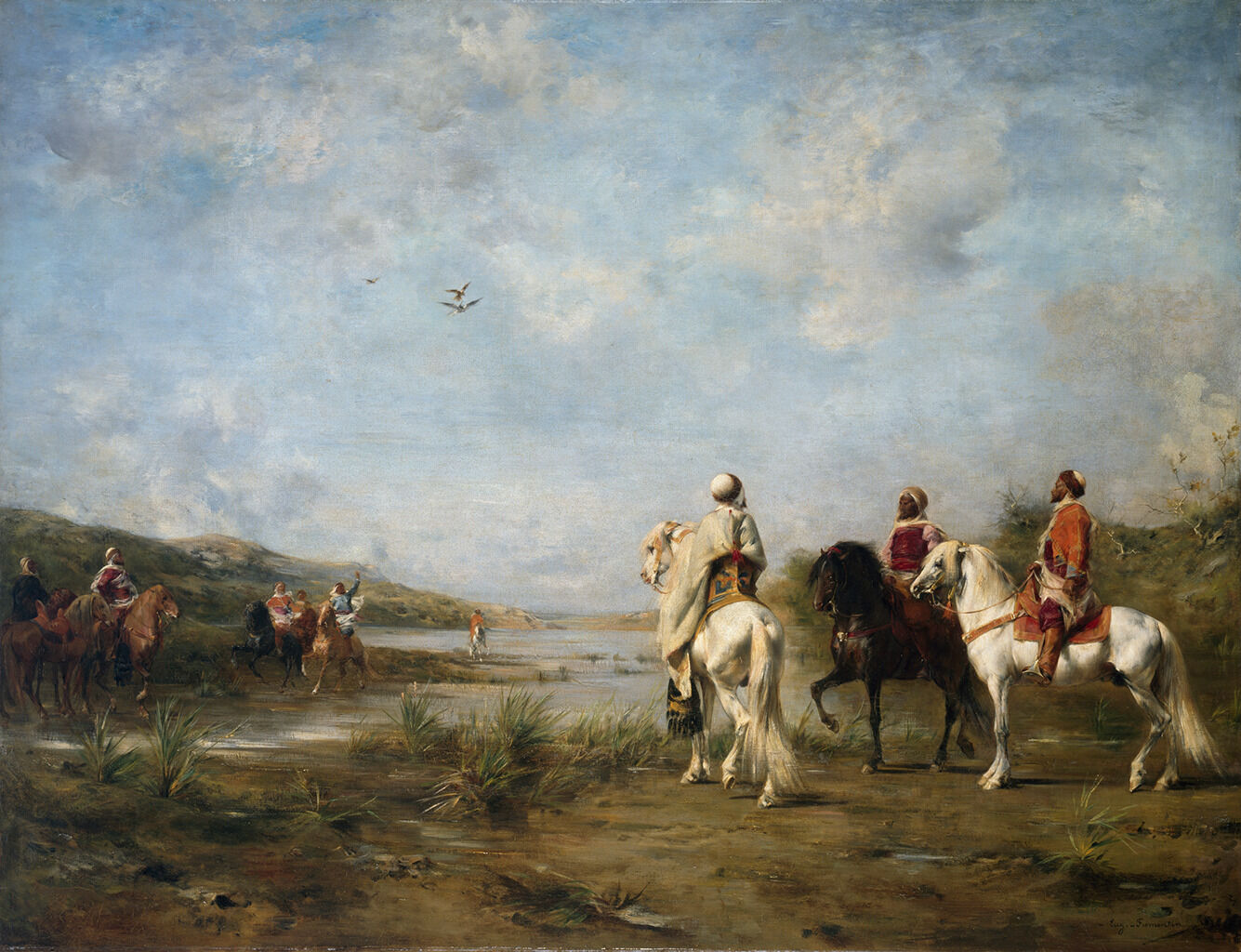
The work illustrated here as figure 2 was simply titled Souvenir d’Algérie at the Salon, where it was exhibited as no. 755. See Thompson and Wright, La vie et l’œuvre d’Eugène Fromentin, 294, 296–97, 305; and Thompson and Wright, Eugène Fromentin, 1820–1876, 358–59, 368. The National Gallery of Ireland’s title is Falcon Hunt (“Algeria Remembered”), but in this entry Falcon Hunt: Souvenir of Algeria is used to evoke the parallel French titles and to avoid perpetuating the confusion that has followed these paintings since they were first exhibited. The Dublin picture reprises one of Fromentin’s masterpieces, the Heron Hunt (Algeria), oil on canvas, 39 x 55 15/16 in. (99 x 142 cm), painted in 1865 for that year’s Salon and now in the Musée Condé, Chantilly (inv. no. 528).
-
Decamps traveled to Turkey in 1828, Marilhat to Egypt in 1831–32, and Delacroix to Morocco and Algeria in 1832. Delacroix reciprocated Fromentin’s admiration; see Sébastien Allard and Côme Fabre, “The Sphinx of Modern Painting,” in Sébastien Allard and Côme Fabre et al., Delacroix, exh. cat. (New York: Metropolitan Museum of Art, 2018), 178.
-
For a nuanced account of Fromentin’s reflections on the brutality inflicted by French forces at El-Aghouat in Algeria soon before his 1852–53 trip, in both Un Été dans le Sahara and in the 1858 painting Street in El-Aghouat (Musée de la Chartreuse, Douai, France, inv. no. 148), see Patrick Noon’s essay in Patrick Noon and Christopher Riopelle, Delacroix and the Rise of Modern Art, exh. cat. (Minneapolis: Minneapolis Institute of Art, 2015), 116–18.
-
Fromentin had described the function of memory as part of his creative process as early as 1843, when he described it as an “admirable optical instrument.” See Eugène Fromentin, Lettres de jeunesse, ed. Pierre Blanchon (Paris: Plon-Nourrit et Cie, 1909), 94, as quoted in translation in James Thompson, The East Imagined, Experienced, Remembered: Orientalist Nineteenth Century Painting, exh. cat. (Dublin: National Gallery of Ireland, 1988), 79n4. On the ubiquity of the souvenir as a genre of painting and literature rooted in reminiscence, see Gary Tinterow, “Le Père Corot: The Very Poet of Landscape,” in Gary Tinterow, Michael Pantazzi, and Vincent Pomarède, Corot, 1796–1875, exh. cat (New York: Metropolitan Museum of Art, 1996), 262.
-
See the biographical entry on Gonse by Rémi Labrusse in Dictionnaire critique des historiens de l’art actifs en France de la Révolution à la Première Guerre mondiale, accessed December 2, 2019, https://www.inha.fr/fr/ressources/publications/publications-numeriques/dictionnaire-critique-des-historiens-de-l-art/gonse-louis.html.
-
“Le Ravin restera au premier rang dans son œuvre, parmi ses tableaux les plus complets et les plus brillants. Il y règne, en vérité, une délicieuse fraîcheur. Quel calme et quelle discrétion d’effet! Au milieu d’une belle falaise ocreuse et sombre, que couronnent quelques touffes de lentisques et d’oliviers, s’ouvre une large grotte. Du fond de son ombre obscure et transparente, dont le velouté indéfinissable fait penser à l’aile de la chauve-souris, une source s’échappe en un mince filet d’argent.” Louis Gonse, “Salon de 1874,” Gazette des Beaux-Arts 10, no. 205 (July 1, 1874): 48. Much of the review is reprinted in Louis Gonse, Eugene Fromentin: Peintre et écrivain (Paris: A. Quantin, 1881), 96–97.
-
“Aujourd’hui nous avons fait une course au fond du ravin de l’Oued-el-Khebir. L’Oued-el-Khebir, malgré son nom de grande, est une toute petite rivière,—en France on dirait un ruisseau,—dont les pluies d’hiver et la fonte des neiges font tout à coup un torrent. Réduite à ses propres ressources, elle n’est plus rien. Elle prend naissance au fond d’un ravin étroit, peu profond, et, comme toutes les rivières montagneuses à leur origine, on la surprend d’abord dans un riant berceau à fond de roche, tapissé de feuillages, de roseaux et de lauriers-roses; elle y naît dans la fraîcheur de l’ombre, dans la retraite et dans le silence, comme les idées dans le paisible cerveau d’un solitaire. La montagne est rocheuse, escarpée et fréquemment creusée par de profonds éboulements. On y voit peu d’arbres, excepté de loin en loin quelques vieux oliviers plantés horizontalement dans les talus.” Eugène Fromentin, Une Année dans le Sahel (Paris: Michel Lévy Frères, 1859), 193; and Eugene Fromentin, Œuvres complètes, ed. Guy Sagnes (Paris: Éditions Gallimard, 1984), 285. The passage is dated “Blida, March [1853].”
-
Oued is Arabic for river. Oued-el-Khebir was named after Sid Ahmed el Kebir, who founded Blida under Ottoman rule in 1535. Fromentin must have been keenly aware that Blida held out against French domination for nearly a decade before it was brought fully under control in 1839.
-
“l’éclat et la vivacité”: [Jules-Antoine] Castagnary, Salons, vol. 2, 1872–1879 (Paris: Bibliothèque-Charpentier, 1892), 117.
-
“Le Ravin est une oasis de fraîcheur et d’ombre limpide. De petits chevaux boivent à la source ruisselante entre les fissures d’une voûte de rochers. Leurs croupes diaprées jettent comme des éclairs de couleur sur les douces ténèbres que versent leurs masses veloutées. Un seul défaut: ces beaux rochers, revêtus d’une teinte si riche et si fine, manquent tout à fait de solidité. Ce sont des tapisseries clouées sur le vide; un coup de vent les emporterait.” Paul de Saint-Victor, “Le Salon de 1874: Les Paysagistes,” L’Artiste: Histoire de l’art contemporain 2 (August 1, 1874): 80.
-
“S’il faut choisir cette année entre M. Fromentin et un ou deux autres orientalistes, ce ne sera pas M. Fromentin qui l’emportera. Son Souvenir d’Algérie est mou et flasque, le rocher ressemble tout simplement à une peau de bête étalée dans le fond.” Marc de Montifaud, “Le Salon de 1874: Paysage,” L’Artiste: Histoire de l’art contemporain 2 (July 1, 1874): 16. Marc de Montifaud was the pseudonym of Marie-Amélie Chartroule (1845–1912), who in 1864 had married comte Jean François Quivogne de Luna. Montifaud’s criticism of Fromentin was no less withering than her assessment of Monet’s Impression, Sunrise (Musée d’Orsay, Paris), on view at the first Impressionist exhibition (April 15–May 15, 1874), which overlapped with the Salon: “The impression of a Sunrise has been dealt with by the immature hand of a schoolboy who spreads pigment for the first time across whatever” (“Exposition du Boulevard des Capucines,” L’Artiste [May 1874]: 308–9; trans. in Anne Distel et al., Impressionism: A Centenary Exhibition, exh. cat. [New York: Metropolitan Museum of Art, 1974], 108).
-
See Thompson and Wright, La vie et l’œuvre d’Eugène Fromentin, 296, as Tribu arabe au bord d’un ruisseau; and Thompson and Wright, Eugène Fromentin, 1820–1876, 364–65. There is also a variant, presumably of the same date, not in Thompson and Wright’s La vie et l’œuvre d’Eugène Fromentin, but see Thompson and Wright, Eugène Fromentin, 1820–1876, 365, as Cavaliers arabes dans un défilé.
-
On the popularity of Fromentin’s Algerian subjects, see Maxime du Camp, Souvenirs littéraires (Paris: Hachette, 1906), 2:202, quoted in English translation in Thompson, The East Imagined, Experienced, Remembered, 78n3; on the artist’s self-doubt in 1872–73, see Thompson and Wright, Eugène Fromentin, 1820–1876, 358–60.
-
The painting by Busson is an oil on canvas and measures 83 1/2 x 62 in. (212 x 160 cm); it does not seem to have been assigned an inventory number. See Thompson and Wright, La vie et l’œuvre d’Eugène Fromentin, 298; and Thompson and Wright, Eugène Fromentin, 1820–1876, 368–69. For an image, see the photo agency of the Réunion des Musées Nationaux et du Grand Palais: https://www.photo.rmn.fr/archive/17-631633-2C6NU0AKAJ8O3.html.
-
Fromentin was popular on both sides of the Atlantic. Numerous Gilded AgeGilded Age: A period in United States history from about 1870 to 1900 characterized by corrupt politicians and great financial gain through monopolies on industrial production. Although wages of industrial and skilled workers rose, the greatest wealth was collected by the entrepreneurs variously called “captains of industry” or “robber barons.” The new influx of wealth contributed to gross materialism. collectors acquired his work, examples of which may be found in museums throughout the United States. Catharine Lorillard Wolfe (1828–87) owned Arabs Crossing a Ford, 1873 (Metropolitan Museum of Art, New York, 87.15.64), and fellow New Yorker William Tilden Blodgett (1823–75) owned an undated early work, Khan in Algiers (Museum of Fine Arts, Boston, 94.138). William T. Walters (1820–94) of Baltimore owned An Encampment in the Atlas Mountains, 1865, and At the Well, 1875 (Walters Art Museum, Baltimore, 37.195 and 37.100), and James J. Hill (1838–1916) of Saint Paul, Minnesota, owned Upper Egypt, a Recollection, 1872 (Minneapolis Institute of Art, 53.82).
-
Not in Thompson and Wright, La vie et l’œuvre d’Eugène Fromentin, but see Thompson and Wright, Eugène Fromentin, 568, cat. no. DA61. Sold at Regards sur l’Orient: Tableaux, sculptures et objets d’art, Sotheby’s, Paris, October 29, 2008, lot 35.
-
Eugène Fromentin, Les Gorges de la Chiffa (?), possibly 1874, oil on unknown support, 10 1/8 x 8 1/4 in. (25.7 x 21 cm), sold from the estate of Frank V. Whitney at Oil paintings and water colors, Fifth Avenue Auction Rooms, New York, April 7–9, 1915, lot 227, as In the Ravine. The painting was not published in Thompson and Wright, La vie et l’œuvre d’Eugène Fromentin, or Thompson and Wright, Eugène Fromentin. All information here is derived from the black-and-white Knoedler photograph in the Witt Library, Courtauld Institute of Art, London, Fromentin, Box 1132, Folder: “Fromentin-Depeux, Outdoor Scenes, Upright.”
Technical Entry
Citation
Chicago:
Diana M. Jaskierny, “Eugène Fromentin, A Ravine: Souvenir of Algeria, 1874,” technical entry in French Paintings and Pastels, 1600–1945: The Collections of the Nelson-Atkins Museum of Art, ed. Aimee Marcereau DeGalan (Kansas City: The Nelson-Atkins Museum of Art, 2026), https://doi.org/10.37764/78973.5.406.2088.
MLA:
Jaskierny, Diana M. “Eugène Fromentin, A Ravine: Souvenir of Algeria, 1874,” technical entry. French Paintings and Pastels, 1600–1945: The Collections of The Nelson-Atkins Museum of Art, edited by Aimee Marcereau DeGalan, Nelson-Atkins Museum of Art, 2026. doi: 10.37764/78973.5.406.2088.
A Ravine: Souvenir of Algeria was completed by Eugène Fromentin on a panel that is approximately one centimeter in thickness. It is constructed of two five-millimeter-thick boards that appear to be joined together solely with adhesive. Due to Fromentin’s travels throughout Algeria, it is possible that this unusual construction was selected from locally available materials. The panel is in plane with slight convexity.
The ground layerground layer: An opaque preparatory layer applied to the support, either commercially or by the artist, to prevent absorption of the paint into the canvas or panel. See also priming layer. is white or slightly off-white in color and is only visible in thinly painted or abradedabrasion: A loss of surface material due to rubbing, scraping, frequent touching, or inexpert solvent cleaning. areas. Most of the composition was underpaintedunderpainting: The first applications of paint that begin to block in color and loosely define the compositional elements. Also called ébauche. with a warm semi-translucent brown washwash: An application of thin paint that has been diluted with solvent., extending to where the sky and cliffside meet (Fig. 5). This wash remains visible throughout much of the landscape, increasing the overall warmth of the scene. In the sky, Fromentin initially laid in a muted gray-blue opaque paint layer that appears to extend beneath the buildings.
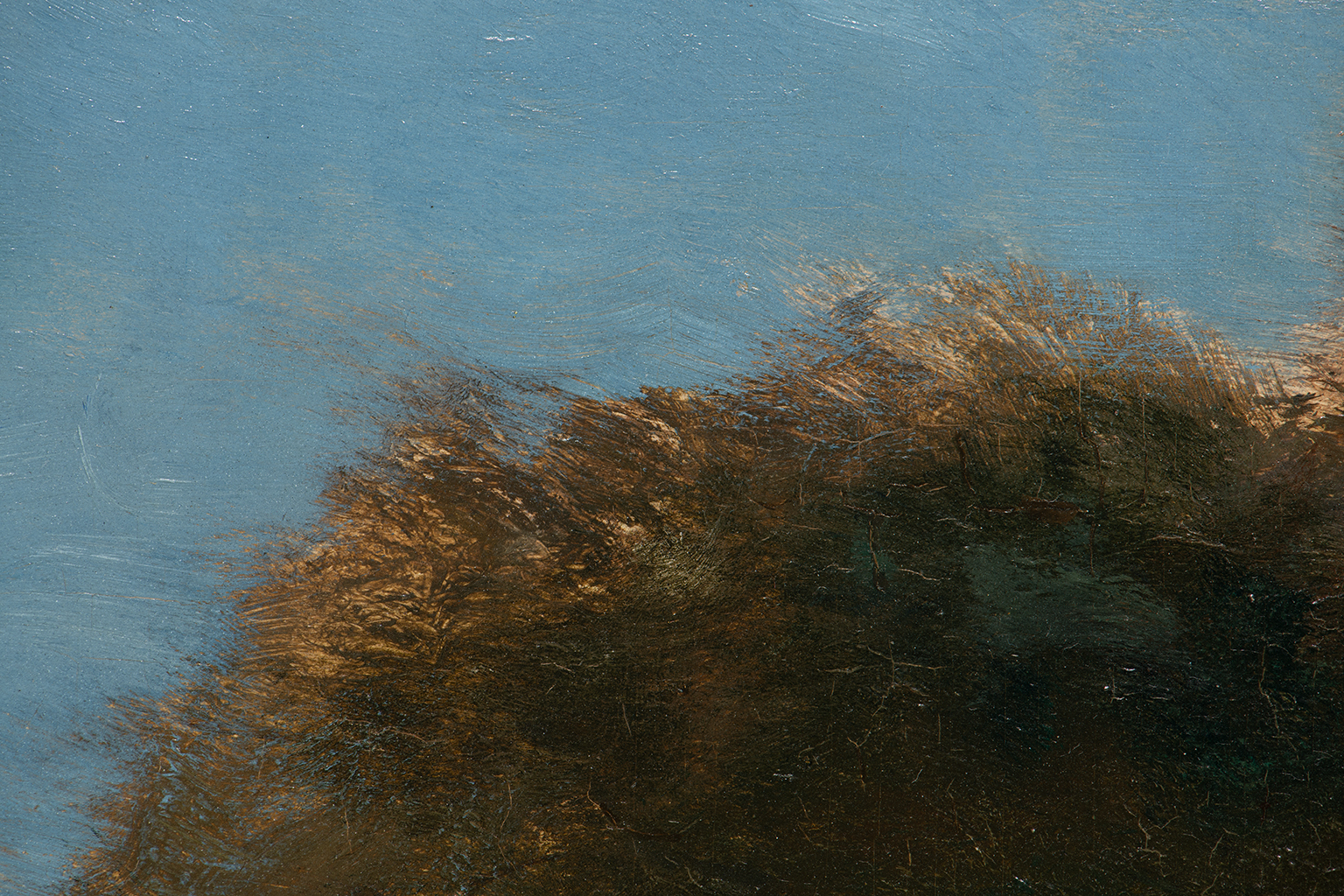 Fig. 5. Detail of the brown wash beneath the trees extending to the sky, A Ravine: Souvenir of Algeria (1874)
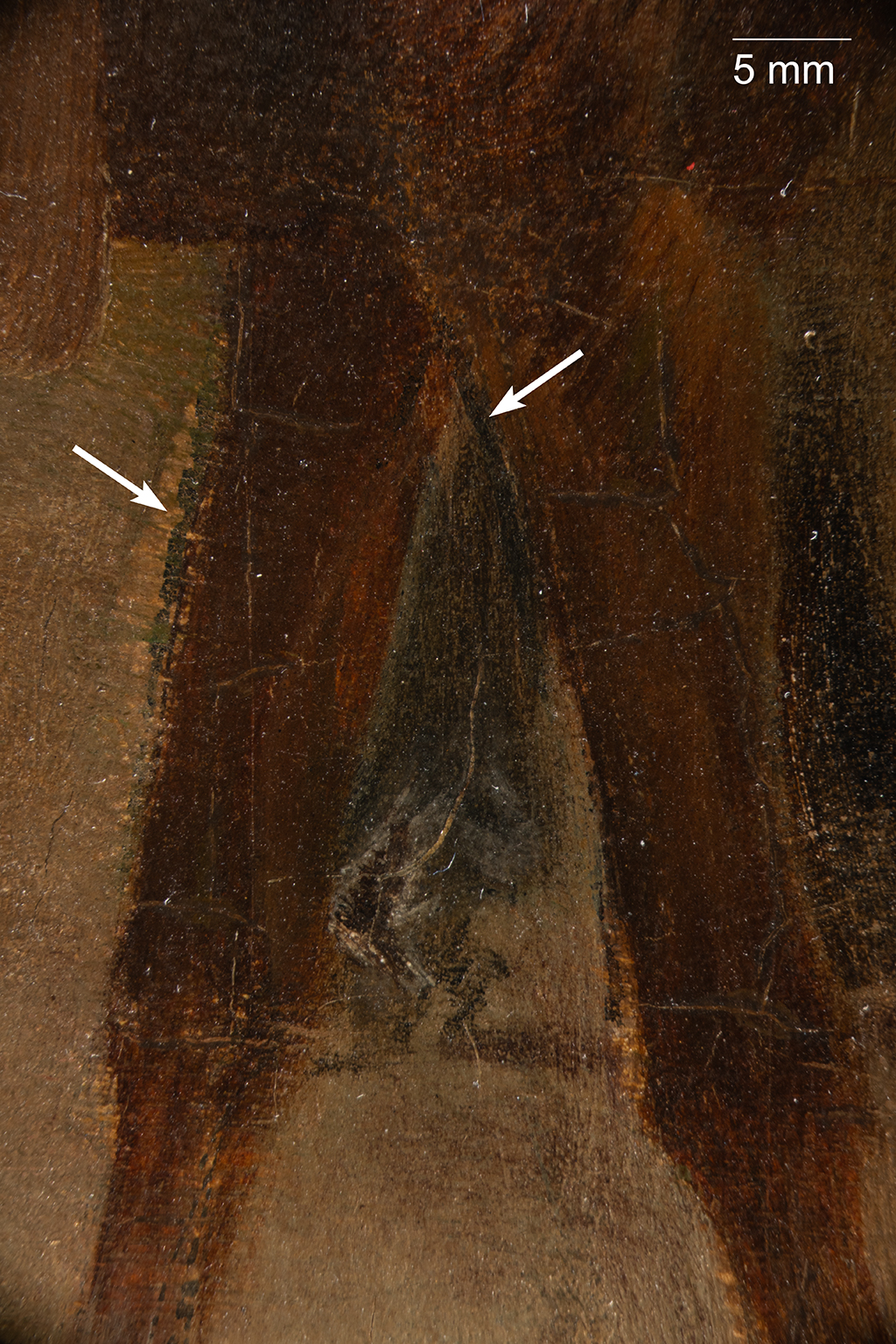 Fig. 6. Photomicrograph of underdrawing found in the left-side tan horse’s legs, A Ravine: Souvenir of Algeria (1874)
While no underdrawingunderdrawing: A drawn or painted sketch beneath the paint layer. The underdrawing can be made from dry materials, such as graphite or charcoal, or wet materials, such as ink or paint. was identified with a stereomicroscope beneath any of the figures, a few black or dark brown lines were visible around the tan horse in the left foreground (Fig. 6). When examining the painting with infrared reflectographyinfrared reflectography (IRR): A form of infrared imaging that exploits the behavior of painting materials at wavelengths beyond those accessible to infrared photography. These advantages sometimes include a continuing increase in the transparency of pigments beyond wavelengths accessible to infrared photography (i.e, beyond 1,000 nanometers), rendering underdrawing more clearly. The resulting image is called an infrared reflectogram. Devices that came into common use in the 1980s such as the infrared vidicon effectively revealed these features but suffered from lack of sharpness and uneven response. Vidicons continue to be used out to 2,200 nanometers but several newer pixelated detectors including indium gallium arsenide and indium antimonide array detectors offer improvements. All of these devices are optimally used with filters constraining their response to those parts of the infrared spectrum that reveal the most within the constraints of the palette used for a given painting. They can be used for transmitted light imaging as well as in reflection., similar dark fluid lines were found around the horse’s mouth (Fig. 7). The use of an underdrawing here may be due to the horse’s close proximity to the viewer, requiring greater precision and detail. In addition to this minimal underdrawing, reservesreserve: An area of the composition left unpainted with the intention of inserting a feature at a later stage in the painting process. appear to have been left both for the group of horses on the left side of the composition and the buildings along the top of the cliff (Fig. 8).
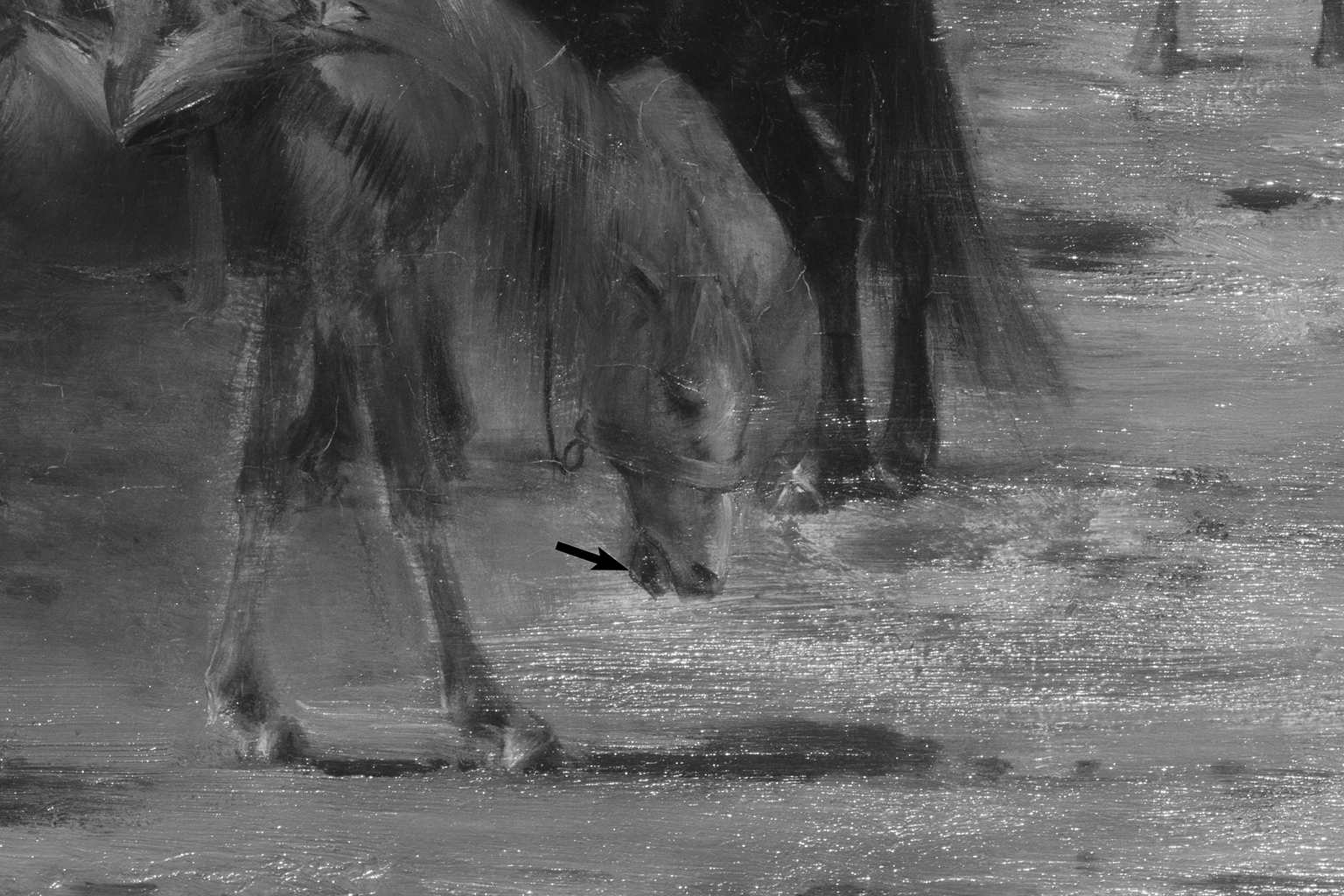 Fig. 7. Detail of an infrared digital photograph showing underdrawing in the left-side tan horse’s mouth, A Ravine: Souvenir of Algeria (1874)
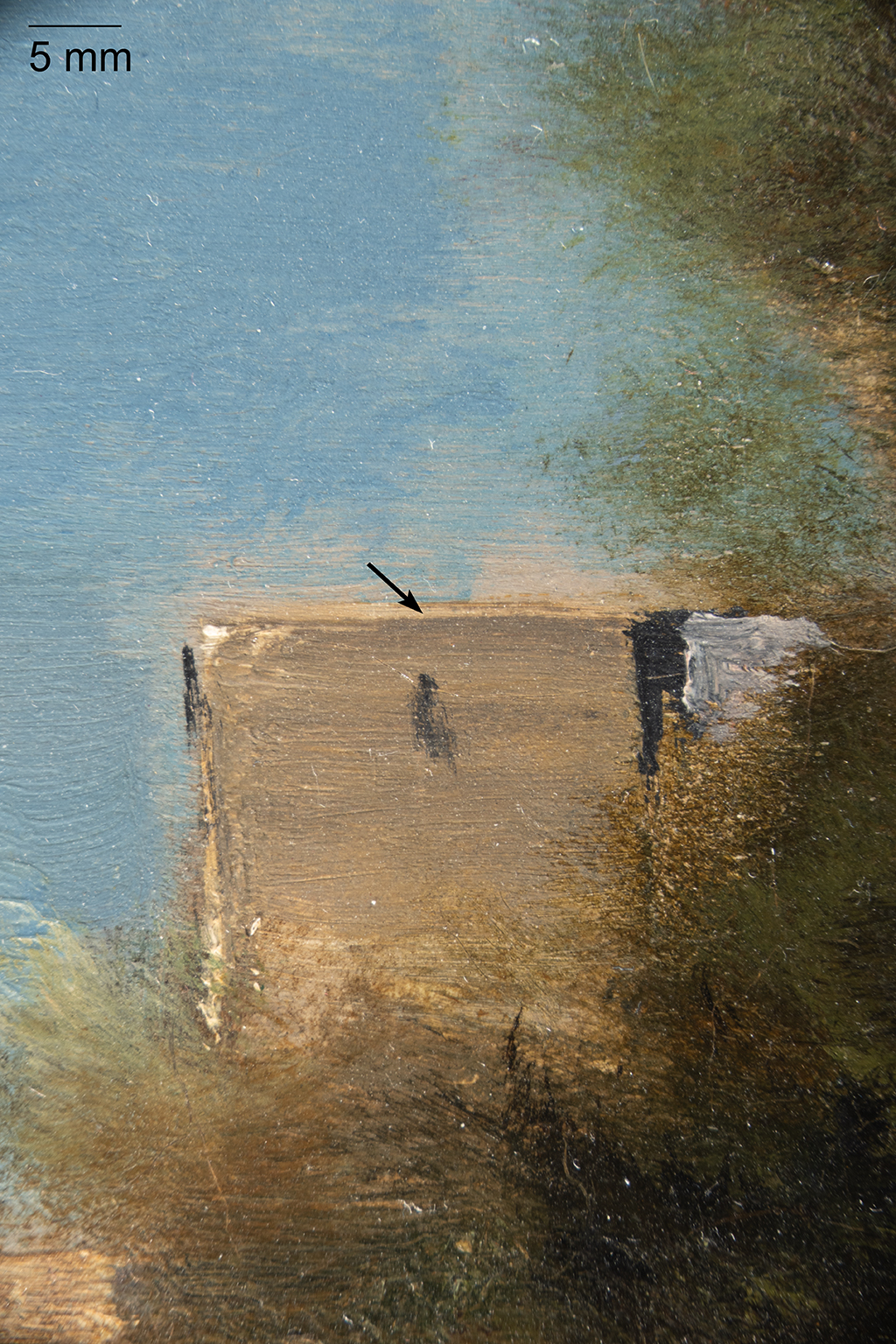 Fig. 8. Photomicrograph of a building on the cliff with an exposed reserve, A Ravine: Souvenir of Algeria (1874)
Most of the painting was completed quickly, often with crisscrossing painterly brushwork throughout the cliffside and foliage, resulting in wet-over-wetwet-over-wet: An oil painting technique which involves drawing a stroke of one color across the wet paint of another color. paint applications. In the foreground, leaves were painted with two distinct methods: some with dry brushwork and others with wet-into-wetwet-into-wet: An oil painting technique which involves blending of colors on the picture surface. blending (Fig. 9). Although the background is convincing as a cliffside, there are few details differentiating one section from the next, creating an awkward flatness. Once most of the landscape was completed, Fromentin returned to add elements, some of which appear to float on top of the foliage as opposed to being integrated into the composition. One clear example is the large tree in the center of the painting, where the trunk ends abruptly (Fig. 10).1A similar occurrence is present in Arabs Resting (1874; private collection; ssee Figure 4 in the accompanying catalogue entry). This indicates that the “floating” appearance of cliffside trees was likely intentional and not the result of past overcleaning., 2Fromentin’s work has been described as lacking “unity in the composition” with regards to small figures not being rendered in the same manner as the landscapes. The same can be said about the lack of communication between compositional elements within the Nelson-Atkins painting. Donald A. Rosenthal, Orientalism: The Near East in French Painting 1800–1880, exh. cat. (Rochester, NY: Memorial Art Gallery of the University of Rochester, 1982), 71.
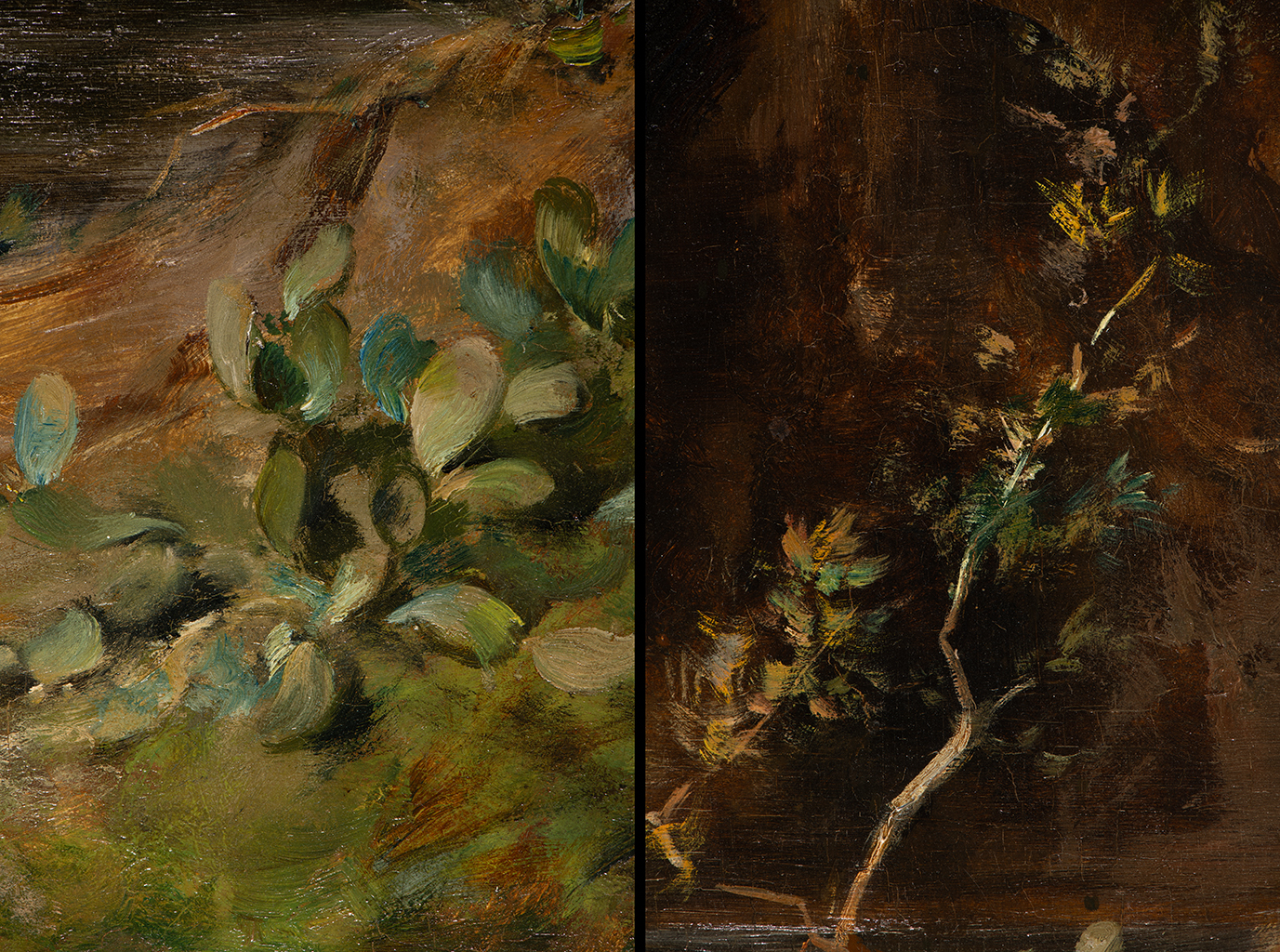 Fig. 9. Details illustrating leaves painted with wet-into-wet paint application (left) and wet-over-dry paint application (right), A Ravine: Souvenir of Algeria (1874)
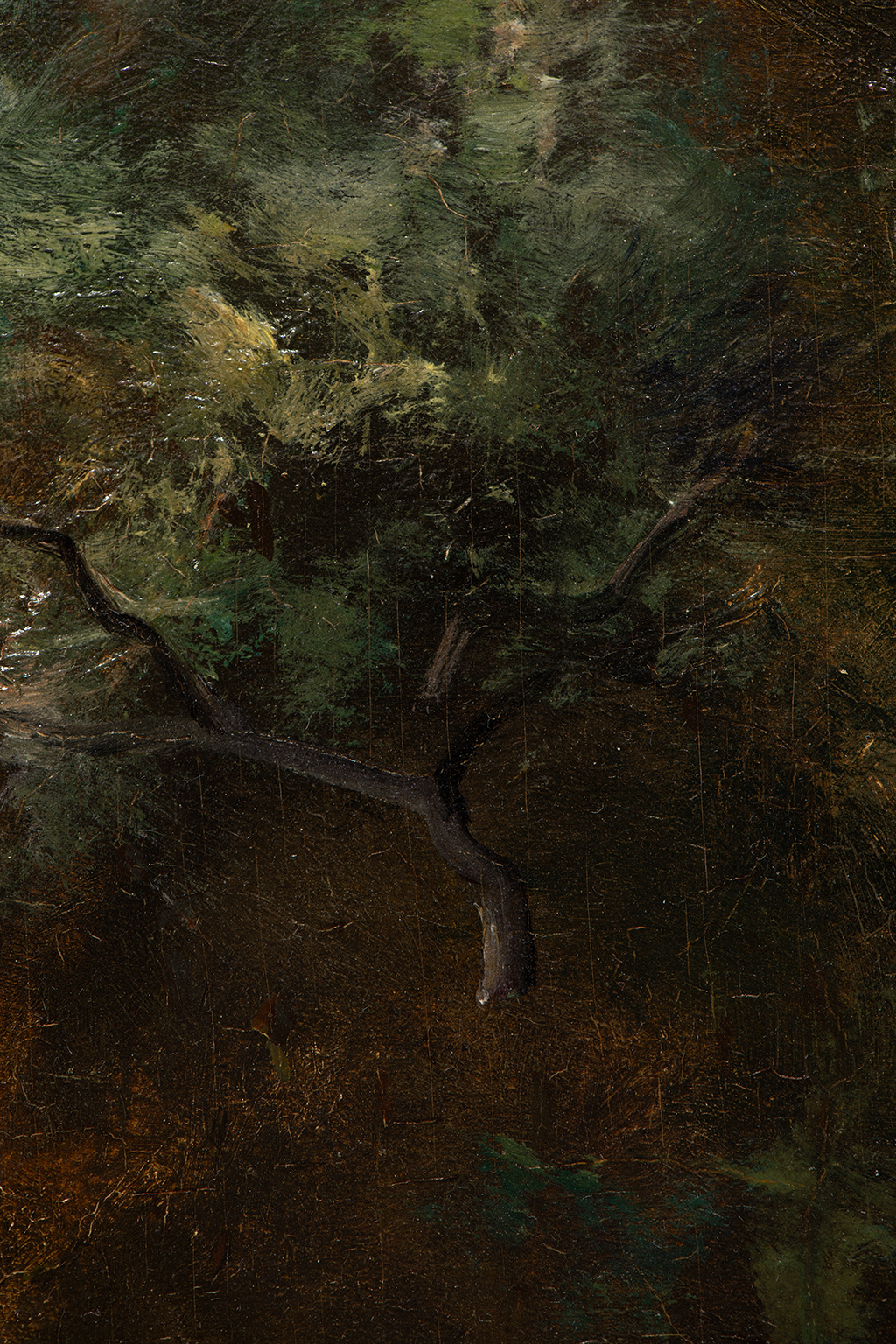 Fig. 10. Detail of the tree in the center of the composition painted on top of the landscape, A Ravine: Souvenir of Algeria (1874)
While reserves for the horses nearest to the viewer indicate a degree of compositional planning, the figures were painted over the dry paint and pronounced texture of the underlying foreground. In some instances, the thinly applied paint allowed lower gray layers to remain visible, as in the head covering of the man with a staff on the right, where the water below provides the covering’s shadows (Fig. 11). In other instances, Fromentin laid in white paint to block out the lower layers before completing the figure (Fig. 12).3While it appears that the white paint for the head covering was used to block out the darker background, it is also possible that the artist changed the color from white to red, as the other garment on this figure appears to have been changed from yellow to red.
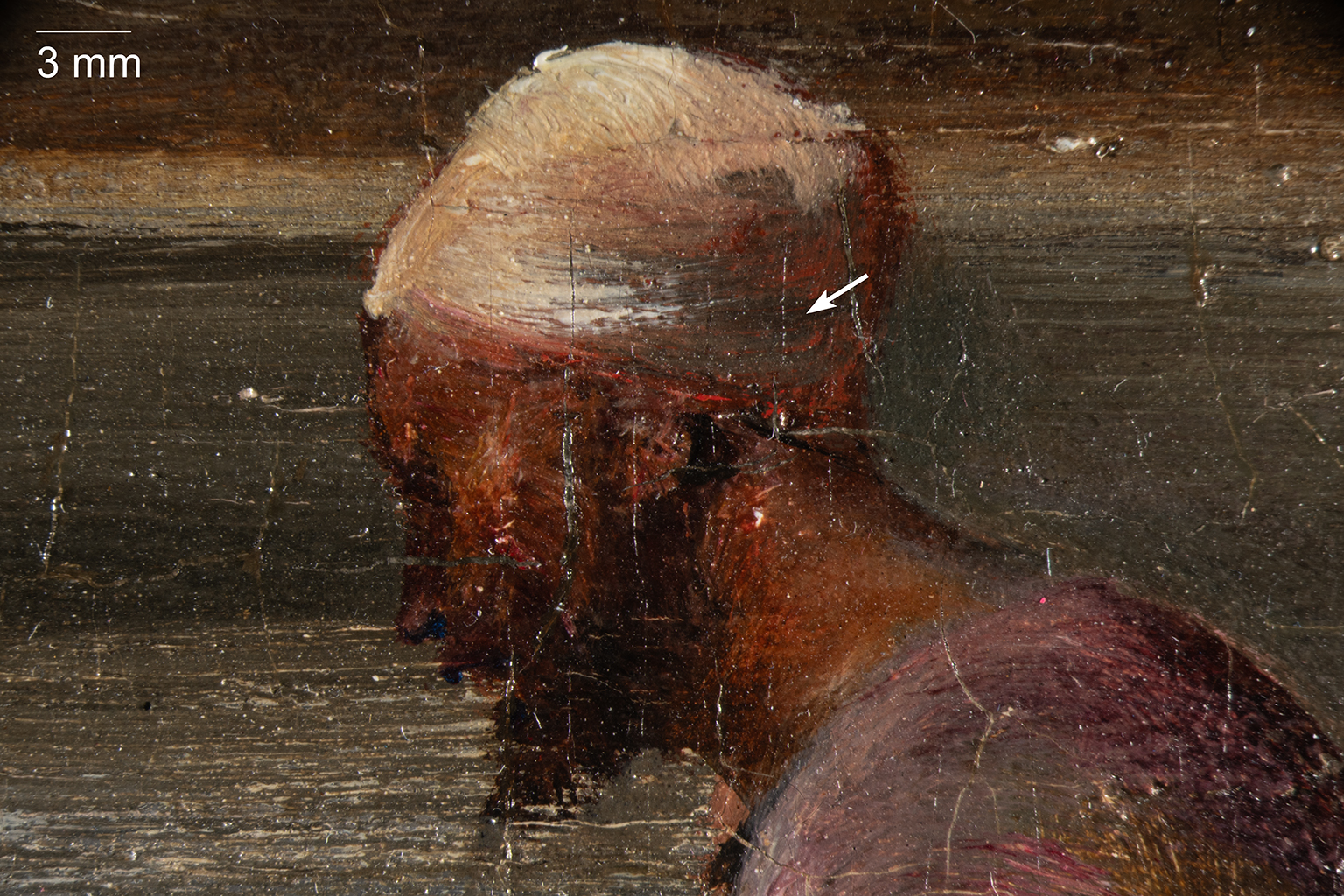 Fig. 11. Photomicrograph of the man with a staff, illustrating lower gray layers (white arrow) visible in the head covering and blue shadows on the nose and mouth, A Ravine: Souvenir of Algeria (1874)
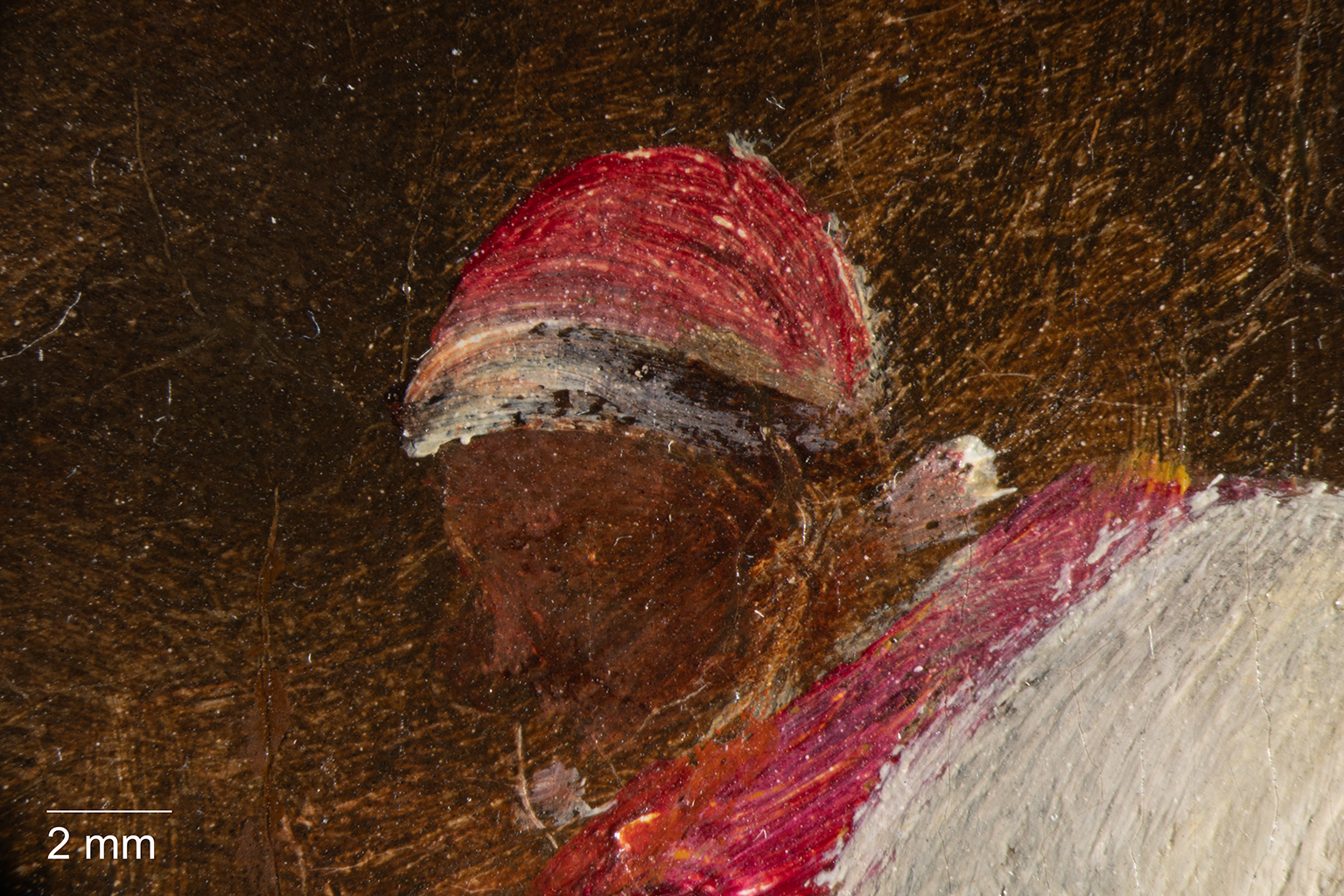 Fig. 12. Photomicrograph of the figure furthest to the right, illustrating white beneath the red head covering, A Ravine: Souvenir of Algeria (1874)
Since the looming cliffside is the main subject of the composition, there are few details on the comparatively small figures. Still, Fromentin successfully portrayed even the most distant figures with a dab or rapid gestural stroke (Fig. 13). Closer to the foreground, more detail is present. For example, the artist added deep blue pigment to the underside of the nose and lip in Figure 11, creating a rich shadow in contrast to the warm brown skin. The finest details can be found on the leftmost horse with its head raised, where paint strokes, less than one millimeter in width, portray the bridle (Fig. 14).
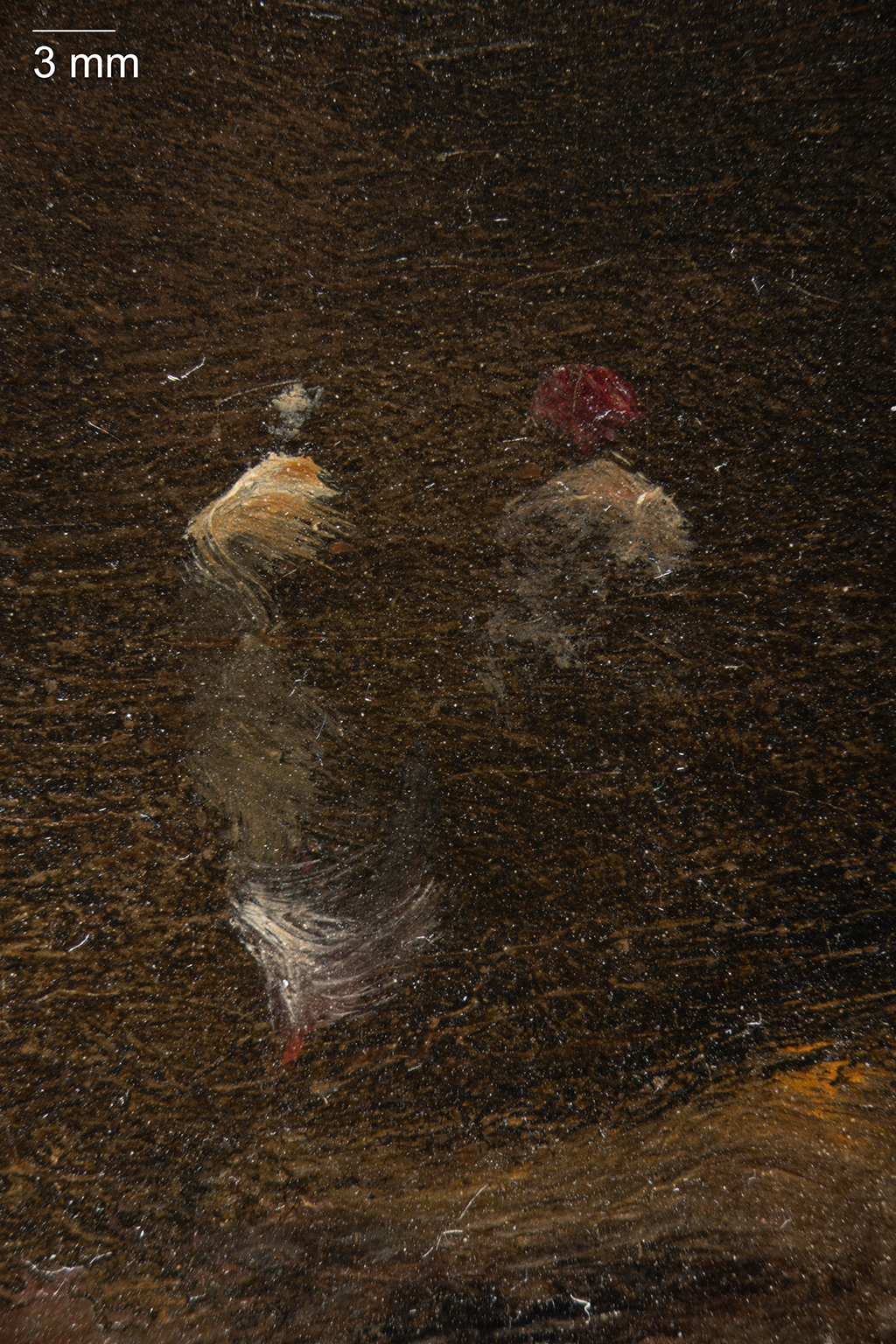 Fig. 13. Photomicrograph of distant figures, A Ravine: Souvenir of Algeria (1874)
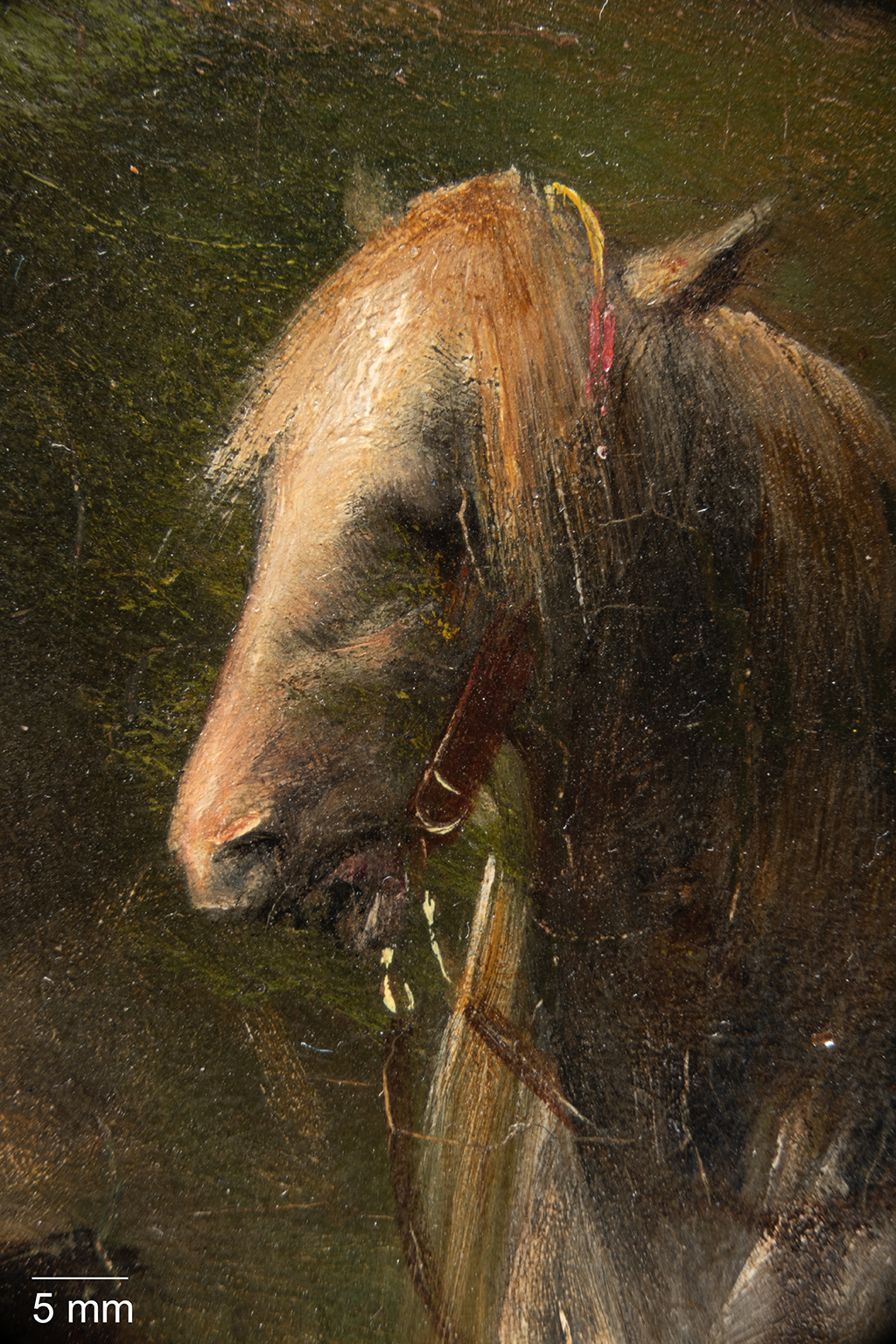 Fig. 14. Photomicrograph of the intricate details in the left-side white horse’s face and bridle, A Ravine: Souvenir of Algeria (1874)
Multiple artist changes are found throughout the composition, ranging from color choices to the initial landscape design. This suggests that Fromentin was not working strictly from a drawing. The most notable change is a repositioning of the riverbank. In raking lightraking light: An examination technique in which light is placed at a shallow angle from one direction to reveal the surface topography., a pronounced horizontal texture is visible approximately five centimeters above where the water meets the cliff (Fig. 15).4Similarly, an underlying texture also shows that the waterfall was once four to five centimeters above its current placement. It is possible that the artist roughly placed where the cliff base and river meet in the center of the composition and then made the adjustment that brought the base of the cliff forward.
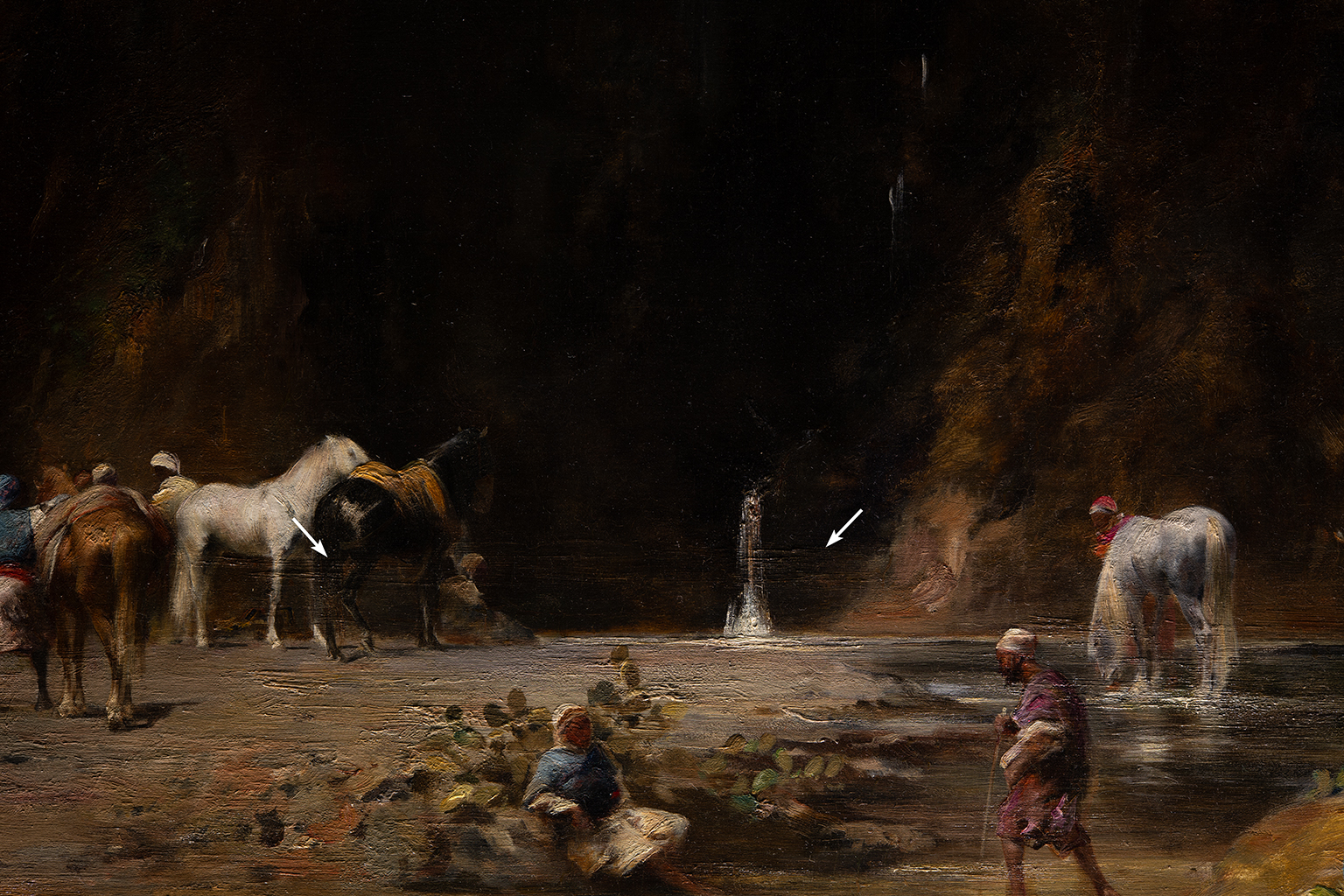 Fig. 15. Detail in raking light, with pronounced horizontal brushwork, showing that the water was lowered approximately five centimeters, A Ravine: Souvenir of Algeria (1874)
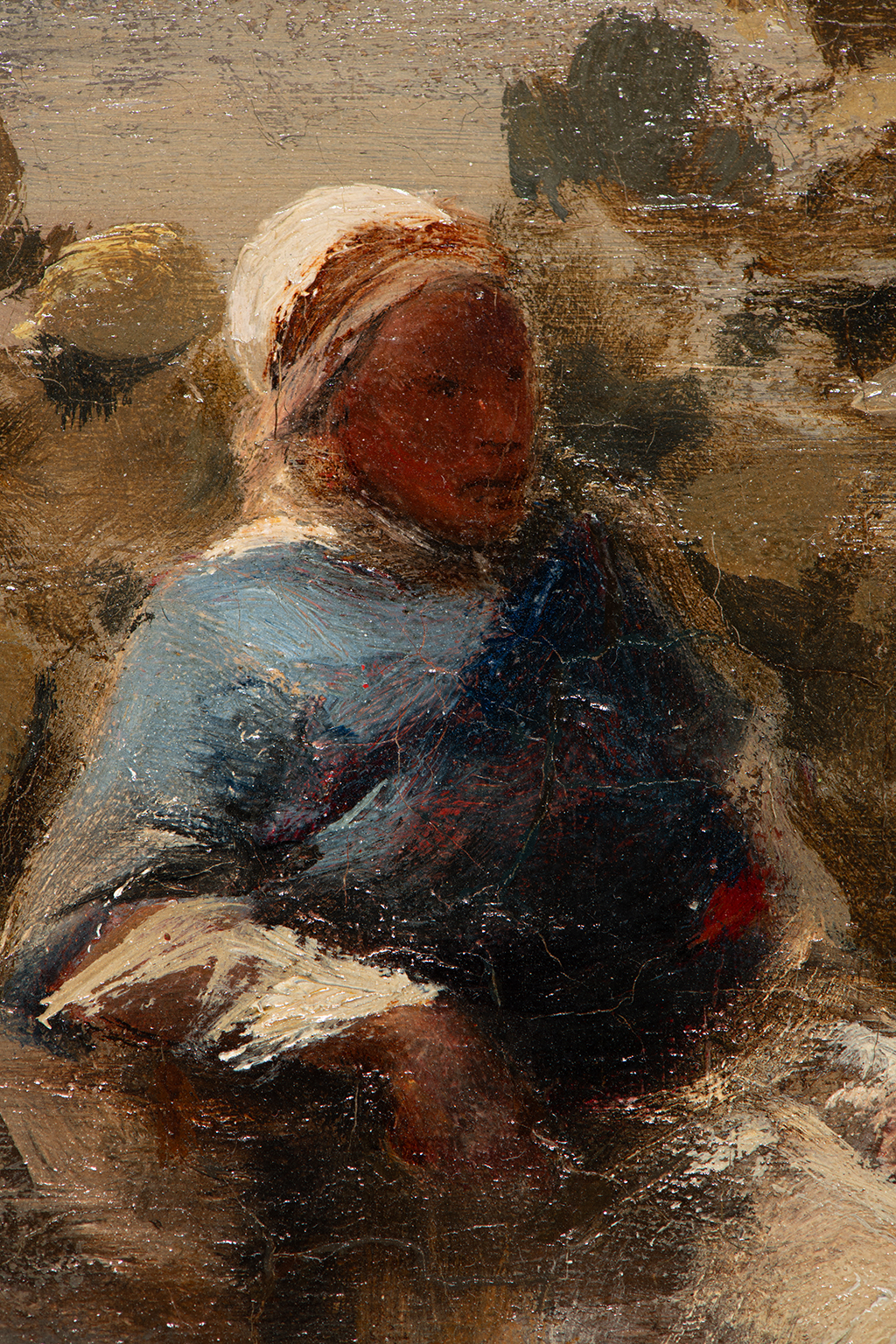 Fig. 16. Detail of reclining figure in center, A Ravine: Souvenir of Algeria (1874)
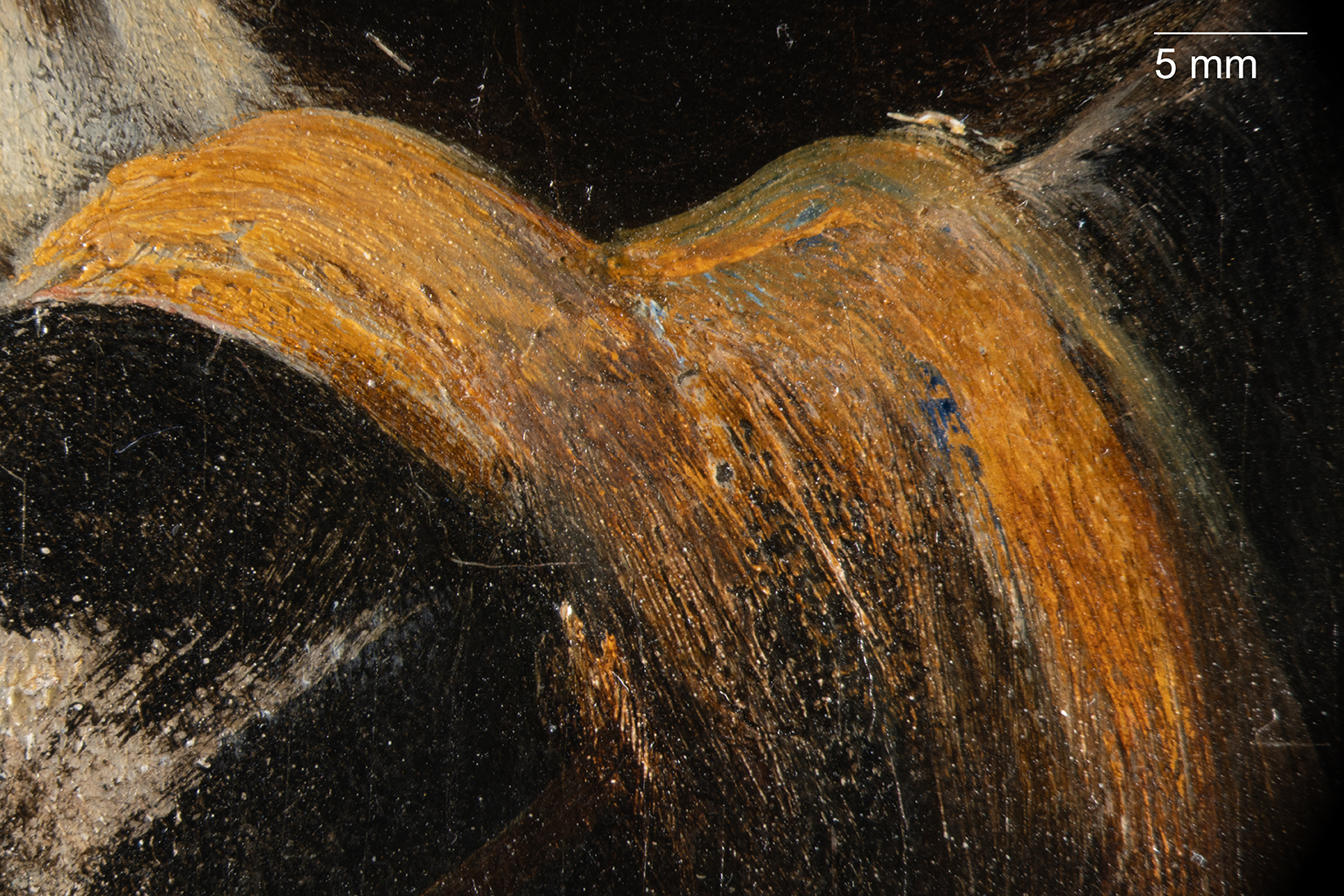
Fromentin further adjusted the composition by changing fabric colors. Red paint peeks through drying cracksdrying cracks: Also known as traction cracks, these are formed as the paint dries. They are usually the result of a "lean" paint with a small percentage of oil drying faster than an underlying "fat" paint layer with a higher percentage of oil. The quick drying of the top layer causes the paint layer to shrink and crack. and areas of abrasion in the blue tunic of the reclining figure (Fig. 16). When considering this figure in relation to the others, the final color selections resemble Algerian tirailleurs uniforms with a blue top and red sash present in the composition. On the black horse near the cliff face, beneath the deep yellow saddle, blue is visible through skips in the paint (Fig. 17). Since the blue paint does not mimic the shape of the saddle, it may have originally been a blue garment draped across the horse’s back.
The painting is in fair condition. Several horizontal splits are present, extending through both layers of the laminated panel, which likely necessitated the addition of a cradlecradle: A grid-like wooden structure attached to the reverse of a panel by a restorer to prevent warping.. On the right side, the topmost split appears to display some movement, indicating that in this location the cradle is no longer firmly attached. Along the bottom edge, two battens were added, likely for the painting to better fit within a frame. Based on the level of fluorescence of the paint on these battens when examined in ultraviolet radiationultraviolet (UV) radiation: A segment of the electromagnetic spectrum, just beyond the sensitivity of the human eye, with wavelengths ranging from 100–400 nanometers. For a description of its use in the study of art objects, see ultraviolet (UV) fluorescence or UV-induced visible fluorescence., it appears they were added early in the painting’s history. Although it is unlikely that the additions are original, the possibility cannot be ruled out as some brushstrokes appear to be continuous across the battens and into the composition. Additionally, as the entire composition appears to have been shifted down slightly, the battens could have been added by the artist to accommodate this adjustment. Abrasion is found throughout the painting and is particularly noticeable in areas of red and blue that were not mixed with white paint, such as in the figures’ clothing. The painting was last treated in 1988, at which time discolored varnish and retouchingretouching: Paint application by a conservator or restorer to cover losses and unify the original composition. Retouching is an aspect of conservation treatment that is aesthetic in nature and that differs from more limited procedures undertaken solely to stabilize original material. Sometimes referred to as inpainting or retouch. were removed, and losses were inpainted along the edges.5Scott Heffley, July 7, 1988, treatment report, NAMA conservation file, 34-103.
Notes
-
A similar occurrence is present in Arabs Resting (1874; private collection; see Figure 4 in the accompanying catalogue entry). This indicates that the “floating” appearance of cliffside trees was likely intentional and not the result of past overcleaning.
-
Fromentin’s work has been described as lacking “unity in the composition” with regards to small figures not being rendered in the same manner as the landscapes. The same can be said about the lack of communication between compositional elements within the Nelson-Atkins painting. Donald A. Rosenthal, Orientalism: The Near East in French Painting 1800–1880, exh. cat. (Rochester, NY: Memorial Art Gallery of the University of Rochester, 1982), 71.
-
While it appears that the white paint for the head covering was used to block out the darker background, it is also possible that the artist changed the color from white to red, as the other garment on this figure appears to have been changed from yellow to red.
-
Similarly, an underlying texture also shows that the waterfall was once four to five centimeters above its current placement.
-
Scott Heffley, July 7, 1988, treatment report, NAMA conservation file, 34-103.
Documentation
Citation
Chicago:
Glynnis Napier Stevenson, “Eugène Fromentin, A Ravine: Souvenir of Algeria, 1874,” documentation in French Paintings and Pastels, 1600–1945: The Collections of The Nelson-Atkins Museum of Art, ed. Aimee Marcereau DeGalan (Kansas City: The Nelson-Atkins Museum of Art, 2022), https://doi.org/10.37764/78973.5.406.4033.
MLA:
Stevenson, Glynnis Napier. “Eugène Fromentin, A Ravine: Souvenir of Algeria, 1874,” documentation. French Paintings and Pastels, 1600–1945: The Collections of The Nelson-Atkins Museum of Art, edited by Aimee Marcereau DeGalan, Nelson-Atkins Museum of Art, 2022. doi: 10.37764/78973.5.406.4033.
Provenance
Citation
Chicago:
Glynnis Napier Stevenson, “Eugène Fromentin, A Ravine: Souvenir of Algeria, 1874,” documentation in French Paintings and Pastels, 1600–1945: The Collections of The Nelson-Atkins Museum of Art, ed. Aimee Marcereau DeGalan (Kansas City: The Nelson-Atkins Museum of Art, 2022), https://doi.org/10.37764/78973.5.406.4033.
MLA:
Stevenson, Glynnis Napier. “Eugène Fromentin, A Ravine: Souvenir of Algeria, 1874,” documentation. French Paintings and Pastels, 1600–1945: The Collections of The Nelson-Atkins Museum of Art, edited by Aimee Marcereau DeGalan, Nelson-Atkins Museum of Art, 2022. doi: 10.37764/78973.5.406.4033.
The artist, by May 1, 1874 [1];
Auguste-Etienne-Louis Tabourier (1822–98) or his son, Louis-Léon-Alexander-Jérôme Tabourier (1858–97), Paris, by March 1877 [2];
Senator Prosper Crabbe (1827–89), Brussels;
Eugène Secrétan (1836–99), Paris, by March 15–July 1, 1889 [3];
Purchased at his sale, The Celebrated Collection of Paintings by Modern and Old Masters and of Water-Colors and Drawings formed by Mr. E. Secrétan, Galerie Charles Sedelmeyer, Paris, July 1, 1889, no. 30, as The Chiffa-Pass (Les Gorges de la Chiffa), by Paul Chevallier, for Boussod, Valadon et Cie, Paris, Goupil Stock Book 12, No. 19942, 1889–March 22, 1892 [4];
Purchased from Boussod, Valadon et Cie by Hector Brame, Paris, March 22, 1892 [5];
Anna Maria Francisca Gabriëlle Van den Eynde (1852–ca. 1926), Brussels, by May 18, 1897;
Purchased at her sale, Catalogue de Tableaux Modernes, Aquarelles, Pastels et Dessins par Axilette, Berne-Bellecour, Billotte, Corot, Daubigny, Decamps, Delacroix, Detaille, Jacque, Diaz, Fromentin, Hébert, Isabey, Jongkind, Leys, Meissonier, Millet, Th. Rousseau, Roybet, Stevens, Tassaert, Troyon, Vollon, Willems; Anciennes Porcelaines de la Chine et du Japon; Garniture de cinq pièces de vieux Chine a fond Capucin; Porcelaines et faïences variées; Douze fauteuils couverts en tapisserie Du temps de Louis XV; Meuble de salon Louis XVI couvert en lampas; Composant la Collection de Mme G. Van den Eynde, Hôtel Drouot, Paris, May 18, 1897, lot 12, as Les Gorges de la Chiffa, by Durand-Ruel, Paris, stock no. 4273, May 18–19, 1897 [6];
Purchased from Durand-Ruel, Paris, by George Jay Gould I (1864–1923), New York and Lakewood, NJ, May 19, 1897–at least March 1914 [7];
With Galerie Georges Petit, by January 1924 [8];
With Albert Duveen, New York, by January 15, 1934;
Purchased from Albert Duveen, through Harold Woodbury Parsons, by The Nelson-Atkins Museum of Art, Kansas City, MO, 1934.
Notes
[1] Paul de Saint-Victor, “Salon de 1874: Septième Article (1),” La Liberté (June 16, 1874), notes that the Salon featured “two paintings of his [Fromentin’s] sending.”
[2] Both Tabouriers went by “L. Tabourier.” The elder Tabourier is listed as the owner of Jean-Baptiste-Camille Corot, Le berger sous les arbres (soleil couchant), 1853, published in European Art: Part II, Christie’s, New York, October 31, 2018, lot 106. He owned it between 1881 and October 8, 1887, when he sold it to Boussod, Valadon, et Cie. There is no record of the son being an art collector, and he was only nineteen in 1877 when Tabourier owned the Nelson-Atkins picture.
[3] Earliest mention of the six Fromentins in the Secrétan collection. Albert Wolff, “Courrier de Paris,” Figaro, no. 74 (March 15, 1889): 1.
[4] The painting was bought by the auctioneer Paul Chevallier at this sale. See Goupil Book 12, Stock No. 19942, Page 112, Row 12, The Getty Research Institute, Los Angeles.
[5] See Goupil Book 13, Stock No. 19942, Page 21, Row 5, The Getty Research Institute, Los Angeles.
[6] An annotated sales catalogue from the Getty Research Institute, Los Angeles, records the buyer’s name as “DRuel.” See email from Paul-Louis Durand-Ruel and Flavie Durand-Ruel to Aimee Marcereau DeGalan, Nelson-Atkins, November 16, 2017, Nelson-Atkins curatorial file. It was sold on May 19, 1897 to George J. Gould and expedited shortly thereafter to New York. See email from Paul-Louis Durand-Ruel to Glynnis Napier Stevenson, Nelson-Atkins, January 6, 2020.
[7] The Nelson-Atkins Fromentin hung in the main hall of George J. Gould’s New Jersey residence as of March 1914. See “A Catalogue of Pictures and Objects of Art at Georgian Court, Lakewood, New Jersey, the residence of George J. Gould, Esq. March 1914,” Duveen Brothers Collectors’ Files, ca. 1910–1925: Gould, George J., The Getty Research Institute, Los Angeles.
[8] See Prosper Dorbec, “L’Hellénisme d’Eugène Fromentin,” Gazette des Beaux-Arts 9, no. 743 (January 1924): 33–34, (repro.), as Chevaux à l’abreuvoir. Georges Beaume, Fromentin (Paris: Sociétés des Éditions Louis-Michaud, [1911]), which is an unreliable source, conflates a reproduction of the Nelson-Atkins work with either another work exhibited by Georges Petit in 1892, Chevaux à l’abreuvoir from the M. Boucheron collection, or a painting entitled Arabes dans la gorge de la Chiffa from the Paul Lagarde collection exhibited by Petit in 1884 and 1892. Pierre Sanchez, Les expositions de la Galerie Georges Petit (1881–1934): Repertoire des artistes et leurs œuvres (Paris: L’Echelle de Jacob, 2009), 4:809. 1924 is the earliest date it is possible for Petit to have owned the Nelson-Atkins painting.
Related Works
Citation
Chicago:
Glynnis Napier Stevenson, “Eugène Fromentin, A Ravine: Souvenir of Algeria, 1874,” documentation in French Paintings and Pastels, 1600–1945: The Collections of The Nelson-Atkins Museum of Art, ed. Aimee Marcereau DeGalan (Kansas City: The Nelson-Atkins Museum of Art, 2022), https://doi.org/10.37764/78973.5.406.4033.
MLA:
Stevenson, Glynnis Napier. “Eugène Fromentin, A Ravine: Souvenir of Algeria, 1874,” documentation. French Paintings and Pastels, 1600–1945: The Collections of The Nelson-Atkins Museum of Art, edited by Aimee Marcereau DeGalan, Nelson-Atkins Museum of Art, 2022. doi: 10.37764/78973.5.406.4033.
Eugène Fromentin, View in the Gorges of Chiffa (A Region of Algeria), 1846, oil on canvas, 23 1/2 x 19 in. (60 x 48 cm), private collection. Sold at Important 19th Century Pictures, Christie’s, London, March 23, 1984, lot 90, as Arabs Resting in a Rocky Landscape, possibly Les Gorges de la Chiffa.
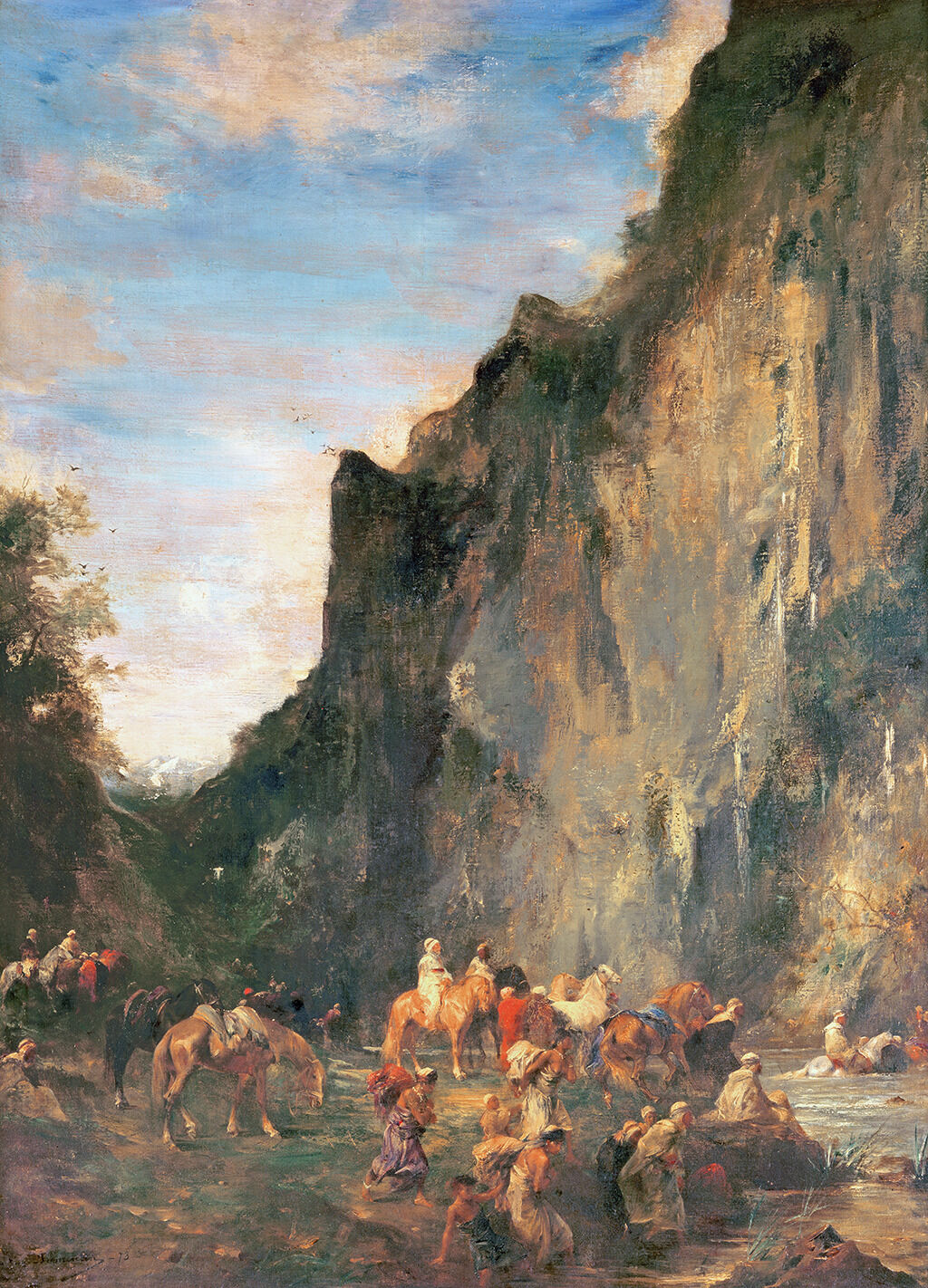
Eugène Fromentin, Arabs Fording a Mountain Stream, 1873, oil on canvas, 33 1/4 x 24 1/2 in. (84.2 x 62.2 cm), private collection. Sold at Pictures, drawings and prints particularly of American, African, Australasian, Eastern and Islamic interest, Christie’s, London, November 2, 1979, lot 216.
Eugène Fromentin, Arab Horsemen in a Gorge, ca. 1873, oil on canvas, 33 1/2 x 24 3/4 in. (85.1 x 62.9 cm), private collection. Sold at 19th Century Continental Pictures, Watercolours and Drawings From various sources, Christie’s, London, March 18, 1994, lot 153.
Eugène Fromentin, Falcon Hunt (“Algeria Remembered”), 1874, oil on canvas, 43 11/16 x 56 11/16 in. (111 x 144 cm), National Gallery of Ireland, Dublin, NGI.4231.
Eugène Fromentin, Les Gorges de la Chiffa, possibly 1874, oil on unknown support, 10 1/8 x 8 1/4 in. (25.7 x 21 cm), private collection. Sold from the estate of Frank V. Whitney at Oil paintings and water colors, Fifth Avenue Auction Rooms, New York, April 7–9, 1915, lot 227, as In the Ravine.
Eugène Fromentin, Ravin, souvenir d’Algérie, 1874, oil on panel, 24 3/4 x 19 1/2 in. (63 x 49.5 cm), private collection. Sold at Regards sur l’Orient: tableaux, sculptures et objets d’art, Sotheby’s, Paris, October 29, 2008, lot 35.
Charles Busson (1822–1908), Old Ditches of the Château de Lavardin, near Montoire, ca. 1874, oil on canvas, 83 1/2 x 62 in. (212 x 160 cm), town hall of Corcieux, on deposit from the Musée d’Orsay, Paris.
Exhibitions
Citation
Chicago:
Glynnis Napier Stevenson, “Eugène Fromentin, A Ravine: Souvenir of Algeria, 1874,” documentation in French Paintings and Pastels, 1600–1945: The Collections of The Nelson-Atkins Museum of Art, ed. Aimee Marcereau DeGalan (Kansas City: The Nelson-Atkins Museum of Art, 2022), https://doi.org/10.37764/78973.5.406.4033.
MLA:
Stevenson, Glynnis Napier. “Eugène Fromentin, A Ravine: Souvenir of Algeria, 1874,” documentation. French Paintings and Pastels, 1600–1945: The Collections of The Nelson-Atkins Museum of Art, edited by Aimee Marcereau DeGalan, Nelson-Atkins Museum of Art, 2022. doi: 10.37764/78973.5.406.4033.
Salon of 1874, Room no. 10, Palais des Champs-Élysées, Paris, opened May 1, 1874, no. 756, as Un ravin;—souvenir d’Algérie.
Exposition des Œuvres de Eugène Fromentin, École nationale des Beaux-Arts, Paris, March 1877, no. 10, as Un Ravin; souvenir d’Algérie, Arabes faisant boire leurs chevaux.
Exposition rétrospective de tableaux et dessins des maîtres modernes, Galerie Durand-Ruel, Paris, opened June 20, 1878, no. 219, as Le Ravin.
Winter Exhibition, Union League, New York, by November 11, 1898, no cat., as The Oasis.
Louisiana Purchase Exposition (St. Louis World’s Fair), St. Louis, April 30–December 1, 1904, no. 69, as Arab Encampment—Gorges of Chiffa.
Winslow Homer and the Critics: Forging a National Art in the 1870s, The Nelson-Atkins Museum of Art, Kansas City, MO, February 18–May 6, 2001; Los Angeles County Museum of Art, June 10–September 9, 2001; High Museum of Art, Atlanta, October 6, 2001–January 6, 2002, (Kansas City only), hors cat.
A Magnificent Age: French Paintings from the Walters Art Museum, June 28–September 7, 2003, The Nelson-Atkins Museum of Art, Kansas City, MO, no cat.
References
Citation
Chicago:
Glynnis Napier Stevenson, “Eugène Fromentin, A Ravine: Souvenir of Algeria, 1874,” documentation in French Paintings and Pastels, 1600–1945: The Collections of The Nelson-Atkins Museum of Art, ed. Aimee Marcereau DeGalan (Kansas City: The Nelson-Atkins Museum of Art, 2022), https://doi.org/10.37764/78973.5.406.4033.
MLA:
Stevenson, Glynnis Napier. “Eugène Fromentin, A Ravine: Souvenir of Algeria, 1874,” documentation. French Paintings and Pastels, 1600–1945: The Collections of The Nelson-Atkins Museum of Art, edited by Aimee Marcereau DeGalan, Nelson-Atkins Museum of Art, 2022. doi: 10.37764/78973.5.406.4033.
Nestor Pauturot, Le Salon de 1874 (Paris: Bureaux du journal le National, 1874), 194, as Ravin en Afrique.
Salon de 1874: Explication des Ouvrages de Peinture, Sculpture, Architecture, Gravure et Lithographie des Artistes Vivants, exh. cat. (Paris: Imprimerie nationale, 1874), 109 [repr., in H. W. Janson, ed., Catalogues of the Paris Salon 1673–1881, vol. 52 (New York: Garland, 1977) and repr., in Pierre Sanchez and Xavier Seydoux, Les catalogues des salons des beaux-arts (Paris: Échelle de Jacob, 2004)], as Un ravin;—souvenir d’Algérie.
Marc de Montifaud, “Le Salon de 1874,” L’Artiste: Histoire de l’art contemporain 1 (May 1, 1874): 305, as un Ravin.
“Salon de 1874: La Fleur du livret,” Le Petit Journal, no. 4,145 (May 2, 1874): 1, as Un ravin.
Albert Wolff, “Le Salon de 1874: M. Fromentin,” Le Gaulois, no. 2049 (May 24, 1874): unpaginated, as Le Ravin.
Ernest Duvergier de Hauranne, “Le Salon de 1874,” Revue des Deux Mondes 3, no. 3 (June 1, 1874): 682.
Aug. Parmentier, “Salon de 1874,” La Fantaisie parisienne, no. 10 (June 15, 1874): 5, as Ravin.
Paul de Saint-Victor, “Salon de 1874: Septième Article (1),” La Liberté (June 16, 1874): unpaginated, as Ravin.
“Avis,” Le Courrier de la Rochelle, no. 48 (June 17, 1874): 2-3, as Ravin and Souvenirs d’Algérie.
Possibly Un Amateur, “Salon de 1874,” Le Voleur, no. 886 (June 26, 1874): 410, as Souvenir d’Algérie.
Louis Gonse, “Salon de 1874,” Gazette des Beaux-Arts 10, no. 205 (July 1, 1874): 48-49, as le Ravin.
Marc de Montifaud [Marie-Amélie Chartroule], “Le Salon de 1874: Paysage,” L’Artiste: Histoire de l’art contemporain 2 (July 1, 1874): 16, as Souvenir d’Algérie.
Paul de Saint-Victor, “Le Salon de 1874: Les Paysagistes,” L’Artiste: Histoire de l’art contemporain 2 (August 1, 1874): 80, as Le Ravin.
“Science—Littérature—Beaux-Arts: Revue artistique, Publications d’art,” Journal officiel de la République française, no. 351 (December 23, 1875): 10,686, as le Ravin.
“Notes: Eugène Fromentin,” Art Journal 2 (1876): 352, as Un Ravin. 11/13/19
“Chronique,” La Presse (January 14, 1876): unpaginated, as Ravin.
Jean-Franc̜ois-Marie Bertet-Dupiney de Vorepierre, Dictionnaire des noms propres, ou Encyclopédie illustrée de biographie, de géographie, d’histoire et de mythologie (Paris: Michel Lévy, 1876), 1:1618, as Ravin en Algérie.
Louis Gonse, Exposition des œuvres de Eugène Fromentin A [sic] l’École nationale des Beaux-Arts, Quai Malaquais, exh. cat. (Paris: Imprimerie Jules Claye, 1877), 21, 31, as chevaux [repr., in Theodore Reff, Modern Art in Paris: Two-Hundred Catalogues of the Major Exhibitions Reproduced in Facsimile in Forty-Seven Volumes, vol. 39 (New York: Garland, 1981)], as Un Ravin; souvenir d’Algérie, Arabes faisant boire leurs.
Lucy H. Hooper, “Art-Notes from Paris,” Art Journal 3 (1877): 189, as Ravine.
Louis Gonse, “Eugène Fromentin: Peintre et écrivain,” Gazette des Beaux-Arts 17 (May 1, 1878): 410, as le Ravin.
Asmodée, “Échos de partout,” La Liberté (June 9, 1878): unpaginated.
“Concours et expositions,” La Chronique des arts et de la curiosité, no. 23 (June 15, 1878): 179.
Exposition rétrospective de tableaux et dessins des maîtres modernes, exh. cat. (Paris: Galerie Durand-Ruel, 1878), 36, as Le Ravin.
Pierre Larousse, Grand Dictionnaire universel du XIXe siècle (Paris: Administration du Grand Dictionnaire universel, 1878), 16:856, as Souvenir d’Alger, Un ravin en Algérie.
Clara Erskine Clement Waters and Laurence Hutton, Artists of the Nineteenth Century and their Works (Boston: Houghton, Osgood, 1879), 1:275, as A Ravine in Algiers.
Louis Gonse, “Eugène Fromentin: Peintre et écrivain,” Gazette des Beaux-Arts 21 (January 1, 1880): 51–52, as Souvenir d’Algérie.
Gustave Vapereau, Dictionnaire universel des contemporains: contenant toutes les personnes notables de la France et des pays étrangers, 5th ed. (Paris: Librairie Hachette, 1880), 755, as Souvenir d’Algérie, un Ravin.
Louis Gonse, Eugene Fromentin: Peintre et écrivain (Paris: A. Quantin, 1881), 29, 96–97, as Le Ravin.
Nouveau dictionnaire encyclopédique universel illustré: répertoire des connaissances humaines (Paris: Librairie illustrée, 1885–1891), 3:34, as Ravin en Algérie.
John Denison Champlin and Charles C. Perkins, eds., Cyclopedia of Painters and Paintings (New York: Charles Scribner’s Sons, 1887), 2:95, as Ravine.
Albert Wolff, “Courrier de Paris,” Figaro, no. 74 (March 15, 1889): 1.
Emma Bullet, “Passing Paris Topics: Recent Observations Among the Artists,” Brooklyn Daily Eagle 49, no. 103 (April 14, 1889): 9.
“France,” Times (London), no. 32,704 (May 21, 1889): 5.
“The Secrétan Collection,” Morning Post, no. 36,489 (May 29, 1889): 7.
C.M.S., “Gallery and Studio: The Great Secretan [sic] Collection to be Sold in Paris,” Brooklyn Daily Eagle 49, no. 158 (June 9, 1889): 7, as The Gorges of Chiffa.
“The Secretan [sic] Collection,” Boston Globe 35, no. 160 (June 9, 1889): 1.
“Cotton Bagging For Georgia,” Macon Telegraph (June 13, 1889): 4.
“Art,” Churchman 59, no. 24 (June 15, 1889): 749.
C.M.S., “Gallery and Studio: Further Notes on the Secretan [sic] Collection of Pictures,” Brooklyn Daily Eagle 49, no. 165 (June 16, 1889): 6, as Gorge of Chiffa.
“Some Artistic Gems: A Grand Collection of Paintings, the Masterpieces of the Greatest of French Artists; The Dethroned Copper King’s Famous Gallery to Be Dismantled; Some Pictures with Histories,” Pittsburgh Dispatch (June 23, 1889): 9, as Chiffa Pass.
Paul Mantz, “La collection Secrétan,” Le Temps, no. 10,231 (June 29, 1889): unpaginated.
Catalogue of The Celebrated Collection of Paintings by Modern and Old Masters and of Water-Colors and Drawings formed by Mr. E. Secrétan (Paris: Boussod, Valadon, et Sedelmeyer, July 1–4, 1889), xv, 32, (repro.), as The Chiffa-Pass (Les Gorges de la Chiffa).
Albert Wolff, Edition De Luxe: The Collection of Paintings by Modern and Old Masters and of Water Colors and Drawings Formed by Mr. E. Secrétan, vol. 1 (Paris: Boussod, Valadon, 1889), xv, xvii, 32, (repro.), as The Chiffa-Pass (Les Gorges de la Chiffa).
Alphonse de Calonne, “La collection Secrétan,” L’Artiste: revue de l’art contemporaine 2 (July 1889): 29, as Gorges de la Chiffa.
Henry Fouquier, “Chronique,” La Revue de famille 1 (July 1, 1889): 382.
“Informations: La vente Secrétan,” Journal des débats politiques et littéraires (July 2, 1889): unpaginated, as Les Gorges de la Chiffa.
“Secretan’s [sic] Art Treasures: Millet’s ‘Evening Prayer’ Sold for a Fortune,” Saint Paul Globe 9, no. 183 (July 2, 1889): 4, as The Chiffa Pass.
“Secretan’s [sic] Great Sale: Scattering His Many Art Treasures; Millet’s ‘L’Angelus’ Going to the Louvre for $111,000—Making Meissonier’s Wedding Day,” New York Times 38, no. 11,807 (July 2, 1889): 2, as The Chiffa Pass.
“The Secrétan Sale,” Times (London), no. 32,740 (July 2, 1889): 5, as Les Gorges de la Chiffa.
“Au jour le jour: La vente Secrétan,” Le Temps, no. 10,285 (July 3, 1889): unpaginated, as les Gorges de la Chiffa.
E. de M., “La Vente Secrétan,” La Liberté (July 3, 1889): 3, as Les Gorges de La Chiffa.
“La Vente Secrétan,” La Justice, no. 3,458 (July 3, 1889): unpaginated, as les Gorges de la Chiffa.
Scaramouche, “La Vente Secrétan,” Le Gaulois, no. 2,501 (July 4, 1889): 1.
Georges d’Heylli, “Revue économique: La vente Secrétan,” L’Économiste français 2, no. 27 (July 6, 1889): 14, as Les Gorges de la Chiffa.
“Sales,” Athenæum, no. 3,219 (July 6, 1889): 39, as Les Gorges de la Chiffa.
“Art and Artists: The Secretan [sic] Sale,” Sunday Inter Ocean 18, no. 105 (July 7, 1889): 16, as Tbe Chiffa Pass.
“Variétés: Un tableau d’un demi-million,” L’Avenir de Bel-Abbès, no. 650 (July 10, 1889): unpaginated, as La Chiffa.
“Variétés: La Vente Secrétan,” Gazette anecdotique, littéraire, artistique 2, no. 13 (July 15, 1889): 23, as Les Gorges de la Chiffa.
W. H. Burbank, “Amateur Photography: The Sale of the Secrétan Pictures,” Art Amateur 21, no. 3 (August 1889): 63, as The Chiffa-Pass.
D. C. T., “The Secrétan Collection,” Art Journal (November 1889): 306, 310, as Les Gorges de la Chiffa.
Appleton’s Annual Cyclopaedia and Register of Important Events of the Year 1889 (New York: D. Appleton, 1890), 29:320, as Gorges de la Chiffa.
Artistes contemporains des pays de Guyenne, Béarn, Saintonge et Languedoc; Léon Bonnat, Maxime Lalanne, Fromentin, Brascassat, Goya, Rosa Bonheur, Falguière, Leo Drouyn, Chabry, Diaz, Ingres; Notices par MM. Louis Bauzon, Paul Berthelot, Paul Bonnefon, Ch. Chaumet, Ch. Marionneau, Laurent Mathéron, E. Toulouze, E. Vallet (Bordeaux, France: 1889), 74, as Un ravin, souvenir d’Algérie.
Narcisse Faucon, Le Livre d’or de l’Algérie, vol. 1, Biographies, 2nd ed. (Paris: Augustin Challamel, 1890), 265, as Un ravin.
[Jules-Antoine] Castagnary, Salons (Paris: Bibliothèque-Charpentier, 1892), 2:117, as Souvenirs d’Algérie.
“Notes,” Nation 64, no. 1662 (May 6, 1897): 341.
“Collection de Mme. G. Van Den Eynde,” Le Journal (May 13, 1897): 4.
“Collection of Mme. G. Van Den Eynde,” International Herald Tribune, no. 22,179 (May 13, 1897): 6.
“Collection de Mme. G. Van Den Eynde,” La Liberté, no. 11,860 (May 14, 1897): 4.
Le Masque de Fer, “Échos: A Travers Paris,” Le Figaro, no. 134 (May 14, 1897): 1.
Un Domino, “Échos de Paris,” Le Gaulois, no. 5670 (May 15, 1897): 1.
“Expositions et Ventes,” Le Figaro, no. 135 (May 15, 1897): 6.
Catalogue de Tableaux Modernes, Aquarelles, Pastels et Dessins par Axilette, Berne-Bellecour, Billotte, Corot, Daubigny, Decamps, Delacroix, Detaille, Jacque, Diaz, Fromentin, Hébert, Isabey, Jongkind, Leys, Meissonier, Millet, Th. Rousseau, Roybet, Stevens, Tassaert, Troyon, Vollon, Willems; Anciennes Porcelaines de la Chine et du Japon; Garniture de cinq pièces de vieux Chine a fond Capucin; Porcelaines et faïences variées; Douze fauteuils couverts en tapisserie Du temps de Louis XV; Meuble de salon Louis XVI couvert en lampas; Composant la Collection de Mme G. Van den Eynde (Paris: Hôtel Drouot, May 18–19, 1897), 12, (repro.) as Les Gorges de la Chiffa.
“Faits divers: Informations diverses,” Le Temps, no. 13,136 (May 20, 1897): unpaginated, as Gorges de la Chiffa.
Gazette Drouot (May 21, 1897): 1, as Les Gorges de la Chiffa.
“Beaux-Arts: La collection van den Eynde,” La Croix, no. 4,320 (May 22, 1897): unpaginated, as Gorges de la Chiffa.
“Mouvement des arts: Collection de Mme Van den Eynde; Vente faite à l’Hôtel Drouot, les 18 et 19 mai,” La Chronique des arts et de la curiosité, no. 21 (May 22, 1897): 197–98, as Les Gorges de la Chiffa.
“Art at the Union League,” New York Times 48, no. 15,238 (November 11, 1898): 7, as The Oasis.
“M. Secrétan,” Times (London), no. 35,775 (March 13, 1899): 6.
M. N., “Chronique des ventes: Tableaux—Objets d’Art; Curiosité,” Le Bulletin de l’art, no. 11 (March 18, 1899): 92.
“American Collections XXI. The Collection of George J. Gould, Esq., Lakewood, N. J.,” Collector and Art Critic 2, no. 12 (April 15, 1900): 200–01, as The Halt.
“Chroniques Rochelaises: Une statue a [sic] Eugène Fromentin,” Le Courrier de la Rochelle, no. 101 (December 20, 1900): 1, as Souvenir d’Algérie, un ravin.
E[rnest] Brard, “Eugène Fromentin,” Le Courrier de la Rochelle, no. 87 (October 30, 1902): 1, as Le Ravin.
Ernest Brard, Nos Gloires nationales: Eugène Fromentin, notes biographiques (La Rochelle, France: Imprimerie de Masson, 1902), 13, as Le Ravin.
Jules Huret, “En Amérique: Maisons de campagne,” Le Figaro, no. 211 (July 30, 1903): 3.
Le Signal: messager de la semaine (September 9, 1903): unpaginated, as Le Ravin.
A. Ollivier, Eugène Fromentin: peintre et écrivain (La Rochelle, France: Imprimerie Rochelaise, 1903), 22, as Le Ravin.
Jules Huret, “Le livre du jour: En Amérique,” Les Annales politiques et littéraires: Revue populaire paraissant le dimanche, no. 101 (July 31, 1904): 7.
Frederick J. V. Skiff, Official Catalogue of Exhibitors: Universal Exposition, St. Louis, U.S.A., 1904, exh. cat. (St. Louis: Official Catalogue Company, 1904), 72, as Arab Encampment—Gorges of Chiffa.
“An Expert’s Notes on World’s Fair Pictures: The Loan Collection,” St. Louis Globe-Democrat 30, no. 134 (September 30, 1904): 10, as Arab Encampment—Gorges of Chiffa.
Pierre Blanchon, ed., Eugène Fromentin: (1820–1876) (La Rochelle, France: Librairie-Imprimerie A. Foucher, 1905), 20, as Le Ravin.
Jules Huret, En Amérique: de New York, a [sic] la Nouvelle-Orleans (Paris: Bibliothèque-Charpentier, 1905), 205.
Théodore Guèdy, Manuel pratique du Collectionneur de Tableaux Comprenant Les principales Ventes des XVIIIe, XIXe siècles jusqu’à nos jours, des œuvres des Peintres de toutes les écoles, Signatures et Monogrammes (Paris, 1906), 63, as La gorge de Chiffa.
Émile Michel, Great Masters of Landscape Painting (1906; repr. Philadelphia: J. B. Lippincott, 1910), 397, (repro.), as The Gorge of the Chiffa.
Delancey M. Ellis, “Loan Collection of Paintings,” New York at the Louisiana Purchase Exposition—St. Louis 1904 (1907): 137.
Karl Baedeker, The United States with Excursions to Mexico, Cuba, Porto [sic] Rico, and Alaska, 4th rev. ed. (Leipzig: Karl Baedeker, 1909), 179.
Les peintres illustrés: Fromentin; huit reproductions fac-simile en couleurs (Paris: P. Lafitte, 1910), 41, as Ravin.
Jules Huret, “La vie de campagne,” L’Amérique moderne 1 (1911): 46.
Georges Beaume, Fromentin (Paris: Sociétés des Éditions Louis-Michaud, [1911]), 98, 145, (repro.), as Le Ravin and Chevaux à l’abreuvoir.
Eugène Fromentin, Correspondance et Fragments inédits, 4th ed. (Paris: Plon-Nourrit, 1912), 297–98, as Ravin.
Isabelle Errera, Répertoire des peintures datées (Brussels: G. Van Oesta, 1921), 2:847, as Gorges de la Chiffa.
Prosper Dorbec, “L’Hellénisme d’Eugène Fromentin,” Gazette des Beaux-Arts 9, no. 743 (January 1924): 33–34, (repro.), as Chevaux à l’abreuvoir.
Prosper Dorbec, L’art du paysage en France: essai sur son évolution de la fin du XVIIIe siècle à la fin du second empire (Paris: Henri Laurens, 1925), unpaginated, (repro.), as Chevaux à l’abreuvoir.
Prosper Dorbec, Eugene Fromentin (Paris: Renouard, 1926), 33, 84, (repro.), as Chevaux à l’abreuvoir.
“Art and Artists: ‘Masterpiece of Week’ On Display Next Sunday; Plan to Give a Single Work of Art a Spotlight and Special Setting Each Week at the Nelson Gallery to Be Inaugurated Sunday,” Kansas City Star 54, no. 173 (March 9, 1934): 15, as Chiffa Pass.
Victor Giraud, “Eugène Fromentin: I, L’Homme,” Revue des Deux Mondes 51, no. 2 (May 15, 1939): 428, as Ravin.
The William Rockhill Nelson Gallery of Art and Mary Atkins Museum of Fine Arts, The William Rockhill Nelson Collection, 2nd ed. (Kansas City, MO: William Rockhill Nelson Gallery of Art and Mary Atkins Museum of Fine Arts, 1941), 168, as Chiffa Pass.
Ross E. Taggart, ed., Handbook of the Collections in the William Rockhill Nelson Gallery of Art and Mary Atkins Museum of Fine Arts, 4th ed. (Kansas City, MO: William Rockhill Nelson Gallery of Art and Mary Atkins Museum of Fine Arts, 1959), 260, as Chiffa Pass.
Barbara Wright, “Poème inédit de Fromentin: ‘La Fin du Rhamadan,’” French Review 38, no. 6 (May 1965): 777, as Le Ravin.
Edwin Palmer Hoyt, The Goulds: A Social History (New York: Weybright and Talley, 1969), 231.
Odile de Saint-Afrique, Carmen Montiert-Ducros, and Lise Carrier, eds., Fromentin: le peintre et l’écrivain, 1820–1876, exh. cat. (La Rochelle, France: Bibliothèque municipal, 1970), 4, 59, as le Ravin.
Lilian Husson, “Plume et pinceau: Eugène Fromentin (1820–1876),” Publications du Comité du vieil Alger 7 (1972): 26, as Le Ravin.
Fouad Marcos, Fromentin et l’Afrique (Quebec: Éditions Cosmos, 1973), 167–68, 209, as le Ravin.
Ross E. Taggart and George L. McKenna, eds., Handbook of the Collections in The William Rockhill Nelson Gallery of Art and Mary Atkins Museum of Fine Arts, Kansas City, Missouri, vol. 1, Art of the Occident, 5th ed. (Kansas City, MO: William Rockhill Nelson Gallery of Art and Mary Atkins Museum of Fine Arts, 1973), 258, as Chiffa Pass.
Emanuel J. Mickel, Jr., Eugène Fromentin (Boston: Twayne, 1981), 22.
Eugene Fromentin, Œuvres complètes, ed. Guy Sagnes (Paris: Éditions Gallimard, 1984), XXXIV, as Le Ravin.
James Thompson and Barbara Wright, Les Orientalists, vol. 6, La vie et l’œuvre d’Eugène Fromentin (Paris: ACR Édition, 1987), 294, 296–98, (repro.), as Un Ravin: Souvenir d’Algérie.
Claude Herzfeld, “Reviewed Work: ‘La Vie et l’Œuvre d’Eugène Fromentin, dans la série Les Orientalistes.’ ACR Edition by Barbara Wright, James Thompson,” Nineteenth-Century French Studies 19, no. 1 (Fall 1990): 150, as Un Ravin; Souvenir d’Algérie.
Maitres des XIXe et XXe Siècles, exh. cat. (Paris: Galerie H. Odermatt et Ph. Cazeau, 1988), unpaginated.
James Thompson, The East Imagined, Experienced, Remembered: Orientalist Nineteenth Century Painting, exh. cat. (Dublin: National Gallery of Ireland, 1988), 79, 87, as The Ravine; Algeria Remembered.
James Thompson and Barbara Wright, Eugène Fromentin au Musée des beaux-arts de La Rochelle: suivi d’une évocation sommaire des œuvres de son père (La Rochelle, France: Musée des beaux-arts de La Rochelle, 1988), 50, as Un Ravin: Souvenir d’Algérie.
Roger Ward and Patricia J. Fidler, eds., The Nelson-Atkins Museum of Art: A Handbook of the Collection (New York: Hudson Hills Press, in association with Nelson-Atkins Museum of Art, 1993), 130, 203, (repro.), as Chiffa Pass.
Elwood Hartman, Three Nineteenth-Century French Writer/Artists and the Maghreb: The Literary and Artistic Depictions of North Africa by Théophile Gautier, Eugène Fromentin, and Pierre Loti (Tübingen, Germany: Gunter Narr Verlag, 1994), 98, as Le Ravin.
Barbara Wright, ed., Correspondance d’Eugène Fromentin (Paris: CNRS-Editions, 1995), 1: 82; 2: 1843, as Un Ravin: Souvenir d’Algérie.
19-20-seiki Furansu kindai kaigaten: Airurando Kokuritsu Bijutsukan shozō Korō kara Pikaso made = French 19th and 20th Century Paintings from the National Gallery of Ireland: Corot to Picasso, exh. cat. (Tokyo: Mainichi Newspapers, 1996), 112, as A Ravine: Algeria Remembered.
Jane Turner, ed., The Grove Dictionary of Art (London: Macmillan, 1996), 11:801, as Algeria Remembered.
Clément Borgal, Eugène Fromentin: tel qu’en lui-même (Paris: L’Harmattan, 1998), 253, as Ravin and Souvenir d’Algérie.
E[mmanuel] Bénézit, Dictionnaire critique et documentaire des peintres, sculpteurs, dessinateurs, et graveurs de tous les temps et de tous les pays par un groupe d’écrivains spécialistes français et étrangers, new ed., ed. Jacques Busse (Paris: Gründ, 1999), 5:743, as Les Gorges de la Chiffa.
Barbara Wright, Eugène Fromentin: A Life in Art and Letters (Bern: Peter Lang, 2000), 441, 490, 494–95, 501n17, as Un Ravin: Souvenir d’Algérie and Algeria Remembered.
Regards sur l’Orient: tableaux, sculptures et objets d’art (Paris: Sotheby’s, October 29, 2008), 44.
Christine Davis, ed., National Gallery of Ireland/Gailearaí Náisiúnta na hÉireann: Essential Guide, 2nd ed. (London: Scala, 2008), 112, as A Ravine and Algeria Remembered.
Deborah Emont Scott, ed., The Nelson-Atkins Museum of Art: A Handbook of the Collection, 7th ed. (Kansas City, MO: Nelson-Atkins Museum of Art, 2008), 117, as A Ravine: Souvenir of Algeria.
James Thompson and Barbara Wright, Eugène Fromentin, 1820–1876: Visions d’Algérie et d’Egypte, new ed. (Paris: ACR Édition, 2008), 358, 360–61, 368–70, 568, (repro.), as Un Ravin; Souvenir d’Algérie.
Catherine Futter et al., Bloch Galleries: Highlights from the Collection of the Nelson-Atkins Museum of Art (Kansas City, MO: Nelson-Atkins Museum of Art, 2016), 30, (repro.), as A Ravine: Souvenir of Algeria.
Patrick Tudoret, Fromentin: Le roman d’une vie, Biographie (Paris: Les Belles Lettres, 2018), 244, as Souvenirs d’Algérie and Un Ravin.